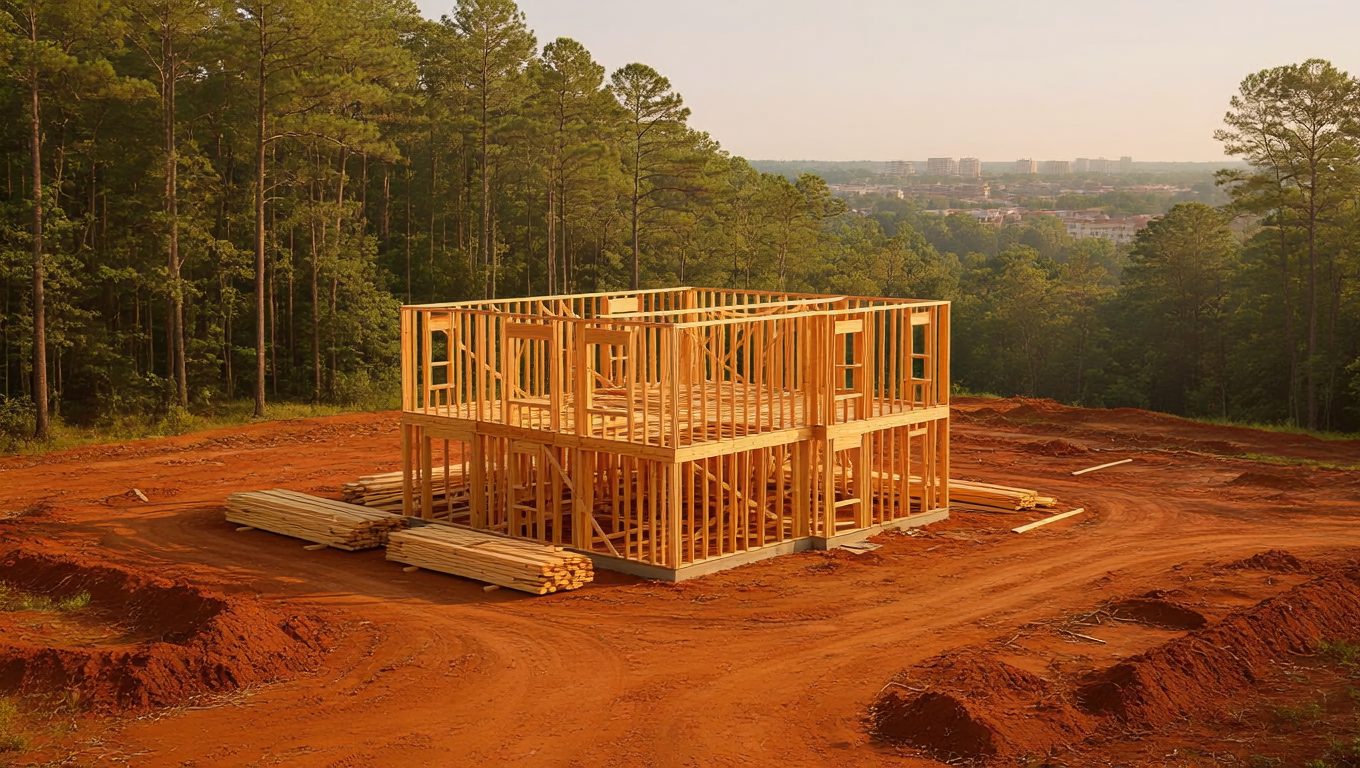
The Raleigh-Durham-Chapel Hill corridor has attracted a steady stream of relocating professionals for years, many arriving with tech and biosciences salaries and plans to build a custom home. What they are finding is that the land to build on – particularly inside the Triangle’s urban core – is harder to come by than the job that brought them there.
That mismatch between demand for custom builds and available lots is reshaping where and how homes get built across the region, according to Reid Hunter, a home build consultant with Hoeken Design Build, a custom builder and renovation firm based in downtown Raleigh.
“Without question, our number one bottleneck right now is people coming to us with dreams and aspirations, and they can’t necessarily find the land that they’re looking for,” Hunter says. Buyers who assumed they would build close to the heart of Raleigh are instead looking at Wake Forest, Knightdale, Zebulon, Hillsborough, and Pittsboro – communities on the Triangle’s expanding edges.
Where Buyers Are Coming From
Hoeken’s typical custom build client is purchasing at $1.2 million or above, and most are relocating from outside the area. Hunter describes a steady flow from the Northeast, Boston in particular, and from California, drawn by positions in the Research Triangle Park tech corridor or institutions like Duke. Local residents make up a smaller share of the custom build pipeline.
That buyer profile creates a degree of insulation from interest rate pressures. Buyers at the $1.3 million-plus level tend to arrive with more cash from a prior home sale or savings, giving them flexibility that sub-million-dollar buyers lack. “When you’re dealing at a price point of say 1.3 plus, there’s a good chance that your buyer has a little bit more cash that they can use in a transaction,” Hunter says. Below $1 million, buyers lean more heavily on financing – and rates are weighing on that segment.
The dividing line in the Triangle right now, in Hunter’s view, is less about geography and more about what buyers can afford. “Price point right now, hands down, is what I’m seeing to be the biggest influence,” he says.
Low Rates Keep Locals in Place
For local homeowners sitting on 2% or 3% mortgage rates, buying new construction means giving up an advantage that is hard to replace. Hunter sees many who might otherwise move up choosing to renovate instead.
“People right now that are moving, they’re moving because they have to move,” he says.
That caution is feeding the renovation side of Hoeken’s business, which operates under a separate brand called Southern Concepts Design Build and focuses on luxury renovations across the Triangle, primarily inside the Raleigh beltline. Hunter notes that the resale market in downtown Raleigh is picking up, with buyers purchasing older homes and renovating almost immediately. Many of these houses have reached the age where major work is needed, and owners who are locked into low rates would rather upgrade in place than trade their mortgage for a higher one.
Choosing Between Custom and Production Builders
For buyers whose construction budget lands between $800,000 and $1.2 million, getting the most house for the money usually comes first. That is where national production builders, which can absorb thinner profits, often have more pricing room than smaller custom firms, Hunter says.
Higher up the price range, buyers start weighing other things: knowing their cabinetry comes from a local artisan, and that their builder is not running a production schedule. “When they have the finances to be able to sort through that kind of thing, it just makes a difference,” Hunter says.
The room to negotiate is typically on the real estate side – the land itself, or spec homes the firm has built. On a home in pre-sale or near completion, Hunter says, a request for a cash credit is sometimes met with a construction add-on instead, such as a deck or a finished room. “It doesn’t always go straight to money,” Hunter says. “A lot of times it just comes to elements of the construction itself that we can do.”
What Gets Cut First
When budgets tighten, Hunter steers clients toward reducing square footage before anything else. Buyers often arrive with a number in their head – 4,500 square feet, say – based on past experience rather than an assessment of what they actually need.
“I typically tend to dial that back first and say, let’s talk about what you need,” he explains. Working through bedroom count, storage needs, and household size often reveals that a smaller footprint can deliver the space a buyer is looking for at a price that fits their budget.
After square footage, exterior materials and design are the next place to find savings. A buyer who wants an English Tudor style, for instance, does not necessarily need premium stone or full brick – alternative siding or a specific roofline can achieve the same look at a lower cost.
Finding Land – and Alternatives
For buyers struggling to find a lot, Hunter points to options beyond public listings. Some builders have relationships with developers and owners holding land that isn’t on the market, and many will help clients search or connect them with a broker who specializes in land. Buyers willing to look farther out may also find more room: in Hillsborough, for example, Hoeken’s Forrest Creek Estates pairs lots of roughly 2.7 acres with about 15 acres of shared green space and walking trails.
For homeowners locked into low rates who cannot justify a move, renovating may be the more practical path. Hunter notes that more buyers in downtown Raleigh are also purchasing older homes and renovating soon after closing, since many of these houses have reached the age where major work is due. For many Triangle households, the next upgrade may come not from a new lot, but from the house already standing.
About the Expert: Reid Hunter is a home build consultant with Hoeken Design Build in Raleigh, North Carolina, where he guides custom home clients across the Triangle through early planning, design, and budgeting.
This article is intended for informational purposes only and does not constitute legal, financial, or investment advice. The views and opinions expressed herein reflect those of the individuals quoted and do not represent an endorsement of any company, product, or service mentioned. Readers should conduct their own due diligence and consult qualified professionals before making any investment decisions.