The conventional wisdom about Orlando’s real estate market, that it’s either cooling off or holding steady, misses what’s actually happening at the neighborhood level. In Lake Nona, a master-planned community in southeast Orlando developed by Tavistock, the market is not moving as one uniform whole. Builder incentives are drawing some buyers toward new construction, while portions of the resale market face longer timelines and tighter seller margins. The pressure does not divide neatly by ZIP code. It varies by community, property type, purchase timing, and each homeowner’s equity position.
Builders Are Pulling Harder Than Resale
In zip code 32827 – the core of what locals consider Lake Nona proper – recent pending activity skews heavily toward new construction. Builders like David Weekley Homes and ICI Homes are deploying closing cost assistance and aggressive incentives that resale sellers cannot match.
“If I were to run a report in just 32827 right now and look at what has gone pending in the last week or so, it will be new construction,” says Sophia Rogers, Broker Associate & Team Founder at SERHANT. She has lived and worked in the Lake Nona area since 2012. “They have more tools to get the buyer over the finish line.”
Rogers, who spent years in operations for homebuilders before transitioning to sales, says she can identify builder-comparison shoppers at open houses by the questions they ask, closing cost assistance, and incentive matching. The salespeople on the builder side are trained specifically to sell against resale, and they are being particularly aggressive in the current environment.
Two Zip Codes, Two Markets
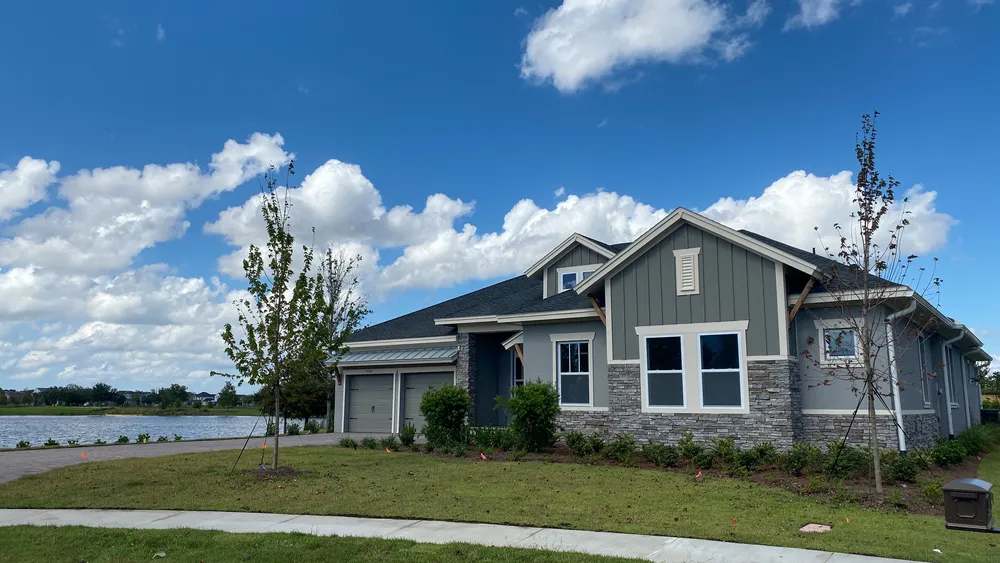
Lake Nona’s internal geography creates distinct submarkets divided by Narcoossee Road. On the 32827 side sits Laureate Park, the newer, amenity-rich core with townhomes, new construction, and walkable green spaces, outperforming the broader area, according to Rogers. While 32827 contains much of Tavistock’s master-planned core, 32832 includes a broad mix of established resale communities, newer construction and luxury properties. Rogers says performance varies by neighborhood, property type, condition, and price point rather than ZIP code alone.
In 32832, Rogers is tracking homes that have sat on the market for close to a year and have now transitioned into short sales. Two out of three five-bedroom listings in one community are under contract as short sales, a concentration she finds notable.
Rogers points to a structural feature that may help preserve Lake Nona’s infrastructure and appearance during a downturn: community development districts, or CDDs. These separate tax assessments fund sidewalks, pools, and amenities independently of HOA budgets, providing dedicated maintenance funding that isn’t necessarily disrupted by an individual owner’s financial pressure.
The 2021–2023 Cohort Is Stuck
The more concerning trend is what’s happening to homeowners who purchased during the pandemic-era run-up, concentrated on the 32832 side of that divide. Rogers describes a pattern: buyers who purchased at elevated prices, then refinanced to pull out equity while values were climbing, now find themselves upside down when they need to sell.
“Those same people who are upside down refinanced their homes while the market was escalating. So they pulled out equity, and now they want to sell, but they’re upside down,” she says. In several transactions this year, sellers needed to bring cash to closing or accept less equity than anticipated.
Rogers draws a cautious parallel to the mid-2000s cycle. “If you remember ’05, ’06, I have scars. It’s happening at a very subtle level,” she says, noting that homeowners aren’t yet walking away from properties, but the financial strain is visible.
Who’s Actually Buying
The buyer pool skews toward relocations and professionals, doctors near the medical campus, pilots near the airport, families drawn by A-rated schools with dual enrollment programs. First-time buyers are rare unless they bring dual high incomes; the prices push entry-level demand to the outskirts.
A recent transaction illustrates the pattern. Relocating buyers who initially planned to rent met Rogers at an open house and ultimately used substantial equity from a previous property to purchase a $1.2 million home. “If you’re coming from California or New York, the prices here don’t seem like a big deal. Or Miami. It’s the locals that are having an issue,” Rogers says.
Consumer confidence and rising utility costs are compounding the slowdown for local buyers, according to Rogers. Discretionary income is shrinking as household expenses climb, making it harder for Orlando-area residents to compete with relocating buyers who arrive with out-of-state equity.
What’s Ahead for Q4
Rogers expects the competitive pressure from builders to intensify as the fourth quarter approaches and builders work to clear inventory before year-end reporting. “I believe that they’re going to be very aggressive this year to get homes off the books, and I think that will be the biggest competition for resale as the fire sales start coming up in the next month or so,” she says.
She is also watching Florida Amendment 3 on the November ballot. If passed, it would reduce the annual assessment cap on non-homestead property from 10 percent to 5 percent, a potential shift in the cost structure for investors holding rental properties in the area.
For resale sellers who failed to attract buyers during the summer season, Rogers says the path forward requires honest repricing. “Nobody wanted your house in the summer. You need to really analyze the whole program if your intentions are to sell,” she says. In a market where builders control the incentive structure, and buyers can see purchase history online, overpricing is no longer a negotiating tactic; it is a way to watch a listing age into irrelevance.
About the Expert: Sophia Rogers is a Broker Associate and Team Founder at SERHANT and has lived and worked in the Lake Nona area of Orlando, Florida, since 2012.
This article is based on information provided by the expert source cited above. It is intended for general informational purposes only and does not constitute legal, financial, or real estate advice. Readers should conduct their own research and consult qualified professionals before making any real estate or financial decisions.