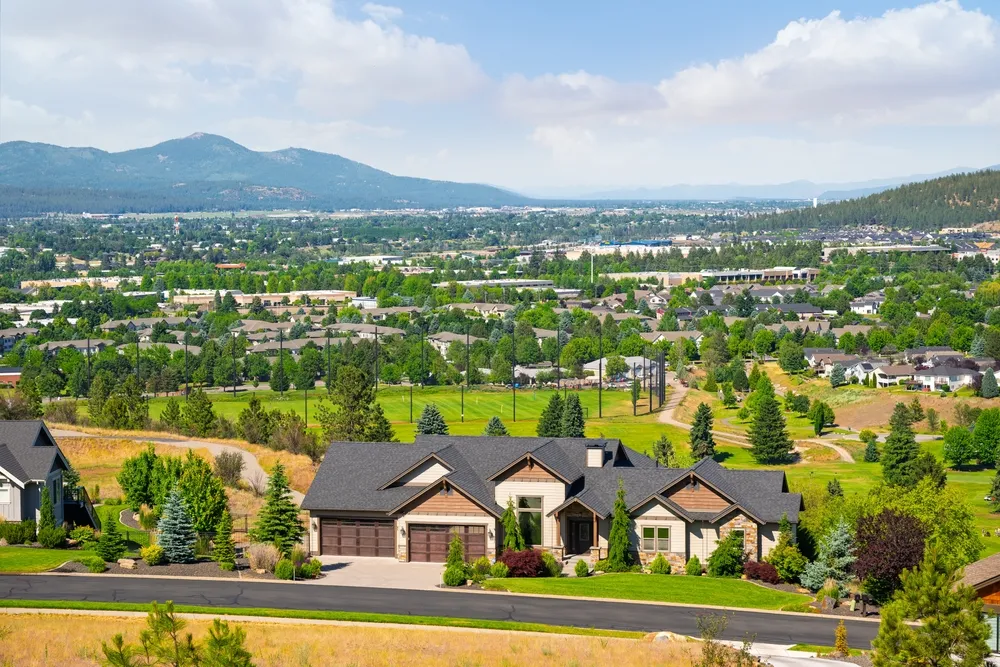
Kootenai County’s housing market splits cleanly by price, and the split reveals something less obvious than typical supply-and-demand math: the fastest-moving homes and the slowest-moving homes are being shaped by two entirely different sets of buyers.
Cody Fenske, who leads Apex Realty Partners with EXP Realty in Kootenai County, works primarily with out-of-state buyers and investors. The team, which Fenske started roughly a year ago after five years as a solo agent, now includes five agents and is the top EXP team in Idaho.
Three Tiers, Three Different Markets
Properties priced under roughly $400,000 to $450,000, entry-level housing in the Coeur d’Alene, Hayden, Rathdrum, and Post Falls corridor, move quickly. “You put something up for four and under, it’s going to be gone probably over a weekend, no problem,” Fenske says. New construction begins to compete at the upper end of that range, but demand still absorbs inventory fast.
At the top, properties priced at $1.2 million and above sell without much delay. Buyers at that level typically have enough cash on hand that interest rates aren’t a significant obstacle.
The stalled tier sits in between. Homes priced from roughly $500,000 to $900,000 are caught between two groups reluctant to move: buyers who would need to trade a low mortgage rate for a much higher one, and older homeowners with no urgency to downsize. “That’s where it starts to become really painful,” Fenske says, “when you’re in those seven and eight hundred thousand dollar loans at the six and a half interest rate or whatever we’re at.”
Fenske notes one consistent exception across all three tiers: properties with distinctive features, shops, larger lots, or unusually nice layouts tend to sell regardless of price point. The stagnation concentrates specifically on homes offering no compelling reason to justify a higher monthly payment.
A Buyer Pool With No Local Ties
Out-of-state buyers make up a significant share of demand across every price point in Kootenai County, not just the entry-level and luxury tiers. Fenske says this pattern shows up consistently in his own client base, with buyers arriving primarily from California, Washington, Oregon, and Colorado. The one exception is the lowest price tier, where local buyers are more likely to be able to afford in, so out-of-state demand plays a comparatively smaller role there. Elsewhere, that buyer profile behaves differently than a typical relocation-driven market: without local ties anchoring their decisions, these buyers move faster on well-priced listings and are less sensitive to the rate environment that’s freezing the middle tier.
The Family-Visit Effect on Short-Term Rentals
That same buyer pattern creates a secondary effect worth noting for investors: a steady, non-seasonal source of short-term rental demand. When buyers relocate without extended family nearby, their parents and relatives visit repeatedly rather than permanently relocating themselves. Fenske estimates his own family accounts for a month and a half to two months of Airbnb occupancy annually from visiting relatives alone.
That shifts the calculus for rental property location. Rather than buying near ski resorts, Fenske recommends targeting areas near the densest residential populations, where visiting family members are most likely to book. “It adds a lot of stability if you purchase in the right areas,” he says. Even when discretionary vacation spending drops, family visits tend to hold steady.
Appreciation Over Cash Flow
For investors weighing this market against alternatives, cash-on-cash returns are the weak point. “Cash flow is not that great, admittedly,” Fenske says. “I could hop over the border and immediately increase my cap rate by a few points if I go over into Washington.”
Where the market stands out is appreciation, particularly through land development. Fenske cites a client who purchased seven acres for $715,000 and received an offer of $1.4 million within seven months, after builders annexed surrounding land and extended city utilities. Another client bought 20 acres for $90,000, subdivided it into four five-acre parcels, added a gravel road and power, and sold each parcel for $225,000 to $250,000, netting roughly $800,000 after costs.
The risk runs proportional to the reward. “All it takes is a municipality saying you can’t do it for this reason or that reason and there goes everything,” Fenske says. Land that can’t be subdivided and can’t easily be rented offers no fallback plan.
On the residential side, Fenske sees opportunity in properties needing minor repairs to qualify for VA, FHA, or USDA financing, work that traditional flippers often overlook because the properties don’t resemble typical flip candidates. One current project was purchased for $215,000 and is under contract at $450,000 after roughly $70,000 in improvements.
Where AI Estimates Go Wrong
A newer challenge Fenske flags: buyers and agents relying on AI tools for renovation cost estimates in a market where labor pricing is highly localized. He describes a recent case where a buyer used AI to estimate a full rewire and replumb at $90,000 to $100,000. Formal bids from local contractors came back at $17,000 for electrical and $25,000 for plumbing, less than half the AI estimate.
“It’s not an area expert,” Fenske says. The gap between AI-generated estimates and actual local pricing can distort purchase decisions in either direction: inflating perceived costs on deals that work, or understating them on projects that don’t. In this case, the AI overestimate nearly killed a deal that was viable at the actual repair cost.
About the Expert: Cody Fenske leads Apex Realty Partners with EXP Realty in Kootenai County, Idaho, working primarily with out-of-state buyers and investors.
This article is based on information provided by the expert source cited above. It is intended for general informational purposes only and does not constitute legal, financial, or real estate advice. Readers should conduct their own research and consult qualified professionals before making any real estate or financial decisions.