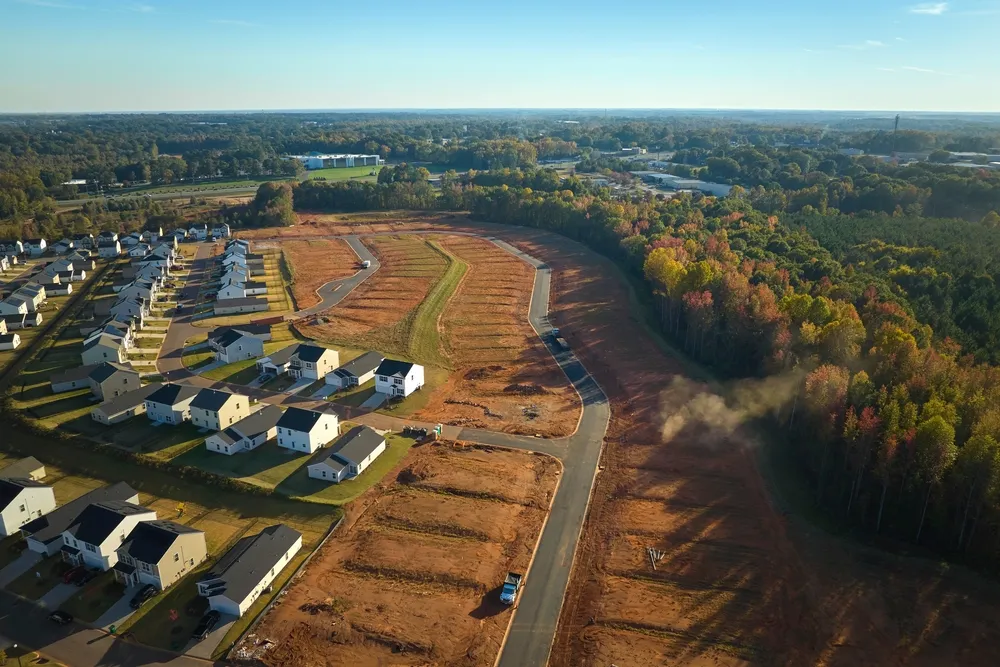
Charlotte continues to attract roughly 130 new residents a day, according to recent estimates. But for developers trying to acquire land in the region, population growth alone is not translating into straightforward transactions. Development costs have climbed, municipal fees have increased, and review timelines have stretched, all of which have widened the gap between what landowners believe their property is worth and what buyers can realistically pay. That disconnect, according to Mellissa Oliver, Director of Land Acquisition at Integral Communities, is now one of the defining features of the Charlotte land market heading into 2027.
Integral Communities is a master-plan mixed-use developer active in California and the Carolinas. Oliver sees the pricing mismatch playing out in nearly every negotiation. “Both landowners and even brokers think their land is worth more than it actually is,” she says. The root cause traces back to the rapid appreciation that followed COVID, when sellers could list property and find a buyer almost immediately. That pricing memory has not fully adjusted to a market where development economics look meaningfully different.
Why the Old Math No Longer Works
The core problem is not that Charlotte land has lost value in absolute terms. The cost of turning raw land into finished development has risen enough to compress what a buyer can offer. Municipality fees for permitting have increased. Review timelines are longer. And municipalities are asking developers to contribute more than what is technically required by ordinance.
Oliver says some brokers compound the problem by setting seller expectations based on outdated market conditions. Once a site goes to market, developers and home builders run their own numbers and often arrive at a lower figure than the broker quoted. “Offers can sometimes be lower than what a broker advised the property owner to list their land for,” she says. The result is a market where listings sit, initial offers disappoint, and negotiations stall before they start.
Integral Communities’ own underwriting has adjusted accordingly. “Underwriting deals in this market has been a little bit more conservative in the past few years,” Oliver says, describing a shift toward building in more contingency to account for higher risk.
Deals That Fall Apart
The pricing gap is not the only friction point. Oliver describes a recurring pattern in which competing buyers win deals by offering aggressive prices or shortened due diligence periods, only to discover during the contract period that their initial assumptions were wrong.
The failures tend to be specific and technical. Certain environmental reports, endangered species surveys, for instance, can only be completed during narrow seasonal windows. A site with a protected plant species that blooms at one time of year cannot have that report completed outside that window. The realistic time to acquire easements that need to be secured before exiting due diligence is overlooked in the rush to submit a competitive offer. When buyers then ask sellers for more time, the answer is often no. The seller might stick to the agreed terms outlined in the contract and choose termination rather than give an extension.
Her takeaway is direct: the work that matters most happens before the offer is submitted, not after. “Putting in that effort up front prior to making the offer will ensure deals don’t fall through,” she says. That means realistic hard-cost estimates without full design plans, accurate permitting timelines confirmed with the municipality, and a clear inventory of the reports and approvals needed before due diligence expires.
Charlotte’s Growth Is Real
Charlotte’s population growth and job creation, including new industrial sites and infrastructure investment, continue to support demand for residential development, groceries, and retail. Oliver says developers are responding by being more selective about which sites they pursue, focusing on markets with steady population growth and measurable job creation.
But growth also creates pressure that the region’s infrastructure has not fully absorbed. “With the increased number of cars that are on the road, the development of infrastructure also needs to increase to meet the new demand,” Oliver says, pointing to the need for contributions from both developers and state and local transportation agencies. Affordability is another concern: incoming residents are pushing prices higher, which prices out current residents trying to buy. Oliver notes that home builders are offering more incentives and working with the city to address affordability, but the tension between rising demand and rising costs has not been resolved.
Oliver describes 2026 as a “leveling out year,” not a return to COVID-era conditions, but a stabilization after the uncertainty of 2025, when construction paused, permitting slowed, and buyers pulled back. She expects more activity heading into 2027. “As we all get comfortable about our reality, as we watch the cost of development, I think we’ll see an improvement there,” she says.
AI Can Scout Land but Cannot Read a Room
One trend Oliver is watching closely is the growing use of AI tools in land acquisition. She regularly hears from people in other states offering to identify development sites remotely using desktop analysis and zoning data. The technology is useful for initial screening, but it has a hard limit.
“You can’t do relationship building with AI,” she says. Knowing that a local development ordinance is about to change, reading how municipal staff might vote on a rezoning, or building enough trust with a seller to close a deal, none of that shows up in a desktop search. Oliver puts the contrast plainly: someone working remotely might identify a site that looks developable based on current zoning, while someone physically present in the market already knows an ordinance change is coming that will affect what can actually be built there.
The distinction matters because land acquisition in Charlotte increasingly depends on navigating municipal relationships and staying ahead of regulatory shifts, not just identifying parcels with the right dimensions and utility access. AI tools can accelerate the screening process, but the decisions that determine whether a deal closes still depend on local knowledge that no algorithm currently replicates.
About the Expert: Mellissa Oliver is Director of Land Acquisition at Integral Communities, a master-planned mixed-use developer active in California and the Carolinas, including the Charlotte, North Carolina market.
This article is based on information provided by the expert source cited above. It is intended for general informational purposes only and does not constitute legal, financial, or real estate advice. Readers should conduct their own research and consult qualified professionals before making any real estate or financial decisions.