Buyers are making offers on homes that don’t exist yet. Investors are committing capital to buildings before a shovel hits the ground. The technology making that possible is reshaping every stage of the transaction, from the first online search to the closing table.
Not long ago, a real estate transaction depended almost entirely on physical presence. You walked through the house. You stood in the space. You felt the light. You met with the lender, reviewed the paperwork, and signed at a table with everyone in the room. If the property didn’t exist yet, you studied floor plans and renderings and tried to imagine the rest.
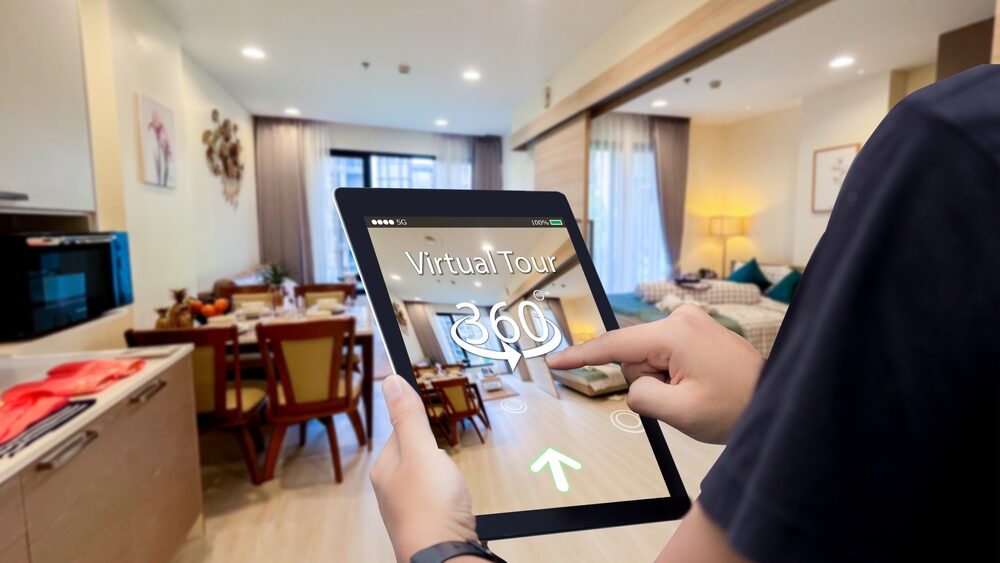
All of that is changing. Immersive visualization tools, from virtual walkthroughs to AI-generated renderings, are giving buyers, investors, and developers the ability to experience a property, or a version of it, long before it exists in finished form. The impact is showing up at every stage of the transaction, from the first decision to make an offer to the last signature on a closing document, and it’s moving faster than many people in the industry expected.
Before It’s Built
Of all the ways visualization technology is changing real estate, perhaps none is more striking than its ability to sell a property that doesn’t yet exist.
Richard Jabbour of the Jabbour Luxury Group at Scenic Sotheby’s International Realty on Florida’s 30A coast has built a process around exactly that. During a recent development cycle, nine of fourteen homes were sold before construction was complete, and several before it had meaningfully begun. The key, he says, wasn’t asking buyers to imagine the finished product. It was making the future tangible.
Modern rendering technology now allows a future home to be placed directly onto its actual homesite, incorporating real views, topography, and surrounding landscape. For waterfront and view-oriented properties, where buyers are purchasing sight lines and outdoor living spaces as much as square footage, that capability changes the conversation entirely. As Jabbour puts it, “A vacant lot becomes a future home. A set of architectural drawings becomes a place where a family can imagine gathering.”
Jabbour’s team has also developed a technique they call Walk Your Plans, in which full-scale layouts allow buyers to physically walk a home’s future floor plan before construction begins. Standing in the kitchen, walking the hallways, understanding how spaces connect, questions that might otherwise arise months into construction get answered in a single afternoon.
Dewayne Clyde Carpenter of the Carpenter Kessel Team in Indian Harbour Beach, Florida, captures the underlying dynamic: “It’s hard to sell preconstruction just off a plan,” he says. This virtual approach brings a floor plan to life, tells a story, shows alternative furniture layouts, and helps buyers emotionally connect with a property long before it’s built. “That’s a powerful advantage when pre-selling a project,” he says.
Closing the Deal
The impact of visualization technology doesn’t end once a property exists. For buyers evaluating homes they’ve never visited in person, virtual walkthroughs have become a primary research tool, and the effect on decision-making is measurable.
One of the clearest patterns in virtual tour data is what happens to lead quality. Oleg Donets, founder of Real Estate Bees, a technology and marketing platform for real estate professionals, has integrated virtual tour capabilities into his company’s website builder and watched the results closely. Prospects who engage with virtual walkthroughs, he says, are significantly more qualified by the time they reach out. They’ve already self-selected. “You’re not convincing them the property is worth their time,” he says. “They’ve already decided that.” The result is a sales conversation that starts further along.
For buyers who are relocating from out of state, the stakes are even higher. Zach WalkerLieb of Willow Manor Real Estate in Las Vegas incorporates 3D tours, immersive walkthroughs, drone mapping, and digital visualization tools into his team’s marketing specifically because many Las Vegas buyers need to evaluate homes, neighborhoods, and lifestyle remotely before they ever visit in person. The biggest benefit, he says, isn’t convenience. It’s confidence. Buyers who can virtually experience a property make faster, more informed decisions, and sellers benefit by attracting more qualified prospects and reducing unnecessary showings.
The tools driving those results aren’t always the ones getting the most attention. In the Washington, DC, Maryland, and Virginia region, Daryl Judy of Washington Fine Properties says he isn’t seeing widespread adoption of virtual reality walkthroughs or buyers putting on headsets to experience homes. What’s actually moving decisions in his market is AI, specifically tools that allow buyers, sellers, architects, and remodelers to quickly generate renderings, test materials and colors, and visualize floor plan modifications in minutes rather than weeks. The technology is less immersive than a full virtual walkthrough, but it’s faster, cheaper, and, in Judy’s market at least, more widely used.
Raising Capital
The influence of visualization technology extends beyond the consumer transaction. For developers seeking equity partners and institutional capital, the ability to offer an immersive experience of a building that doesn’t yet exist has become a meaningful advantage in the fundraising process.
Daniel Kaufman, founder of Kaufman & Company, a build-to-rent developer operating in markets across the country, has been building virtual walkthroughs into his development process for several years. The results, he says, are tangible. Equity partners reach commitment faster, site visits before offers are fewer, and the overall decision cycle compresses. When an investor can walk through a building that doesn’t exist yet and feel how the units flow, how the amenity deck connects to the residential floors, how natural light moves through the space, the back-and-forth that typically precedes a capital commitment is significantly reduced. His company has received capital commitments on build-to-rent projects before a single piece of ground has been turned.
For developers of single-family homes, the financial logic runs parallel but plays out differently. Richard Jabbour of the Jabbour Luxury Group works with buyers, not institutional investors, but early presales driven by immersive pre-construction presentations produce similar economic benefits: reduced carrying costs, validation of design decisions, and the ability to secure buyers for properties before they are completed and listed on the open market. The financial case for investing in visualization technology, he says, begins well before the first unit is sold.
After the Sale
The further visualization technology travels into the transaction, the more it starts to look like something other than a marketing tool.
Alexander Paykin brings an unusual vantage point to this question. As a New York real estate attorney and broker, and chair of the New York State Bar Association’s Committee on Technology and the Legal Profession, he spends considerable time thinking about how technology changes not just how properties are sold but how disputes about them get resolved. What he’s watching most closely isn’t the walkthroughs themselves. It’s the record they leave behind.
When a buyer completes a virtual walkthrough of a pre-construction property, that interaction generates a precise digital record of what was shown and represented before the transaction closed. The practical effect, Paykin says, is fewer disputes about what was promised versus what was delivered. “You’ve got a precise digital record of what the buyer saw before they signed,” he says. That changes the legal landscape in ways the industry is only beginning to reckon with.
Paykin sees the technology moving in an even more consequential direction. The same buildings generating 3D walkthroughs are also generating continuous data streams from smart meters, HVAC systems, structural sensors, and security logs. The opportunity, he says, is to converge those layers into what the industry calls a digital twin: a live, data-connected model of a physical building that doesn’t just show what a space looks like, but what it’s actually doing, including energy consumption, occupancy patterns, maintenance histories, and temperature variations. That’s where 3D becomes an underwriting tool and a disclosure mechanism, not just a sales asset.
Still Evolving
The next frontier, according to those watching it most closely, is the convergence of visualization with construction itself. Kaufman sees augmented and virtual reality intersecting with modular and prefabricated building methods in ways that could allow developers to design, visualize, and essentially pre-approve a structure in 3D before it ever reaches the factory floor. The efficiency implications for development timelines and costs are significant.
This article is based on information provided by the expert sources cited above. The views expressed are those of the individual contributors and do not represent a unified industry position. This article is intended for general informational purposes only and does not constitute legal, financial, or real estate advice. Readers should conduct their own research and consult qualified professionals before making any real estate or financial decisions.