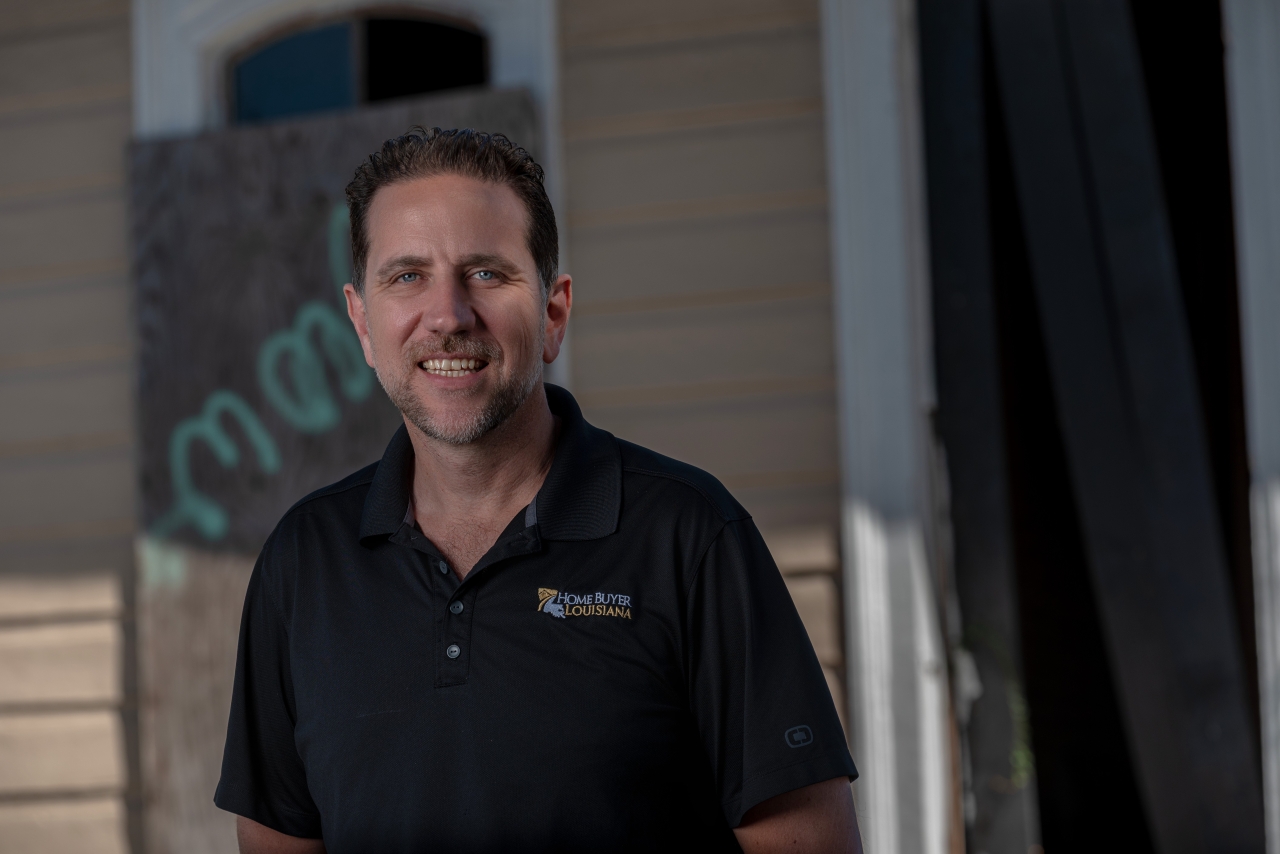
Stephen Keighery’s journey from scaling an Australian tech company to revolutionizing distressed property investment in Louisiana reveals how systems thinking can humanize an industry – and rebuild communities one house at a time.
Most real estate investors see distressed properties as transactions. Stephen Keighery sees them as complex human problems waiting for systematic solutions. This perspective shift, born from years building two-sided marketplaces in the tech world, has positioned him as one of Louisiana’s most innovative voices in real estate investment.
When Two Worlds Collide
After helping scale hipages Group from startup to ASX listing in Australia, Keighery could have pursued any number of opportunities. Instead, he chose something unexpected: buying distressed houses in New Orleans. The decision wasn’t about finding the easiest path, it was about finding the most meaningful one.
“Louisiana is full of culture and character, but it also has complex housing challenges like succession issues, storm damage, and aging homes that most investors see as barriers,” Keighery explains through his work with Home Buyer Louisiana. What others viewed as obstacles, he recognized as opportunities to build something different, not just another startup, but a business that rebuilds communities house by house.
The Systems Behind the Empathy
Keighery’s tech background fundamentally shaped his approach to traditional real estate investing. At hipages, he built systems connecting homeowners with contractors, a two-sided marketplace requiring structure, repeatability, and scale. When he discovered real estate wholesaling (connecting distressed sellers with rehabbers), the parallel was immediately clear.
“The technology mindset helps scale without losing the personal touch,” Keighery notes. His company now uses automation and data to ensure sellers receive fast responses and consistent experiences, while maintaining the empathy and local insight that complex situations demand.
The sophistication of Keighery’s operation reveals itself in the details. His team no longer needs to physically visit properties before making offers, they’ve developed comprehensive questionnaire processes and data-driven spreadsheets that capture everything from past renovation history to appliance ages. AI transcribes phone calls, allowing the team to quickly reference specific details without burdening sellers with repeated questions. Its efficiency in service of humanity, not instead of it.
Louisiana’s Unique Laboratory
Louisiana’s real estate challenges would overwhelm most investors. Succession issues where heirs disappeared after Hurricane Katrina and were never officially declared deceased. Title problems stemming from generations of informal property transfers. Storm damage and deferred maintenance creating properties that appear uninsurable or unfinanceable.
Keighery thrives in exactly this complexity. “When you can step in and help a family clear a title, close out an estate, or take on a property others won’t touch, you’re solving real problems that most avoid,” he observes. “The opportunity isn’t just in the transaction, it’s in becoming the trusted solution when everything feels stuck.”
This approach has led to some remarkable outcomes. One Mandeville property involved a family home with major foundation issues and multiple heirs spread across different states, each processing grief differently. Most buyers would have walked away from the tangled title and emotional complexity. Instead, Keighery’s team coordinated the legal intricacies, structured a fair sale, and even provided extra time after closing for the family to move personal items and find closure. The result wasn’t just another deal: it was a family unburdened and a neighborhood improved.
Where Most Investors Fail
The most common mistake Keighery observes among new Louisiana investors reveals why local expertise matters so profoundly. “They do not know how to comp,” he states bluntly, referring to the process of determining property values through comparable sales. “You can literally cross a street and go from Garden District to Central City, that’s point-one miles, but completely different markets.”
Traditional comp methodologies – searching within a 0.5-mile radius for similar properties – work in many markets. In New Orleans, they fail spectacularly. National companies and larger players struggle to enter the market precisely because this local knowledge can’t be easily replicated or scaled. Keighery has built his competitive advantage on understanding these nuances while maintaining systems that allow regional expansion.
The Human Cost of Inexperience
The real estate investment education industry has created a dangerous dynamic: influencers with limited experience teaching people with no experience how to get wealthy in a business they don’t understand. The consequences fall on vulnerable sellers.
“The major risk is they generally will waste a lot of time,” Keighery explains. “For someone distressed due to foreclosure or facing something really imminent, time is extremely valuable.” Inexperienced investors make promises they can’t keep, tie up properties they can’t close on, and disappear when complications arise, leaving sellers worse off than before.
Keighery’s advice for homeowners considering selling distressed properties centers on verification: check Google reviews, confirm Better Business Bureau accreditation, and most importantly, call the investor’s title company directly. “If that title company can tell you they close deals all the time and are legitimate, you know that investor is consistently doing good business,” he notes.
Technology Meets Tomorrow
Looking ahead, Keighery sees transparency and data-driven decision-making reshaping real estate investment in ways traditional investors aren’t prepared for. “Good systems beat guesswork,” he emphasizes, pointing to Home Buyer Louisiana’s comprehensive tracking of lead sources, follow-up metrics, offer-to-contract ratios, repair costs, and resale trends.
Artificial intelligence and automation will continue quietly reshaping how investors operate, but Keighery is clear about the proper role of technology. “The key isn’t replacing the human element, it’s using tech to enhance it,” he explains. “If we can use systems to save sellers time, reduce stress, and close faster, then we’re using innovation in the right way to help more people and strengthen more communities.”
Building Regional Impact
Home Buyer Louisiana has expanded from New Orleans to Baton Rouge, Lafayette, and the Mississippi Gulf Coast, with plans for comprehensive Southern coverage within five years. The growth strategy reflects Keighery’s philosophy: expand area by area, going deep in each market to maintain local expertise even while operating regionally.
“We don’t want to do it straight away,” Keighery clarifies regarding expansion. “When we move, we’re deep and we still feel local even when we’re not.” It’s the tech entrepreneur’s mindset applied to community revitalization – scalable systems deployed with local sensitivity.
As Louisiana’s real estate challenges continue evolving and the investment education industry floods the market with underprepared competitors, Keighery’s approach offers something increasingly rare: sophistication that serves, systems that care, and scale that stays human.
About Stephen Keighery
Stephen Keighery is the founder of Home Buyer Louisiana and a real estate investor with over 200 deals across Louisiana. After helping build an ASX-listed tech company in Australia, he relocated to New Orleans and applied his two-sided marketplace expertise to transform distressed property investing.
He’s an active mentor in the Louisiana real estate community through the New Orleans Real Estate Investors Association and Westbank Real Estate Investors group, and invests in early-stage companies through Gulf South Angels.
This article was sourced from a live expert interview.
Every month we conduct hundreds of interviews with active market practitioners - thousands to date.
“The criminals are always one step ahead. With AI technology, anyone can be impersonated through video and voice. We’ve seen how easily these tools can be weaponized for fraud, a...
The Florida residential real estate market is suffering from slow response times and complacency among local agents, according to Joseph Bograd, team leader of The Bograd Team. When Bograd t...
The real estate industry’s productivity crisis isn’t about a lack of time, it’s about failing to implement systematic approaches to time management, according to industry c...
A growing management gap between corporate leadership and field agents is reshaping the real estate industry, according to Bill Crespo, CEO and founder of Path2PRO Coaching. Many brokerage o...
In an industry focused on aggressive growth and consolidation, Mortiles distinguishes itself—growing to employ 650 full-time staff and 1,300 independent contractors while intentionally mai...
Industry veteran Lucas Piper, owner of Five Star Vacation Home Rentals in Austin, identifies ongoing property maintenance, rather than acquisition strategy or financing, as the main reason m...