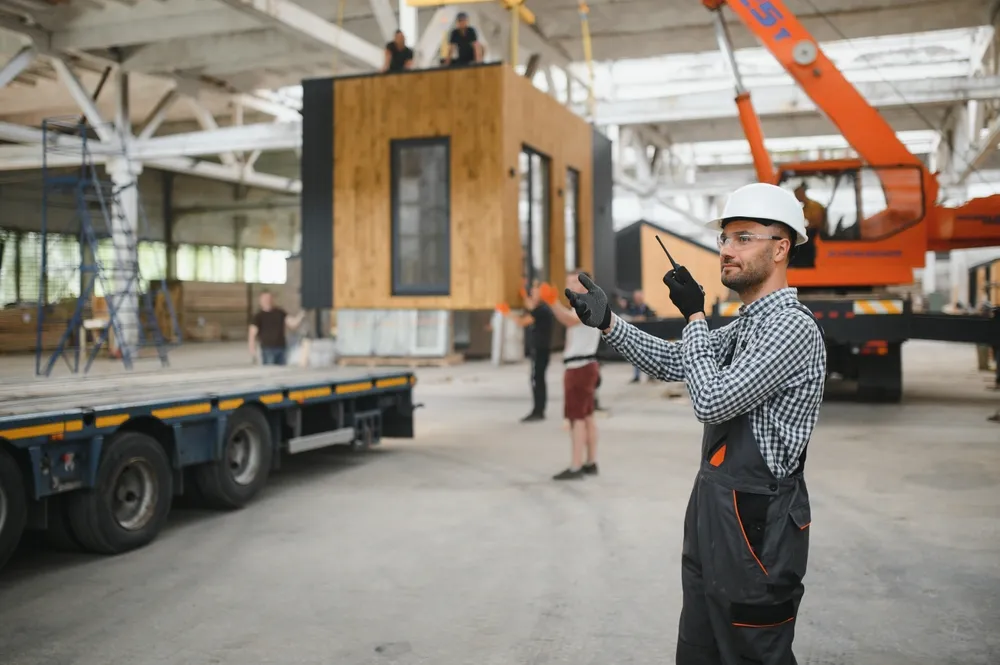
For years, offsite and modular construction occupied a familiar position in housing conversations: promising in theory, unproven at scale, and haunted by high-profile failures from the last decade. That position is changing, not because the technology suddenly became viable, but because the economics of conventional construction have deteriorated to the point where developers are actively seeking alternatives. In New England, where labor shortages, rising material costs, and elevated interest rates have made traditional project timelines untenable, one robotics-enabled manufacturer is scaling from 10 completed units to more than 100 in the next 12 months.
Vikas Enti, CEO & Co-Founder of Reframe Systems, says developers are no longer approaching modular out of curiosity. “They’re actively listening out of desperation,” he says. “They need a solution.” The company operates a regional fabrication center where software and robotics support the production of housing components for projects ranging from ADUs to five-story apartment buildings.
Why the Math Has Changed
Multiple cost pressures are converging simultaneously. Interest rates have raised the carrying cost of lengthy construction timelines. Material costs have escalated. And subcontractor availability has become acute enough that developers cannot reliably schedule trades.
“A lot of developers are not able to build anything today,” Enti says. The question they face is how long to wait for on-site construction costs to come down versus finding other mechanisms now.
On the technology side, advances in machine learning and computer vision have reduced the cost of useful robotic work cells. According to Enti, his company can build a functional robotic cell for less than $200,000 – down from what previously would have cost several million dollars. That shifts the breakeven calculation: a factory now only needs to produce around 100 homes per year to achieve financial payback, rather than 1,000.
The company’s factories are designed to be no larger than a garden center, deployable in under 100 days, and costing roughly $5 million – a fraction of the $100 million facilities that characterized the previous generation of modular startups, many of which failed.
Who It Works For
Not every project type fits volumetric modular construction. Enti draws a clear line: custom homes built to a single owner’s specifications are a poor match. Programmatic development – townhomes, built-to-rent communities, multifamily buildings, anything with repetition across units or sites – is where the model produces real efficiency gains.
“It doesn’t have to be a thousand units, but it has to have a programmatic need,” he says.
The company currently has 114 units contracted for delivery over the next 12 months, including a 12-unit single-family community, a 24-unit five-story building starting early next year, and 68 cabins for a hospitality client. According to Enti, about 75% of current customers are organic inbound – developers who found the company after their projects stopped working with conventional construction methods.
Enti says the company’s technology also lowers the skill level required to work in the factory. Rather than needing carpenters with a decade of experience, Reframe can hire apprentices or high school co-op students and train them on software-orchestrated production. That widens the available labor pool at a time when skilled trades workers are scarce.
The Financing Gap
One structural barrier remains: construction lending. Traditional lenders appraise drawdowns based on visible site progress. With modular construction, 60 to 80 percent of the work happens in the factory before anything appears on site.
“It’ll feel like nothing’s happening on the job site until one day the building’s there,” Enti says. “But we need to get paid for all the work that’s happening in the factory.”
Some lenders – Enti names TD Bank – have adapted their processes for modular timelines. But the broader lending market still requires education. Reframe’s longer-term answer is to offer construction financing directly from the factory, similar to how an automaker provides purchase financing. “Can you get financing from a modular factory so you can actually build your home? We think that’s the future,” Enti says.
For developers evaluating modular construction, that financing friction adds time at the front end of a project. Until more lenders adjust their drawdown schedules, developers using offsite methods may need to either work with lenders already familiar with the model or wait for factory-direct financing options to mature.
Policy Signals
Government interest has moved beyond pilot programs. The Roads to Housing Act recently became law, with provisions advancing financing for modular construction and simplifying regulatory frameworks. The Department of Defense has stipulated preference for industrialized construction, with Enti citing an estimated $11 billion in potential work over the next decade for barracks and family housing, a figure he heard at a conference and flagged as needing verification.
At the state level, Colorado has established a modular financing program offering grants and low-interest loans for factory setup. Multiple cities have proactively invited the company to establish local production facilities, seeing modular manufacturing as both a housing and jobs solution.
Resilience Without a Premium
Factory-controlled environments allow for consistent airtightness and energy performance without adding cost, according to Enti. He estimates energy use reductions of 70 to 80 percent compared to conventional builds. The argument extends to insurance: homes achieving higher resilience ratings – including wildfire-preparedness certifications – should, in Enti’s view, eventually command lower premiums.
Insurers are not yet underwriting specifically for factory-built homes, but they are already adjusting for measurable performance metrics like airtightness and wildfire-preparedness ratings. “We’re able to achieve those ratings a lot more easily with factory-built than if you were retrofitting on the job site,” Enti says.
For buyers and renters, the implication is direct: energy costs and insurance premiums are the fastest-growing line items in housing expenses. Homes built to higher performance standards in a controlled environment may reduce those ongoing costs substantially – without requiring a buyer to pay more upfront.
About the Expert: Vikas Enti is CEO and Co-Founder of Reframe Systems, a physical AI company modernizing homebuilding through software, robotics, and regional fabrication centers.
This article is based on information provided by the expert source cited above. It is intended for general informational purposes only and does not constitute legal, financial, or real estate advice. Readers should conduct their own research and consult qualified professionals before making any real estate or financial decisions.