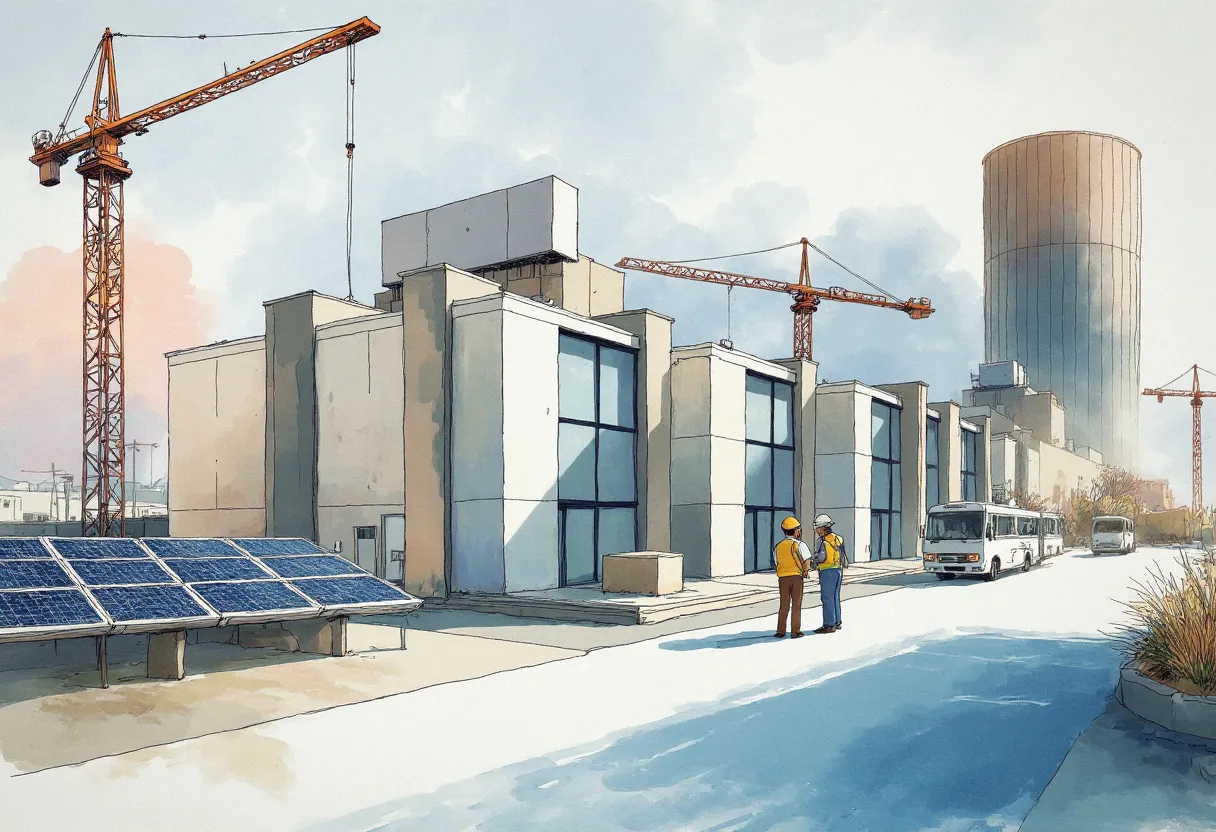
Venture capital and engineering firms are redirecting resources to data infrastructure, sidelining traditional office and retail projects across Texas, according to industry veteran Sergio Grado.
Grado, owner of GradCo Distributors and former business development executive at several global construction and engineering firms, says the Texas commercial real estate market has shifted sharply in recent years. “Data centers right now are the big game. That’s what’s feeding a lot of industries. That’s where a lot of the money is. That’s where the venture capitalists are looking at,” Grado says.
This shift is not just a passing trend but a fundamental reallocation of capital and engineering resources. Grado notes that engineers who once focused on office buildings, stadiums, or retail centers are now almost exclusively bidding on data center projects. “Engineers, whether they’re civil or mechanical, when you ask them what they’re working on, it’s ‘we’ve got so many data centers that we’re bidding on, we just picked up this data center,’” Grado explains. “Whereas before it used to be office buildings, ballparks, stadiums.”
The Data Center Boom’s Broader Impact
The surge in data center development is creating ripple effects that extend far beyond the commercial real estate sector. According to Grado, power infrastructure has become a top priority, with energy companies racing to provide generators and turbine systems capable of supporting the enormous electricity needs of these facilities. International equipment manufacturers are also moving into the Texas market to capitalize on this demand.
“I’ve got a friend who’s an attorney for a German company that set up shop here in Houston specifically to bring over their generators from Germany,” Grado says. “These are big turbine generators that can produce a lot of output.”
The scale and consistency of data center demand across Houston, Dallas, Austin, and San Antonio suggest this is not a speculative bubble, but a structural change in how capital is deployed in Texas real estate. “Houston is more oil and gas-based, Dallas has more diverse industries, and Austin is like the next Silicon Valley,” Grado says. “But data centers are what’s emerging across all of them.”
Implications for Traditional Commercial Real Estate
This rapid pivot to data centers is changing the landscape for developers, brokers, and investors who have historically focused on office, retail, and mixed-use projects. As engineering talent and investment dollars shift toward data infrastructure, traditional projects are finding it harder to secure the resources they need.
Grado warns that industry professionals who do not understand the unique site requirements, power needs, and regulatory complexities of data centers will struggle to remain relevant. “There’s a whole market to the ancillary support—energy companies trying to get involved, companies trying to acquire generators,” he says.
The trend raises concerns about the future pipeline of conventional commercial real estate developments. If institutional and venture capital investors view data infrastructure as a core investment rather than a niche, capital for office and retail projects may be more limited than headline numbers suggest.
GradCo’s Response to Infrastructure Demands
GradCo Distributors is adapting to these changes by offering products that address evolving infrastructure challenges. The company recently began distributing the Bracho Power Boost, a UL-certified battery backup system designed for properties without space for traditional generators.
“When generators are too big to place somewhere, you don’t have a whole lot of options,” Grado notes. The system has been especially popular in the condominium market, where individual owners often have no backup power during outages.
Looking Ahead: Lasting Change or Temporary Surge?
Whether data centers will continue to dominate Texas commercial real estate over the next one to two years depends on how quickly supporting power infrastructure can be deployed. Grado believes the current momentum indicates a lasting shift, not a temporary spike in activity. He argues that the steady demand for data centers across diverse Texas markets points to a permanent reorientation in how developers and investors approach commercial real estate.
As venture capital and engineering firms continue to prioritize data infrastructure, traditional office and retail projects may remain on the sidelines, marking a new era for Texas commercial development.