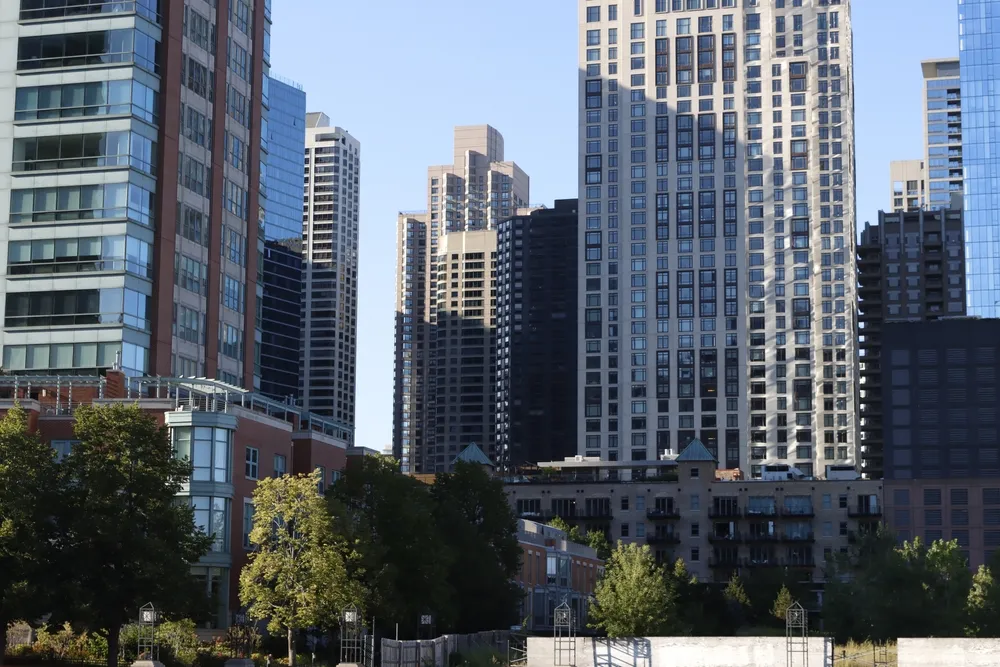
In most major U.S. metros, luxury residential prices have either recovered from pandemic-era disruptions or pushed past their 2019 peaks. In downtown Chicago, several of the city’s most invested-in neighborhoods, Gold Coast, Streeterville, Magnificent Mile, and parts of River North, remain flat to down over the past five years. That gap between Chicago’s trajectory and the broader luxury market is drawing a specific type of buyer back into the market.
Chris Katsulis, Founder & Team Leader of the C. Thomas Group operating under The Nav Agency at AptAmigo, has spent seven years in Chicago residential and commercial real estate after a 15-year career in institutional trading. His current transactions range from a $125,000 cash deal to a $6.5 million listing, with several multimillion-dollar land and commercial deals in progress. The trading background, he says, shapes how he frames every transaction: as a risk assessment rather than a lifestyle decision.
“I approach real estate just like I approach trading. It’s a risk approach,” he says. “Would I rather have an opportunity missed where I don’t capture inflationary gains on real estate? Or would I rather just continue to pay rent?”
What Happened to Downtown
New construction in the city’s top buildings, One Chicago, Tribune Tower, St. Regis, One Bennett Park, topped out around $1,250 per square foot before 2020. That placed Chicago well below comparable construction in New York, San Francisco, or Los Angeles. But the combination of civil unrest on Michigan Avenue, reduced tourism, and what Katsulis describes as a period of lax enforcement under successive mayoral administrations stalled the recovery that was underway in 2018 and 2019.
The buyers who were active in that period, primarily empty nesters aged 50 to 80 downsizing from large North Shore suburban homes, largely paused their plans. “2020 put a lot of that to rest around Michigan Avenue and River North and near north,” Katsulis says.
Luxury condos in those neighborhoods now trade roughly 25 to 30 percent below their pre-pandemic levels. That discount is drawing capital back in. Katsulis points to large transactions happening inside buildings like the St. Regis, driven by individually wealthy buyers making five- to ten-year bets on recovery. “This isn’t a one-year bet,” he says. “The risk is neutral to upside in Chicago right now versus neutral to downside. If there’s any downside left, I think it’s very nominal.”
The Property Tax Dampener
One structural feature distinguishes Chicago from lower-tax luxury markets: the property tax rate suppresses price volatility. In suburban Chicago, rates run around two to two and a half percent annually. Inside the city, rates have climbed over the past 20 years from roughly 1.25 to 1.5 percent up toward the 2 percent mark.
That tax burden acts as a ceiling on appreciation, according to Katsulis. Markets with one or one-and-a-half percent tax rates and more predictable tax structures, he names Arizona and Florida, see prices swing more aggressively in both directions. Chicago’s higher carrying costs mean prices move more slowly, limiting both the upside and the downside. For buyers assessing risk, that dynamic cuts both ways: less speculative froth, but a longer timeline to realize gains.
Katsulis also notes that the tax structure creates an unintentional education subsidy for homeowners with children. A homeowner paying an extra $10,000 in annual property tax on a $1.5 to $2 million home is still spending far less than the $40,000 to $50,000 that private school costs, and Chicago holds several public high schools ranked among the top 25 nationally.
Where the Value Is Concentrating
Beyond the downtown luxury play, Katsulis identifies Bronzeville, situated between the University of Chicago’s Hyde Park campus and the South Loop, as a neighborhood where rents have risen meaningfully over the past decade while purchase prices remain 20 to 30 percent below the already-discounted South Loop.
The West Loop has been the city’s growth story over the past decade, absorbing the commercial and residential energy the South Loop failed to capture. But shifts are underway: Google is leaving the West Loop for the Loop. And the area around the United Center has received approval for a multi-billion-dollar development that Katsulis expects will drive change in what has historically been an underinvested part of the city.
“There’s going to be some structural change based on investment in private dollars and maybe some public funding,” he says. “And there’s going to be some that happens just because the disparity between where prices have gone gets too wide and people start identifying distressed areas as a value.”
For buyers considering multifamily investment, Katsulis says Bronzeville offers proximity to downtown, lakefront parks, and cultural institutions at roughly half the cost of comparable properties in Old Town, Lincoln Park, or Lakeview.
A Political Catalyst
Chicago expects a new mayor in February, and Katsulis sees the transition as relevant to the pricing floor forming in downtown neighborhoods. Two consecutive administrations, in his view, failed to reassure residents and prospective buyers in the near-north neighborhoods most affected by post-2020 disruptions.
“At the very least it could stop the bleeding for some of these areas because they’re still going down,” he says. “With the anticipation of who’s winning this election come February, I just think that there is going to be a little bit of a rebound, even moving into it on the anticipation that there’s going to be some sort of change.”
The bet Katsulis describes is not speculative in the traditional sense. Prices in these neighborhoods have already declined 25 to 30 percent. The buyers entering now are not chasing momentum; they are purchasing at a discount to peak values in neighborhoods with established infrastructure, betting that political transition and private investment will close the gap between Chicago’s downtown and other major-city luxury markets over the next five to ten years.
About the Expert: Chris Katsulis is Founder and Team Leader of the C. Thomas Group, operating under The Nav Agency at AptAmigo, covering downtown Chicago real estate. He spent 15 years in institutional trading before transitioning to real estate seven years ago.
This article is based on information provided by the expert source cited above. It is intended for general informational purposes only and does not constitute legal, financial, or real estate advice. Readers should conduct their own research and consult qualified professionals before making any real estate or financial decisions.