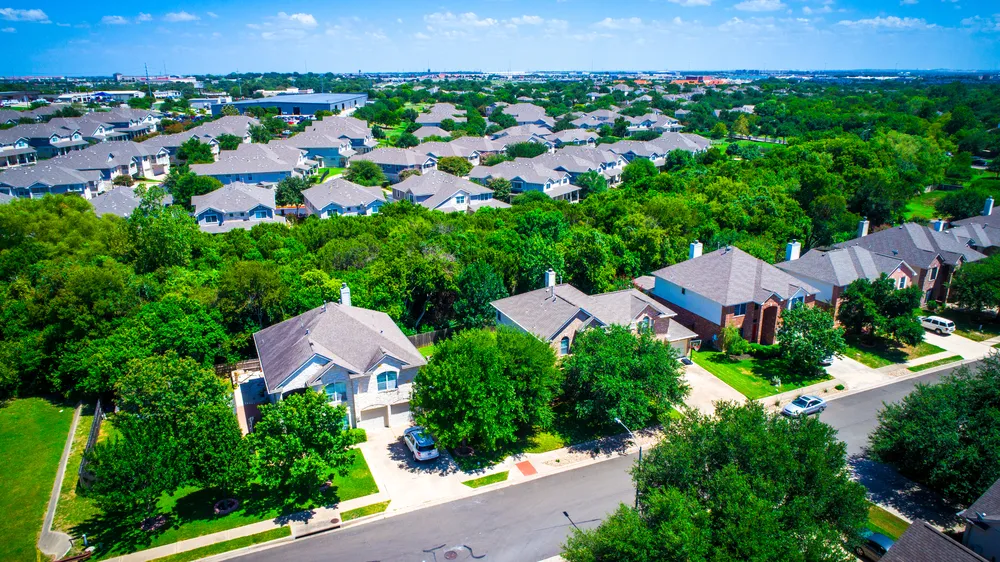
The Central Texas housing market has gone through a significant reset since its 2022 peak, and for buyers willing to do their homework, that correction is creating real opportunity. Prices in Williamson County – which covers communities like Georgetown, Round Rock, Leander, and Cedar Park – have declined roughly 20% from their highs, while sales volumes across both Williamson and Travis counties are ticking back up by between 2% and 5%, depending on the area. The picture that emerges is one of cautious stabilization rather than ongoing decline.
Tanya Kerr, Broker Associate and Founder of T. Kerr Property Group, has been working this corridor for years. Her 13-agent team covers a wide swath of Central Texas from South Austin up through North Williamson County. She describes the current environment plainly: “We’re in a buyer’s market. Buyers are behaving like it’s a buyer’s market.”
A Market That Corrected
The 2022 peak was, by most accounts, unsustainable. Low inventory, pandemic-era migration, and historically low interest rates pushed prices to levels that the underlying fundamentals couldn’t support. The correction that followed was painful for those who bought at the top. “People who bought at the height of the market are underwater right now,” Kerr says. “There’s nothing we can do about that.”
But the market has largely found its floor. Prices have held steady for roughly 18 months, and Travis County’s median price has recently seen a modest uptick, suggesting that the most desirable urban pockets are beginning to recover ahead of the broader market.
What’s changed most noticeably is buyer behavior. Decision timelines have lengthened, days on market have increased, and buyers are scrutinizing deals far more carefully than they did during the frenzy years. “They’re being more deliberate,” Kerr says, “more careful about their bottom line and their finances.”
Sellers Adjusting to a New Reality
The shift in buyer behavior has forced sellers to recalibrate their approach. The days of listing a property and fielding multiple offers within a weekend are largely over in most price ranges. Sellers who are succeeding today are coming to market with well-maintained homes, competitive pricing, and a willingness to negotiate by offering closing costs, covering repairs, or helping with rate buydowns when needed. “Sellers have to make sure that they are listening to the market and how it’s responding to their listing,” Kerr explains.
Condition has become a particularly sensitive issue. The group’s cancellation rate on contracts has climbed to between 15% and 20%, well above historical norms. Buyers who encounter problems during inspection are walking away rather than negotiating, which means deferred maintenance that might have been overlooked during a hot market is now a deal-killer. Sellers who address condition issues before listing have a meaningful advantage.
Presentation also matters more than it once did. Poor marketing and weak listing photography can hurt a property’s chances in a market where buyers have more options and less urgency.
Where Deals Are Getting Done
Not all segments are moving at the same pace, and understanding which price points are active can help both buyers and sellers set realistic expectations. The sub-$400,000 first-time buyer segment remains the strongest part of the market, with well-priced entry-level homes still moving quickly. “The first-time homebuyer, that’s still moving really quickly,” Kerr says.
At the other end of the spectrum, luxury properties are still transacting, but only when priced accurately. Overpricing remains the fastest way to stall a sale regardless of a home’s quality. Unique properties with standout features, an acre lot with a strong view, for example, are generating competitive interest when positioned correctly. One recent listing that had sat unsold with previous agents generated multiple offers after being repositioned, a reminder that strategy and execution still matter significantly.
The Relocation Factor
Central Texas continues to attract a steady stream of out-of-state buyers, particularly from the Northeast and Pacific Northwest. Kerr sees a steady influx of relocators from New York and Seattle, many of whom are arriving for work transfers. This buyer profile requires a different kind of support than a local purchaser, people moving across the country want to minimize how many times they have to move once they arrive, so their research tends to be more intensive and their timelines longer.
To serve this segment, the group maintains a YouTube channel focused on relocation education, covering neighborhood-by-neighborhood considerations, commute realities, and cost-of-living context. Texas’s structural advantages continue to support inbound migration. The absence of a state income tax remains a meaningful draw for high-income earners seeking to reduce their tax burden, and the state’s business-friendly regulatory environment continues to attract corporate relocations.
Development Pipeline Points
For investors evaluating the market, the current correction offers a genuine opportunity, but with important caveats. Motivated sellers are willing to transact at competitive prices, and the development pipeline across the region is substantial. Data centers, aerospace-related projects, and large-scale entertainment and mixed-use developments are either confirmed or under consideration. Within Georgetown specifically, projects near Southwestern University and a development called Heirloom are adding to the area’s long-term growth story.
That said, investors need to run the numbers carefully. Texas property taxes are higher than in many comparable states, and the rental market has softened. “Before you run off and purchase a home, you need to really run the numbers and make sure you understand the return on investment,” Kerr advises. The buy-and-hold thesis remains sound for patient capital, but the short-term cash flow math requires more scrutiny than it did a few years ago.
What Comes Next
As Central Texas heads into the second half of 2026, the market’s trajectory looks more like a slow, steady normalization than either a sharp recovery or a continued slide. For buyers, that means negotiating leverage and more time to make considered decisions. For sellers, it means preparation and realistic pricing matter more than ever. And for the region as a whole, the underlying drivers, population growth, business investment, and quality of life, remain intact, even as the market works through the excess of the pandemic years. The question isn’t whether Central Texas will recover, but how long patient buyers and sellers will need to wait before the numbers fully reflect the region’s fundamentals again.
About the Expert: Tanya Kerr is a Broker Associate and Founder of T. Kerr Property Group, leading a 13-agent team covering Central Texas from South Austin through North Williamson County, including Georgetown, Round Rock, Leander, and Cedar Park.
This article is based on information provided by the expert source cited above. It is intended for general informational purposes only and does not constitute legal, financial, or real estate advice. Readers should conduct their own research and consult qualified professionals before making any real estate or financial decisions.