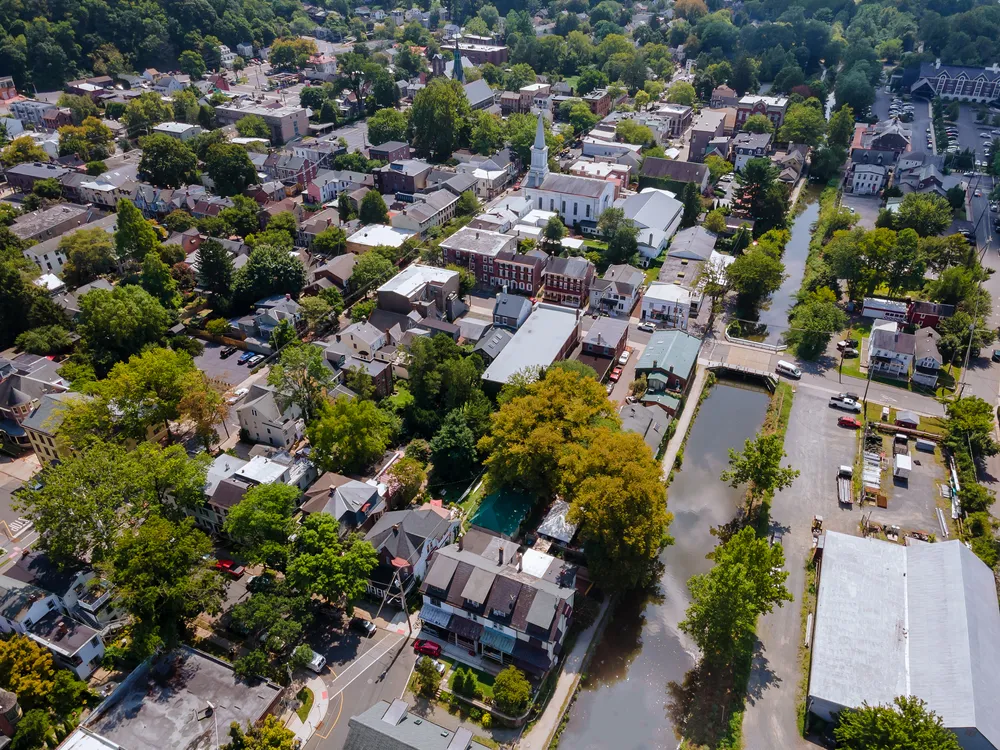
Two towns can sit the same distance from Manhattan, offer the same dining and entertainment, and line the same river, yet trade at prices that differ by a factor of three. That gap, playing out right now between New Hope and Easton along Pennsylvania’s Delaware River corridor, illustrates how housing density and supply constraints create distinct price environments even within a single agent’s territory.
New Hope Borough and its surrounding townships – Solebury and Upper Makefield – function as a cash-heavy luxury market. Carle Robbins, a Realtor with Addison Wolfe Real Estate who covers the Delaware River corridor from New Hope through Lehigh Valley, says the buyer pool reflects two converging forces: generational wealth transfers and longtime homeowners sitting on decades of appreciation.
“Right now in America is the largest wealth transfer between generations that’s ever happened,” Robbins says. “That gives other generations the ability to pay cash for homes, as well as people who are selling off their current residence.”
The result is a market where financing is almost beside the point. Among her recent activity, roughly 10 deals are under contract or in progress over a 45-day stretch; transactions include a $1.6 million cash deal and a $1.9 million purchase with minimal financing. Nothing in New Hope Borough lists below a million dollars.
The Price Gap Between River Towns
Easton, also on the Delaware and roughly the same commute from Manhattan, trades at a fraction of New Hope’s prices, between half and a third, by Robbins’s estimate. The difference comes down to density and supply. New Hope is a small borough with limited housing stock; Easton is a larger city with substantially more inventory.
Robbins currently has a complete rehab project under contract in Easton’s historic district for under $200,000. Fixed up, she estimates it will be worth around $450,000. An equivalent property in New Hope, she says, would sell for approximately $1.4 million. Both towns offer similar lifestyle amenities, restaurants, entertainment, and river access, but the scarcity in New Hope creates a floor that Easton’s larger supply base does not produce.
Historic Homes and the Expectations Gap
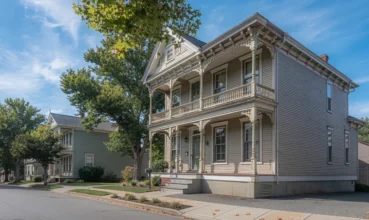
Across the corridor, historic properties carry characteristics that consistently surprise buyers. Robbins identifies them: bedrooms smaller than modern standards, low ceilings (she recently toured a home with five-and-a-half-foot doorways), unfinished basements with gravel or dirt floors, steep staircases built before modern codes existed, kitchens smaller than buyers expect, and layouts requiring passage through one bedroom to reach another, what the industry calls functional obsolescence.
These are not minor aesthetic issues. They create real pricing discrepancies between historic homes that might appear comparable from the street. “One stone home is not like another stone home,” Robbins says. “Just because one house sold for a million and a half dollars down the street, if the other house has low ceilings, it’s chopped up with tiny bedrooms, it’s probably going to sell for $900,000, because to make it like the other house, you have to put a significant amount of money into it.”
For buyers, this means that comparable sales data in historic markets is less reliable than in developments with standardized floor plans. Two properties on the same block can differ by hundreds of thousands of dollars based on ceiling height, bedroom layout, and whether the home has been updated to modern expectations.
Sellers who discover issues during the inspection period face a practical choice: offer concessions or disclose the problems to every subsequent buyer. Most choose concessions. Robbins says that once a seller has knowledge of an issue, they must disclose it to everyone else, making repair or a price adjustment the simpler path forward.
Lehigh Valley’s Rental Squeeze
Further north along the corridor, Lehigh Valley is experiencing rental scarcity driven by rapid population growth, particularly among 18-to-34-year-olds. Robbins describes it as the fastest-growing area in the Northeast for that age group. Many of these residents work in Manhattan and commute two or three days a week, paying lower taxes and rent than they would in New York while maintaining access to the city.
Robbins, who serves as secretary of the Greater Lehigh Valley Realtors board for 2026, says rents have roughly doubled from what she would have predicted in 2020. The growth stems from distribution center development, proximity to both Manhattan and Philadelphia, and a cost of living that undercuts both cities. “You can live in a city and still have a great quality of life at a fraction of the price,” Robbins says, “and you could be in the mountains in 20 minutes.”
Home prices in the Valley are rising year over year as well. Robbins says every agent she talks to through the board is seeing the same pattern: prices climbing monthly and rental inventory remaining scarce.
Headwinds Split Along Income Lines
The outlook diverges sharply by market segment. New Hope’s wealthy buyer base makes it largely insulated from affordability pressures – Robbins calls it “pretty much recession-proof.” Buyers there have discretionary income and are not sensitive to changes in mortgage rates or consumer prices.
The Lehigh Valley’s broader middle-market buyers face a different set of conditions: mortgage rates near 7 percent, rising insurance costs driven by natural disasters, climbing food prices, and creeping property taxes.
“For a first-time homebuyer, the difference between 6% and 7% is huge,” Robbins says. “Insurance rates are going up, food prices are going up, taxes are creeping up, and mortgage rates are getting brutal again.”
The cumulative effect of these costs hits first-time buyers hardest. In a market where prices are already rising, and rental scarcity limits the alternative, buyers in the Lehigh Valley face a narrowing window: rising home prices make waiting expensive, but monthly carrying costs make buying painful.
About the Expert: Carle Robbins is a Realtor with Addison Wolfe Real Estate, covering the Delaware River corridor from New Hope through the Lehigh Valley in Pennsylvania. She serves as secretary of the Greater Lehigh Valley Realtors board for 2026.
This article is based on information provided by the expert source cited above. It is intended for general informational purposes only and does not constitute legal, financial, or real estate advice. Readers should conduct their own research and consult qualified professionals before making any real estate or financial decisions.