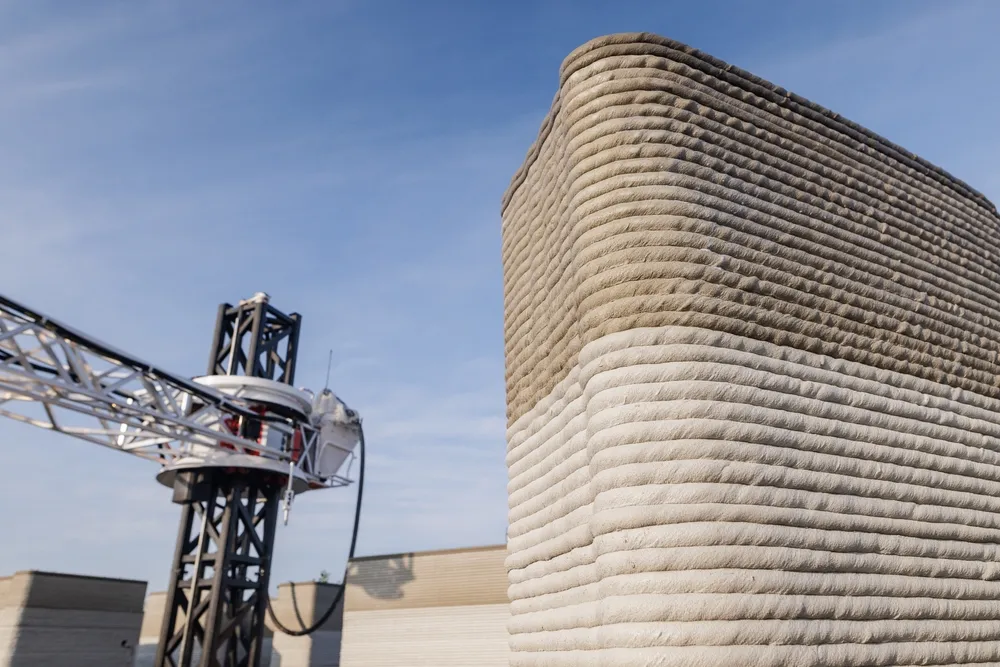
The wood-frame, stucco-clad homes that dominate Southern California residential construction burned by the thousands last year. Concrete does not burn. The technology that once made concrete homes prohibitively expensive for residential use – the formwork, the labor, the time – is now being stripped away by robotic printers laying walls with a precision no human crew can match.
According to Ahmed Mahil, Founder, CEO & Global President of Luyten 3D, an Australian robotics company that manufactures construction 3D printers and proprietary concrete materials, Southern California lost 14,000 homes in last year’s catastrophic fires. He frames the losses not as anyone’s specific failure but as a systemic mismatch between building materials and intensifying weather patterns. “Concrete is the most resilient material worldwide, and it can resist the fires and prevent their spread,” Mahil says. The alternative is continuing with what he calls “the stucco, cookie-cutter paper wall kind of design that we have.”
Luyten is now working with a California distributor called Concreta 3D on projects in Malibu, Pacific Palisades, and Altadena. The company’s printer in California can produce structures up to six meters high and 14 meters wide, with unlimited depth.
The Cost Barrier Explained
Traditional concrete construction requires formwork: temporary molds that hold wet concrete in place while it cures. Those molds require large crews to assemble, level, brace, and remove. They require inspection and vibration to prevent air pockets. Mahil estimates that formwork accounts for 60 percent of the cost in traditional concrete construction. That expense has historically limited concrete to commercial buildings, infrastructure, and high-budget custom homes.
Three-dimensional printing eliminates formwork. The robot deposits concrete in precise layers – Mahil claims accuracy to 100 microns – building walls directly without molds. “No formwork means you don’t need 20 guys to put up the formwork,” Mahil says for a 200-square-meter house. “It’s just one robot and a crew of two to three maximum.”
Mahil argues that a builder who currently completes 10 houses a year could, with the same crew and overhead, complete 50 using robotic printing. That productivity gain is what he frames as the core value for builders adopting the technology.
What Buyers Get Beyond Fire Resistance
Concrete’s thermal mass – its ability to absorb and slowly release heat – means printed concrete walls can reduce heating and cooling loads compared to traditional framed walls with cavity insulation. The wall geometry itself can be optimized by the printer, with internal structures designed to trap air or redirect sound.
Architects are among the technology’s strongest advocates, according to Mahil, because robotic printing removes the cost penalty for curves and complex shapes. Designs previously shelved as too expensive to form in traditional concrete can now be printed without additional cost per curve.
Why the Industry Has Resisted
Construction is what Mahil calls “a risk-averse and technology-resistant industry.” One key lesson Luyten learned, he says, was “not to try and change everything and bring weird machines that will scare many on these sites.”
That insight led to the company’s most recent product: the Ascent system, announced in June 2026, which converts existing tower cranes into 3D concrete printers rather than requiring builders to adopt entirely unfamiliar equipment. Mahil says the response has been broad, with inquiries arriving from jurisdictions across Asia, Africa, the Middle East, the Americas, and Europe.
The crane-based approach also addresses vertical construction – apartment towers and mid-rises – which Mahil argues is where the global housing crisis is most acute. Most of the world’s population lives in vertical housing, he notes, and earlier 3D printing systems were limited to one- or two-story structures.
What Buyers Should Weigh
Permitting remains a significant hurdle. Luyten’s concrete material, Ultimate Crete, is certified in California, Florida, and Iowa, but certification is not the same as widespread code acceptance across all jurisdictions. Each project may still require additional engineering review and local approval.
Mahil acknowledges the industry is “in its infancy.” Long-term performance data for 3D-printed concrete homes in seismic zones, under repeated thermal cycling, or exposed to decades of marine air does not yet exist. Buyers are early adopters bearing uncertainty that conventional construction does not carry.
Luyten’s Altadena projects lean toward social housing, while the Malibu and Pacific Palisades work targets high-end residential – suggesting the technology is being tested across multiple price segments simultaneously. For someone rebuilding after losing a wood-frame home to fire, the relevant comparison is not just what a home costs to build but what it costs to replace after the next fire season.
About the Expert: Ahmed Mahil is Founder, CEO, and Global President of Luyten 3D, an Australian robotics company with operations in California specializing in construction 3D printing technology.
This article is intended for informational purposes only and does not constitute legal, financial, or investment advice. The views and opinions expressed herein reflect those of the individuals quoted and do not represent an endorsement of any company, product, or service mentioned. Readers should conduct their own due diligence and consult qualified professionals before making any investment decisions.