
In an industry where artificial intelligence threatens white-collar jobs but can’t replace skilled trades, Kelvin Enfinger Jr. offers a refreshing perspective on what the future of con...

What Is Home Performance in Real Estate, and Why Should Buyers Care?

Written by:
Date:
27 Aug 2026
Share via Facebook

Share via Linkedin

Share via X

Copy to clipboard


Most home buyers can describe a house by its bedrooms, bathrooms, and square footage. Far fewer can tell you how that same house actually behaves once someone is living in it. That gap is what the real estate industry is starting to call home performance, and it is quickly becoming one of the more important concepts buyers overlook before making an offer.
Pearl, a national home performance data company, has spent years building a picture of how homes actually operate rather than just how they look. According to Tim Stanislaus, SVP of Business Development at Pearl, the concept comes down to a simple distinction. “It’s the difference between how a home looks and how a home actually works,” he explained in a recent interview. “A home is here to fulfill certain obligations to its owners. It’s here to keep them safe, to keep them comfortable, to be responsible and efficient with utilities and resources, to be resilient in the face of weather and climate, and to be able to create and store its own energy.”
How a Listing Differs from a Lived Experience
Traditional real estate listings tend to focus on aesthetics and features: an updated kitchen, the number of bathrooms, whether the floors were recently redone. What they rarely capture is what it actually costs to run the home each month, what the air quality will be like, whether the temperature stays even throughout the house, or whether the home can hold up to changing weather over time.
Stanislaus pointed out that these details usually surface only after a buyer has already moved in. “It’s not until you have spent a couple of nights in a home that you really begin to understand all the little secrets about this home that you didn’t know until you were actually living in it,” he said. By then, the purchase decision has already been made.
Why Buyers Should Ask About It Before Making an Offer
The moment home performance stops being an abstract idea and becomes something real usually happens the day after closing, when a buyer starts to feel the actual comfort, air quality, and utility costs of the home. Stanislaus described this timing problem directly: in a typical transaction, buyers only discover performance issues once it is too late to negotiate or walk away.
That is why Pearl is pushing to bring performance data into the search process itself, rather than treating it as an afterthought. The idea is to let buyers compare homes on performance the same way they already compare price, location, and size, and to use that information to narrow down a list of homes before they are seriously considering an offer.
A Data Set Built Across Nearly 100 Million Homes
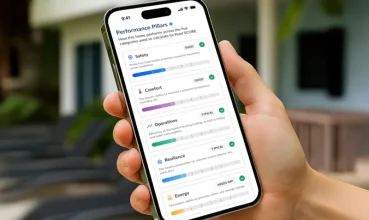
Pearl’s data currently covers 97 million single-family homes across the country, giving buyers and agents a much larger reference point than a single inspection or listing description ever could. That scale is part of what allows Pearl to build a standardized way of comparing homes, one that goes beyond visible features and into how a house actually performs across its safety, comfort, operations, resilience, and energy characteristics.
For buyers, the practical takeaway is straightforward. A home that looks great on a listing page can still come with expensive surprises once someone is actually living in it. Asking about home performance before signing anything, rather than discovering it after moving in, is quickly becoming a standard part of a smart home search. Buyers can learn more about how Pearl SCORE measures home performance directly on Pearl’s website.
Pearl is a ratings and standards company that built the national standard for home performance. Pearl SCORE™ rates every single-family home in the U.S. on a 1-to-1,000 point scale across five key element pillars— Safety, Comfort, Operations, Resilience, and Energy — so buyers, sellers, and real estate professionals can understand how a home performs in daily life.
This article is based on information provided by the expert source cited above. It is intended for general informational purposes only and does not constitute legal, financial, or real estate advice. Readers should conduct their own research and consult qualified professionals before making any real estate or financial decisions.
Disclosure: Individuals or companies mentioned may have a commercial relationship with KeyCrew.
Similar Articles
Explore similar articles from Our Team of Experts.