


While luxury towers grab headlines, a quieter transformation is reshaping South Florida’s real estate fundamentals. Innovation districts like FAU Research Park in Boca Raton are creati...

Why Older Homes In The Northeast Cost More To Heat Than Newer Ones

Written by:
Date:
03 Aug 2026
Share via Facebook

Share via Linkedin

Share via X

Copy to clipboard

Regional building code disparities are creating systematically different energy cost outcomes for buyers depending on where and when a home was built, a pattern most buyers never investigate before making an offer.
Two Markets, Two Different Energy Realities
Where a home was built and when it was built are among the strongest predictors of what a buyer will actually spend on energy, yet most buyers treat these as background details rather than core financial variables. The regional divergence, according to Tim Stanislaus of Pearl, is driven primarily by the uneven evolution of building codes over the past 15 to 20 years. Not all states have adopted energy standards at the same pace, and the gap between the most and least progressive markets now produces meaningfully different operating costs for homes that might otherwise look identical on a listing.
“Energy efficiency does vary significantly by region,” Stanislaus says, “and that is predominantly driven by variations in building codes.”
The Northeast has moved fastest, and for economic reasons rather than ideological ones. Heating a home costs more per unit of energy than cooling one, which has forced northern states to adopt stricter standards earlier.
The Northeast’s Compounding Problem
Aggressive code adoption benefits newer construction in the region but does not address the deeper structural problem: the Northeast’s housing stock is old. Stanislaus describes a compounding penalty facing buyers in that market.
“You’ve got kind of a double whammy in the Northeast,” he says. “You’ve got very expensive to heat homes, and then you have homes that are very old and were not built to modern code.”
This combination, high heating costs and aging construction built to outdated standards, has pushed local governments to adopt more aggressive energy auditing requirements and higher building standards. But those requirements apply to new construction and renovations, not to the existing stock that dominates many Northeast markets. A buyer purchasing a 1960s colonial in Connecticut is still buying a home built to the energy standards of that era, regardless of what current code requires.
The contrast with the Sunbelt is direct. Stanislaus notes that southern and Sunbelt states have generally built to lower energy codes, partly because cooling is cheaper than heating and partly because regulatory environments have been more permissive. Those markets have also seen significant new construction over the past decade, meaning a larger share of available homes were built to relatively recent standards.
The result: buyers in the Northeast face a higher baseline risk of energy cost surprises than buyers in markets with newer housing stock, even when the homes appear comparable on price and square footage.
What Buyers Are Missing in Their Research
Most buyers skip the one research step that would reveal this risk. “The main takeaway for home buyers is to be very aware of the year of construction and the code to which that home was built,” Stanislaus says. “And to do some research on that code and understand where that code sits relative to current standards and current code.”
This information does not appear in a standard listing. Beds, baths, square footage, and renovation history are all readily available. The specific energy code to which a home was originally constructed is not, and most buyers, and many agents, do not know how to find it or what to do with it once they do.
The gap matters because energy costs are not static. As utility rates rise and climate patterns shift, the efficiency difference between a home built to older code and one built to current code widens over time. A buyer who does not account for this is underpricing the long-term cost of ownership.
According to Pearl’s co-sponsored research with realtor.com, new construction homes cost $25,000 less to operate over 10 years than comparable existing homes, with energy consumption identified as the largest single driver of that gap. Stanislaus attributes this primarily to code evolution: “How a home is originally built and the code that it was originally built to is one of the largest determinants of how a home performs.”
Pearl and the Case for Code-Aware Buying
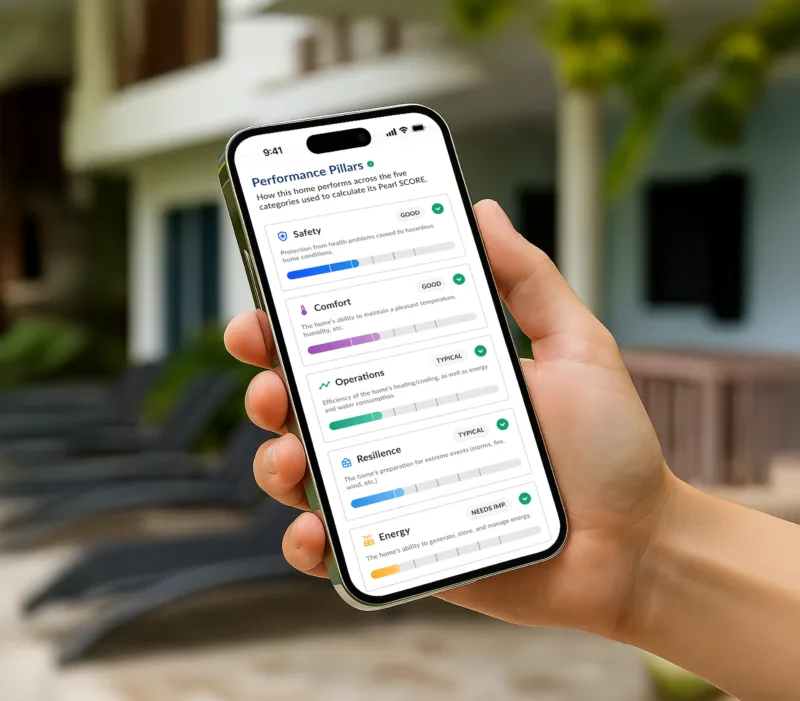
Pearl is attempting to make this kind of code-aware analysis accessible to buyers before they make an offer. The company’s scoring framework draws on data from 97 million U.S. homes and translates construction-era and regional code differences into a normalized performance metric buyers can use to compare homes across markets and vintages.
“That’s what Pearl is here to do, to help bring these insights forward and to make them easily accessible and easily comparable across homes,” Stanislaus says. The Pearl SCORE™ is designed to surface the energy efficiency implications of a home’s construction year and code compliance without requiring buyers to become building code experts themselves.
Realtor.com‘s use of the framework gives it broad distribution potential. Pearl is one company offering this type of analysis; buyers who want similar insights independently would need to research local code histories and compare them against their target home’s construction year, a process that remains difficult without specialized tools. If regional code disparities become a standard part of how buyers evaluate homes, particularly in high-heating-cost markets like the Northeast, older homes built to outdated standards may face pricing pressure as energy performance data enters mainstream buyer due diligence.
About Pearl: Founded in 2013, Pearl is a ratings and standards company building the national standard for home performance. Pearl SCORE™ rates every single-family home in the U.S. across five key pillars, Safety, Comfort, Operations, Resilience, and Energy, so home buyers, homeowners, and real estate professionals can understand how a home performs in daily life. As a Certified B Corporation, we’re accountable not only to our shareholders, but also to the homeowners and communities we serve. For more information, visit pearlscore.com.
This article is based on information provided by the expert source cited above. It is intended for general informational purposes only and does not constitute legal, financial, or real estate advice. Readers should conduct their own research and consult qualified professionals before making any real estate or financial decisions.
Disclosure: Individuals or companies mentioned may have a commercial relationship with KeyCrew.
Similar Articles
Explore similar articles from Our Team of Experts.




The Gap Between What Self-Storage Sellers Want and What Buyers Will Pay Is Finally Starting to Close
Transaction volume in self-storage has been slower than buyers and sellers would both like. Capital is ready to deploy, and assets need to trade. But the gap between what sellers believe the...

