
Industry veteran argues independent brokers are being sidelined at public companies in favor of predictable revenue streams The commercial real estate industry is witnessing a fundamental sh...

Modular Housing Factories Are Moving to the U.S. to Bypass Construction Labor Shortages

Written by:
Date:
05 Aug 2026
Share via Facebook

Share via Linkedin

Share via X

Copy to clipboard

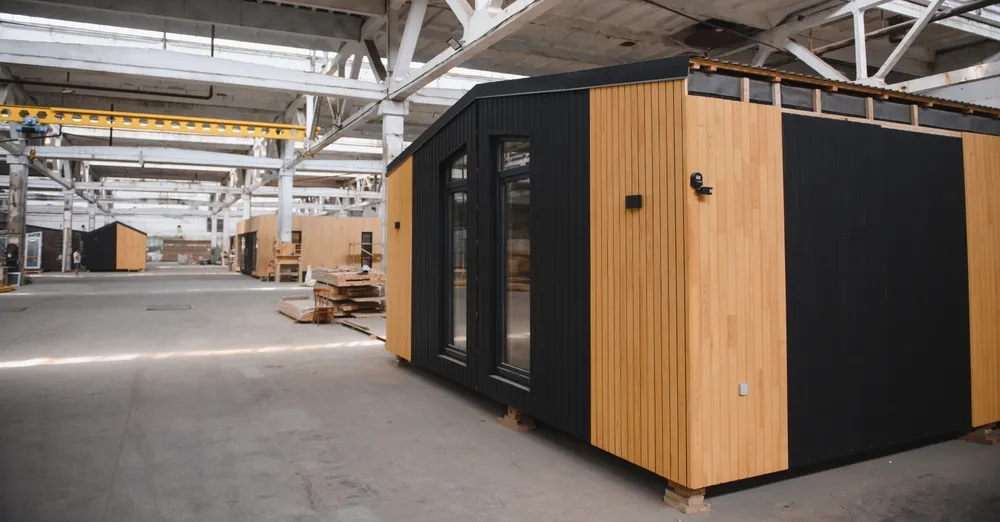
The skilled-trade shortage in U.S. construction has persisted for years, but the industry’s response is taking a specific new form: developers are moving production into factories, and those factories are increasingly being built on American soil. For buyers in markets where labor constraints have slowed new housing and driven up prices, domestic factory production could expand supply in ways that conventional construction cannot – because it does not depend on hiring local tradespeople who are not available.
Matt Young, General Director and Founding Member of studio3eight, a multi-disciplinary design firm that works on modular and conventional projects internationally, including in the U.S., has seen this transition from both sides. His firm initially designed modular housing intended for fabrication in Vietnam, where labor costs are low. But the modular company he collaborated with is now investing in a U.S.-based factory – driven less by material costs and more by what Young calls “the changing labor market in the U.S.”
Why the Factory Solves What Hiring Cannot
The core problem is straightforward: there are not enough skilled construction workers to meet housing demand in many U.S. metros. Young illustrates the point with an account from his own work: identical building designs built in two different cities, he says, produced different outcomes – one city had a strong crew and delivered a watertight building, while the other could not find qualified workers and the same design leaked.
In Young’s view, a factory removes that geographic variability. Workers train on one system, in one location, producing consistent results regardless of which city the finished module ships to. He expects the next phase will add automation to factory floors to compensate for the skilled-labor gap – machines handling repetitive framing and assembly tasks that would otherwise require tradespeople who are unavailable.
If that holds, buyers in markets where new construction has stalled because builders cannot staff crews could see factory-built homes add to inventory without waiting on the labor shortage to resolve first.
Why Factories Are Moving Onshore
Modular production originally gained traction in low-labor-cost countries: China, Vietnam, Indonesia, Thailand. Shipping finished modules across the Pacific was feasible when labor savings offset transport costs. But that math has shifted for the U.S. market. Transport is expensive, and U.S. building codes require American compliance officers to inspect modules at every stage of assembly. When the factory is overseas, according to Young, that means flying inspectors internationally and scheduling multi-stage visits before modules can ship.
Domestic factories eliminate both problems. Inspectors drive rather than fly. Modules ship by truck rather than container ship.
Young notes that supplier clustering is already happening: raw-material providers are locating near modular factories so that components travel short distances to one central point, and the assembled module ships only once to the final site. That consolidation reduces logistics costs and shortens the supply chain.
Where Modular Works and Where It Does Not
Factory-built housing works best on flat land with repetitive designs – suburban subdivisions, mid-rise apartment blocks, workforce housing. Transport constraints limit module dimensions to roughly 30 feet by 12 feet, according to Young, which means designs must accommodate those sizes. The exterior can be customized with separate facade panels, but the interior geometry stays rectangular.
Young says the biggest misconception he corrects is that modular housing looks like shipping containers. He cites, as one example, five-star hotels in New Zealand built with modular bathrooms, and argues modular has also been used in commercial buildings – not just affordable row housing. “I think the real estate world is looking at a very limited view,” he says, describing the common perception of modular as “a poor man’s product” as one he thinks is increasingly out of date given how the method is being applied across price points.
Still, the market is in early-adoption mode. Young observes that developers who come to him asking about modular have already done their research – “those early adopters tend to be the ones who come to you.” Developers who have not yet investigated it are generally not persuaded by a single pitch, which means supply growth from this channel will be gradual.
What Modular Changes About Project Timelines
The speed advantage comes from running site work and factory production at the same time. Young explains that foundations, plumbing pre-lay, and landscape work happen on site while modules are being built in the factory. Once shipped, modules go up in days or weeks rather than months. That concurrent timeline also reduces holding costs – the financing a developer pays while a project sits under construction.
For buyers, shorter construction timelines mean homes reach the market faster once a project breaks ground. In labor-constrained markets across the Southeast, Mountain West, and parts of the Pacific Northwest where construction backlogs have persisted, domestic modular factories represent a supply channel that, in Young’s assessment, operates independently of local workforce availability – unaffected by weather, seasonal fluctuations, or the hiring difficulties that have delayed conventional projects for years.
Young’s own estimate of the industry’s timeline for broader acceptance has compressed: “I would have said five to 10 years. Now I’m saying three to five.”
About the Expert: Matt Young is General Director and Founding Member of studio3eight, a Vietnam-based multi-disciplinary design firm working internationally across architecture, interior design, and urban planning.
This article is intended for informational purposes only and does not constitute legal, financial, or investment advice. The views and opinions expressed herein reflect those of the individuals quoted and do not represent an endorsement of any company, product, or service mentioned. Readers should conduct their own due diligence and consult qualified professionals before making any investment decisions.
Similar Articles
Explore similar articles from Our Team of Experts.