

Market timing sounds logical in theory: wait for the bottom, buy at the lowest possible price, and maximize your return. In many real estate markets, this approach can occasionally work. In ...

Why Parking Needs to Be Part of the Architecture Conversation From Day One

Written by:
Date:
23 Jul 2026
Share via Facebook

Share via Linkedin

Share via X

Copy to clipboard


There’s a moment that architects and developers know well. The design is coming together, the unit mix makes sense, the retail program is working, the amenities are where they need to be, and then someone runs the parking numbers. What follows is rarely smooth. Beams get heavier, structural grids shift, excavation scopes expand, and the ground-floor program that everyone spent months refining starts to shrink.
It’s one of the most common and most preventable problems in urban development. And according to Kevin Paxton, Architectural Design Specialist at KLAUS Multiparking America, it almost always traces back to the same root cause: parking being treated as a late-stage coordination item rather than an early design constraint.

“Project teams that address parking during schematic design—or even earlier—consistently have greater flexibility to optimize constrained sites,” Paxton explains. “Those that postpone the conversation often discover the constraints when changes become far more difficult and costly.”
Paxton works directly with architects, planners, and developers on the integration of mechanical and automated parking systems, and he points to three areas where early engagement has the most impact.
The first is the structural grid. Conventional parking dictates column spacing in the range of 60 feet to accommodate standard stall widths and drive aisles, a module that rarely plays well with residential or mixed-use programs. When a mechanical system is introduced early, the grid can be calibrated to serve both the parking and the livable program above it, rather than forcing a compromise between them.
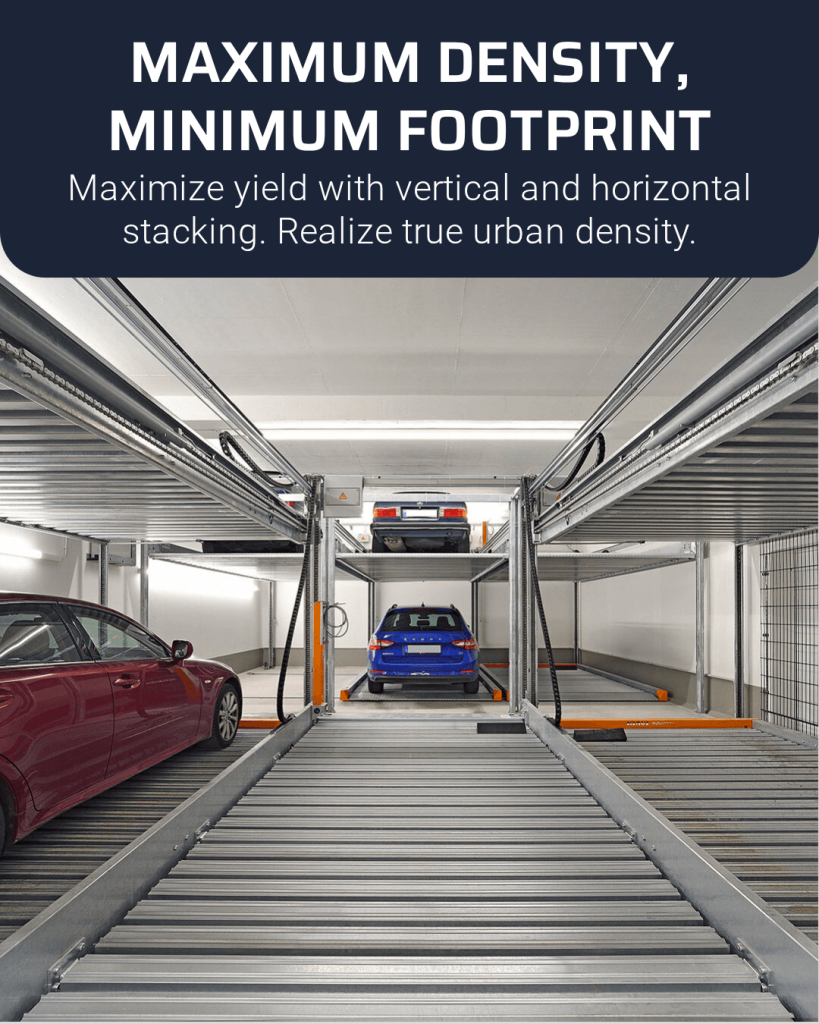
The second is acoustic and vibration coordination. Mechanical parking systems involve moving components, and in mixed-use or residential buildings, isolation from occupied spaces needs to be built into the structural and mechanical design from the start. It’s a manageable challenge when it’s addressed early. It becomes a significantly harder and more expensive one when the system is specified after the building section is already locked.
The third, and increasingly urgent, issue is EV readiness. Municipal mandates around EV charging infrastructure are expanding, and the electrical load implications are substantial. A parking level designed to support future charging at every stall is a fundamentally different design from one retrofitted for it later. Because mechanical systems concentrate vehicles in a smaller footprint, they can actually simplify EV infrastructure planning, but only when that coordination happens early enough to be reflected in the electrical design.
What Paxton is describing isn’t a niche technical concern. It’s an argument for treating parking as an architectural problem, one that deserves the same integrated attention as any other major building system. As urban sites get tighter and program demands grow more complex, the design teams that internalize that idea early are consistently the ones delivering projects that work as intended, on budget, and without the last-minute compromises that tend to follow parking that gets sorted out too late.

Disclosure: Individuals or companies mentioned may have a commercial relationship with KeyCrew.
Similar Articles
Explore similar articles from Our Team of Experts.