

After years of steady returns, multifamily real estate is losing its grip on private equity capital. New supply has flooded key markets, rents have flattened or declined in many metros, and ...

Second Homes, Short-Term Rentals, and Remote Sites: Who's Actually Buying Kit Homes

Written by:
Date:
29 Jul 2026
Share via Facebook

Share via Linkedin

Share via X

Copy to clipboard

The narrative around alternative housing usually centers on affordability or aesthetics. But for a growing segment of buyers in Canada, remote islands, and rural areas worldwide, kit homes aren’t a lifestyle choice – they’re the only construction option available. When traditional builders won’t travel to a site, when local labor doesn’t exist, and when permitting favors simplicity, a structure that ships flat and assembles with basic tools becomes less novelty and more necessity.
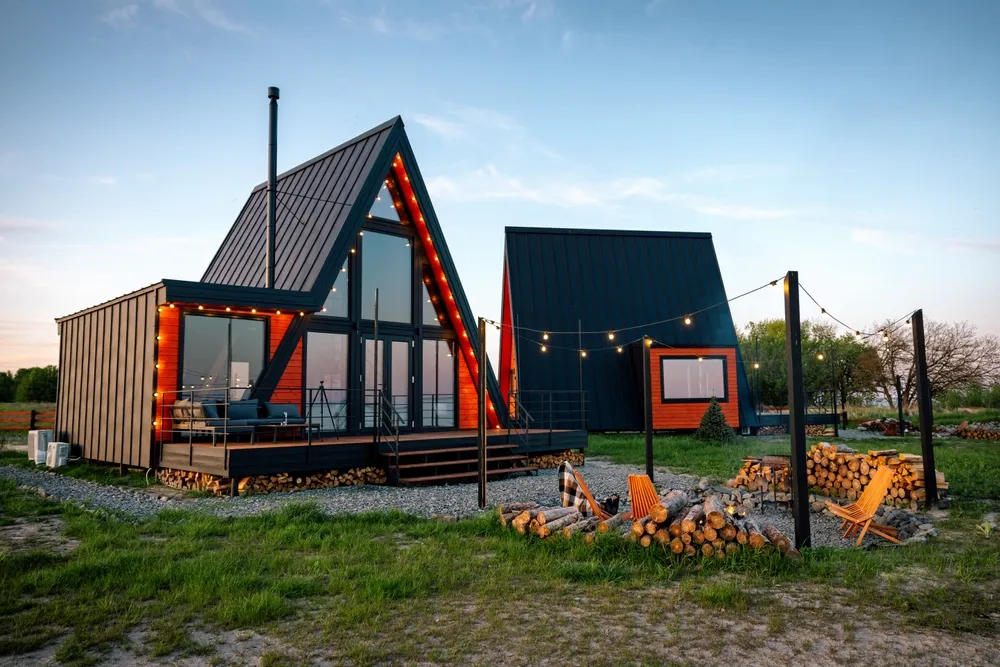
Indrek Kuldkepp, Founder & Managing Director of Estonia-based Avrame, manufactures A-frame homes in kit form and ships them to 27 or 28 countries. The company’s biggest market is Canada, with a U.S. manufacturing partner serving domestic buyers. His account of who’s buying – and why – corrects the assumption that kit homes are primarily an affordability play.
The Buyer Isn’t Who You’d Expect
In Canada, Avrame’s largest segment isn’t off-grid homesteaders or first-time buyers priced out of traditional housing. It’s second-home buyers purchasing for part-time short-term rental use. They buy land outside Toronto, use it one or two months per year for their own family, and rent it out the rest of the year, according to Kuldkepp. “It generates income, pays for itself,” he says. “So you basically have a free summer house.”
The short-term rental logic has a specific economic rationale beyond cost savings. Operators competing for bookings need differentiation, and distinctive architecture typically commands a premium in construction costs. Kuldkepp says that with A-frames, different architecture costs less rather than more. “Usually different means double the price. In our case, different means minus 20%.”
The other major buyer segment is people in genuinely remote locations where no general contractor will bid the job. One Avrame home was delivered to northern Canada by dog sled. The company has shipped to the Azores, Madeira, and the Falkland Islands. “It’s not that they are madly, deeply in love with A-frames,” Kuldkepp says. These buyers aren’t drawn to the aesthetic so much as the fact that few builders will take on a remote or hard-to-reach site at all.
The IKEA Problem
The most common misconception about kit homes, according to Kuldkepp, is underestimating the assembly challenge. He draws a direct parallel to flat-pack furniture: you receive components, not a finished product, and the gap between opening the box and having a livable structure requires real competence with tools.
“If you are born with two left hands, you shouldn’t assemble it by yourself,” he says. Successful DIY builders include a policeman in Germany who built one for his daughter and a preacher in Canada who built his own, neither professional builders, but both competent with tools. “You don’t have to be a builder, but you do have to know how to use tools. If you don’t, I suggest you better leave it for professionals.”
The risk of failure is real. “You can screw it up beyond repair if you don’t know at all what you are doing,” Kuldkepp adds.
Permitting Varies Widely
In the United States, permitting for A-frames is relatively straightforward, with the exception of California. Europe is more restrictive; southern England, northern Italy, and urban Germany often require new construction to match neighboring homes in form, making triangular structures impossible to permit. This pushes buyers toward rural and off-grid sites.
Australia presents a recent cautionary example. Avrame had two homes delivered and five or six in the pipeline when the government introduced a new safety license requirement mid-process. “They made a law that you also need a safety license, and we don’t have it obviously yet,” Kuldkepp says. The company is working on compliance, but the regulatory shift has stalled active projects.
He sees the Australian policy as counterproductive given that country’s construction backlog. Buyers who purchase from local Australian providers, general contractors, or builders sometimes wait three, four, or five years to get a house built because supply is insufficient, according to Kuldkepp. Opening the market to alternative housing formats like container homes and kit homes would be the logical step, he says, but the government is moving in the opposite direction.
Affordability as a Demand Driver
Kuldkepp identifies rising interest from younger families who cannot afford traditional construction. “Everything gets more expensive,” he says. “Especially younger families, they just can’t afford the traditional way anymore. Permitting costs, everything is so expensive.” He describes this as a rising trend visible in the company’s revenues.
But he stops short of claiming kit homes are a mainstream affordability solution today. “Affordable housing is something governments have to resolve one day because it’s getting worse and worse,” he says. “Definitely kit homes are one of the solutions to this big problem. But I think the pain has to grow yet in order to actually make things move.”
His forward outlook is blunt: for kit homes to move from niche to mainstream, economic conditions have to deteriorate further. “In order to grow bigger, to go more for mainstream, things have to get worse generally in the markets,” Kuldkepp says. The company’s growth, in other words, is tied not to marketing or product development but to how unaffordable traditional construction becomes.
Structural Advantages
The A-frame’s triangular shape – a house made entirely of roof – produces cost and maintenance advantages that matter for anyone evaluating long-term holding costs, kit-home or otherwise. Because the structure encloses fewer cubic meters of air than a conventional home of the same footprint, heating and cooling costs tend to be lower. A steep, all-sided roof line also means less exterior surface exposed to weather damage, and symmetrical framing simplifies assembly regardless of who’s doing the building.
Whether a given kit home holds up structurally over time comes down to the specific materials and engineering behind it, something buyers evaluating any manufacturer, not just Avrame, would want verified independently rather than taken on the seller’s word.
For buyers considering a kit home as an investment property or a primary residence in a location where traditional builders won’t go, the question is not whether the structure performs; it’s whether the buyer has the skills to assemble it, or the budget to hire someone who does.
About the Expert: Indrek Kuldkepp is Founder and Managing Director of Avrame, an Estonia-based manufacturer of A-frame kit homes that ships to 27 or 28 countries, with Canada as its largest market and a U.S. manufacturing partner serving domestic buyers.
This article is based on information provided by the expert source cited above. It is intended for general informational purposes only and does not constitute legal, financial, or real estate advice. Readers should conduct their own research and consult qualified professionals before making any real estate or financial decisions.
Similar Articles
Explore similar articles from Our Team of Experts.