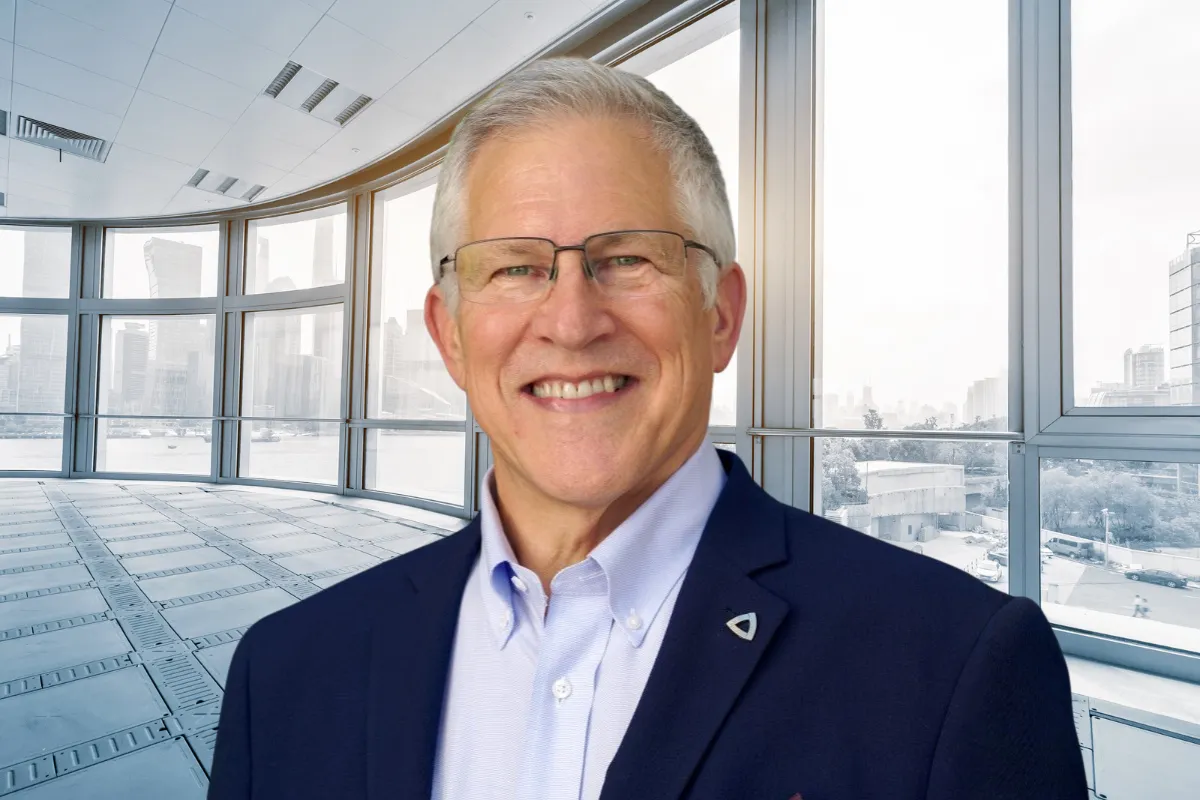
After nearly fifty years in commercial real estate, Ted Branson noticed a clear pattern in his career: almost all of his transactions—95%—were industrial deals. This realization led him to pursue his SIOR designation and, most recently, to launch Landmark Commercial Real Estate’s dedicated industrial division in Wichita, Kansas.
Branson’s deep experience in the sector, combined with a surge in demand for industrial space, positioned him to lead Landmark’s expansion at a critical moment for the market. “My broker asked me a couple of years ago to form an industrial department and said, ‘If you get hit by a bus, I’ll lose all your expertise,’” says Branson, now Industrial Division Director at Landmark. The challenge was clear: after decades as a solo operator, Branson needed to build a team that could scale his knowledge and adapt to the region’s accelerating growth.
From Solo Practice to Team Leadership
Transitioning from individual broker to team leader required Branson to rethink his approach. He recognized the need to delegate both responsibility and opportunity.
He began by assigning his more challenging listings to a team member who showed interest in industrial deals, then gradually expanded that arrangement. Team members now handle much of the day-to-day work and split commissions with Branson.
“They handle showings, negotiations, and closings, with my guidance and input, and we split the commissions,” he explains. “I know at some point, I’ll be paying them more and taking less for myself.” This system has enabled the division to rapidly grow its listing inventory. “I had 30-40 listings myself, but it felt good to start giving some of that away,” Branson says. “Now I can say, ‘Hey Roc, go get those listings,’ and we’ve magnified our listing count quite a bit.”
Wichita’s Strategic Location Fuels Industrial Growth
Wichita’s industrial market is expanding quickly, driven by its central position at the intersection of major transportation routes. “We’re at a crossroads of highways in the center of the country,” Branson explains. The city sits just south of I-70 and directly on I-35, creating a direct link from Dallas to Chicago and easy access to Denver and Kansas City.
This geographic advantage is drawing attention from national companies and developers, fueling demand for larger facilities. “We’re starting to see some mega warehouses here, and mega for us is 100,000 to 500,000 square feet,” Branson says. He currently has two projects underway in the 100,000 to 300,000 square-foot range.
Wichita’s commitment to speculative development has also played a key role. Several years ago, Branson advocated for a city-backed spec building program, arguing that companies considering Wichita needed to see available inventory before making relocation decisions. “If there’s nothing built, they just pass Wichita by,” Branson says. The city ultimately approved the initiative, and spec buildings have since become a regular fixture. “Several spec buildings have been going up routinely,” Branson reports, providing ready-to-occupy space that appeals to regional and national users.
Major Projects Reshape the Market
The transformation of the ICT Twenty-One site marks a milestone for Wichita’s industrial sector. A former oil refinery, the site was remediated and redeveloped into a central logistics hub. “Getting that refinery cleared out, the pollution dealt with—the owner got permissions and got it cleared,” Branson says. The site now hosts three 200,000-square-foot warehouses and a Love’s truck stop, turning what was once an eyesore into a key intersection for trucking and warehousing. All three warehouses are fully leased.
Park City, a northern suburb, has also experienced rapid industrial development. “We had one developer in particular up in Park City. He’s built about three million square feet over the last ten years,” Branson says. The developer operates bonded warehouse businesses and leases space to other users, typically achieving full occupancy within a year of completion.
National Players and Out-of-State Capital Move In
Wichita’s industrial momentum is attracting major national companies and outside investors. Amazon now operates a 1.3 million-square-foot facility in the area, along with two additional warehouses. “They have a presence here,” Branson says, underscoring the market’s appeal to large logistics operators.
Investment groups from outside Kansas are also entering the market. “There is a large fund that just bought a large acreage—they want to build more,” Branson explains. “They bought three large warehouses that were existing and now are all sold or leased up, so they’re ready to go build some more.” This Colorado-based group exemplifies a broader trend: institutional capital seeking opportunities in mid-continent markets with lower land costs and available labor.
Overcoming Outdated Perceptions
Wichita’s industrial success is, in part, the result of deliberate efforts to update the city’s reputation. “Years ago, if a company was going to move here and told their employees, they would say, ‘Oh no, not Wichita—cowboys, farms, flatland, nothing to do,’” Branson recalls. In response, local business leaders and economic development agencies focused on promoting Wichita’s advantages, such as affordability, quality of life, and family-friendly amenities.
“Thirty years ago, commerce started really working on what the pluses of being in Wichita are,” Branson says. The city began to appear on national lists for best places to live and raise a family, and its low cost of living became a selling point for relocating companies.
Aerospace remains at the heart of Wichita’s economy. “We’re the air capital of the world. Boeing, Beechcraft, Cessna, Textron, and Learjet are all here,” Branson notes. The recent acquisition of Spirit AeroSystems by Boeing, along with Bombardier’s continued presence, has further solidified this foundation.
Wichita State University adds another layer to the city’s industrial appeal. “Our University and the National Institute of Aviation Research are expanding their facilities. There’s a great cooperative at the WSU campus that’s continuing to train engineers and other people in those industries and tech,” Branson says. This pipeline of skilled workers supports both traditional manufacturing and newer technology-driven operations.
Building for the Future: A Team Approach
The launch of Landmark’s industrial division marks the start of a new phase for Branson and his team. They have built a targeted marketing database, segmented by industry, enabling customized outreach to manufacturers, distributors, and logistics operators. “We can select what properties we send to whom,” Branson says, making their approach more efficient and responsive to client needs.
Branson emphasizes that the division is more than a collection of agents; it’s a cohesive unit with a shared brand and strategy.
Looking Ahead
Wichita’s industrial market shows no signs of slowing. Its central location, affordable land, and growing recognition among national companies position it as a logical choice for logistics and distribution. “With massive changes and growth in Kansas City, we’re the next stop for people that want to be somewhere in the middle on the way to Dallas or Oklahoma City,” Branson observes. “We’ve attracted a lot of the notable companies.”
For Branson, the division’s growth is both the culmination of his career and a succession plan for the future. By building a team that can carry forward his expertise and relationships, he’s preparing Landmark to capture opportunities as the market expands. The combination of Wichita’s infrastructure, ongoing investment, and a new generation of industrial specialists suggests that the city’s industrial sector is poised for continued expansion, and that Branson’s team will remain at the center of that momentum.
Recent news adds that warehouse employment in Wichita is up 40% over the past few years, with Amazon opening a 3rd last mile facility here, and more large warehouses going up. Along with the employees not wanting to move to Kansas decades ago, many have found that Wichita is a very sophisticated small city of 400K+, with well-developed arts, higher education, sports, and other entertainment, etc.