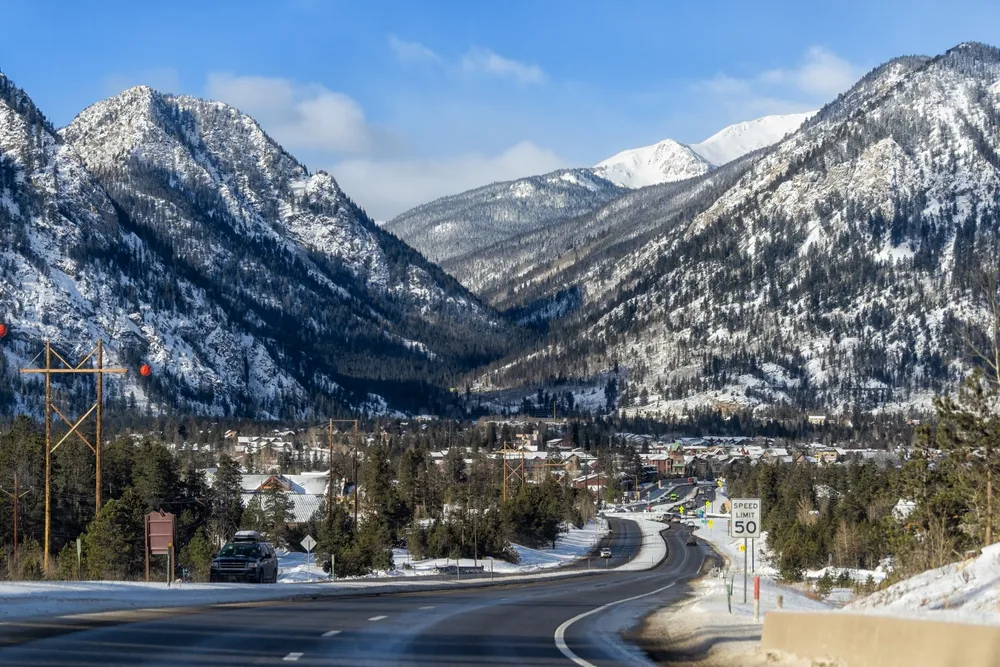
Mountain real estate in Colorado’s Summit County has long carried a reputation as a stable store of value: limited land, world-class ski resorts, and steady demand from wealthy second-home buyers. But several pressures are converging in ways that test that assumption. Buyers treating a Summit County purchase as a guaranteed hedge may be underestimating risks that have accumulated quickly.
The headwinds stack up quickly: borrowing costs, insurance availability, snowfall variability, and stock-market volatility. Any one of these would put pressure on a second-home market. Together, they create a stress scenario that the “limited land, unlimited demand” narrative does not account for.
Insurance and Snowfall Risks
Colorado now ranks among the most difficult states for property coverage, according to Dishon Lutz, a Real Estate Broker with Real Estate of the Summit who works across Breckenridge, Keystone, Frisco, and Steamboat Springs; he places it at “number three, most difficult state to get insurance.” For a buyer closing on a mountain home, that does not just mean higher premiums. It can mean difficulty obtaining a policy at all, which complicates financing and resale. A property that is hard to insure is a property with fewer potential buyers down the line.
Lutz notes that Summit County experienced notably low snowfall in the most recent season. “Whenever we have low snow, it impacts our tourism,” he says. Tourism drives the rental income that many second-home owners rely on to cover carrying costs, including HOA dues, insurance, taxes, and maintenance. One bad snow year is survivable. A pattern of below-average winters is a structural risk to the revenue model that justifies many purchases.
Borrowing Costs and Equity
Lutz frames it directly: “It always comes back to money and how expensive it is to borrow money.” Higher rates shrink the buyer pool for any market, but they hit second-home markets disproportionately. A primary residence is a necessity; a vacation home is discretionary. When financing gets expensive, discretionary purchases are the first to be delayed or downsized. Local buyers who need financing are already feeling the squeeze; Lutz notes that interest rates are “really impacting that consumer” and making monthly payments “that much more difficult.”
Summit County’s buyer base skews toward professionals and small business owners purchasing in the two-to-three-million-dollar range, people whose liquidity often sits in equities. “If people are making money, they’re diversifying by taking some of those profits and putting it into real estate,” Lutz says. The reverse is also true: a sustained market downturn pulls demand out of the second-home pipeline. Summit County’s fortunes are tied to portfolio performance in ways that a primary-home market is not.
Scarcity Meets Recalibration
None of this means Summit County property values are about to collapse. The supply constraint is genuine. Lutz cites a figure of 95 percent of available land already built on, making the county “kind of like oceanfront property” in terms of scarcity. That floor matters. But scarcity alone does not guarantee appreciation when carrying costs rise, rental income drops, and the buyer pool thins.
Lutz characterizes the current market as moving toward greater balance after the pandemic-driven distortion, a period when cheap borrowing, remote work, and pent-up demand for outdoor experiences drove prices sharply higher amid limited supply. He sees the current environment as healthier than that frenzied period. But “healthier” for the market overall can mean worse for an individual buyer who purchased at peak prices and now faces higher insurance premiums, lower rental occupancy due to a weak snow year, and fewer comparable sales to support their equity position.
Shifting Market Dynamics
The market is already reflecting this recalibration. Inventory is rising, properties are sitting on the market longer, and sellers are offering concessions (replacing flooring, including furniture, and covering painting costs) that would have been unthinkable during the pandemic surge, according to Lutz. Buyers have more leverage and more time to be selective, which means sellers of dated or poorly located properties face longer timelines and weaker offers.
For anyone evaluating a Summit County purchase as an investment rather than pure lifestyle spending, the question is not whether the land is scarce. It is whether the income model, tourism-driven, weather-dependent, insurance-constrained, and tied to equity-market wealth, can sustain carrying costs through a stretch of unfavorable conditions. The recent low-snow season offered a preview of what that stress looks like on the rental revenue side, and insurance costs are not trending downward.
About the Expert: Dishon Lutz is a Real Estate Broker at Real Estate of the Summit, serving Summit County, Colorado’s mountain resort corridor, including Breckenridge, Keystone, and Copper Mountain.
This article is intended for informational purposes only and does not constitute legal, financial, or investment advice. The views and opinions expressed herein reflect those of the individuals quoted and do not represent an endorsement of any company, product, or service mentioned. Readers should conduct their own due diligence and consult qualified professionals before making any investment decisions.