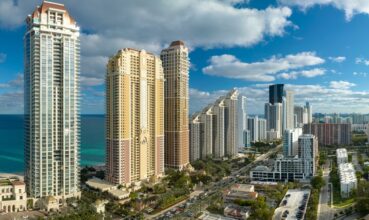
Miami’s luxury condo market is known for its high-profile branded towers – names like Cipriani, St. Regis, and Four Seasons dominate headlines and attract buyers willing to pay a premium...

Twin Sisters Shape Miami's Luxury Real Estate Market Through Economic Shifts

Written by:
Date:
13 Nov 2025
Share via Facebook

Share via Linkedin

Share via X

Copy to clipboard


Miami’s luxury real estate landscape has changed significantly over the past two decades, evolving from what Carolina Lopez and Katherine Lopez of ONE Sotheby’s International Realty recall as a “little town” where “you used to know everybody” into a cosmopolitan hub attracting global wealth. The identical twin sisters, who have worked in Miami’s luxury market since 2003, offer insight into how the city’s real estate dynamics have shifted alongside its rapid growth.
A Pathway Into Luxury Real Estate
The Lopez sisters’ entry into real estate began with an unexpected recommendation while working at Aventura Mall during college. “The owners of the mall were like pushing us to get the license,” Carolina recalls. “They said, ‘You guys are very good salespeople. You are very community-oriented. I like the way that you guys communicate to the clients. Why don’t you guys try?’”
That moment launched a career spanning multiple market cycles and positioned the sisters as specialists in Miami’s luxury segment. Their approach leverages the marketing advantage of being identical twins with a relationship-driven business model that extends beyond individual transactions.
“It is an advantage because it’s like free marketing,” Katherine explains. “When people see us both together, they always gonna recognize us. There’s people that approach us who have talked to us once, many years ago.”
However, collaborating as sisters brings its own challenges. “We’re very perfectionist, and we push each other to the max,” Carolina notes. “Working as sister partners means we push each other to the limit every day, because working with a sister is not like working with a friend or colleague where you have boundaries when you communicate.”
International Networks Fuel Growth
The sisters’ business model extends beyond Miami, with international networking through real estate expos in Spain, Mexico, Brazil, Venezuela, and France. This global approach developed from Katherine’s early work with developers, which involved frequent travel to promote projects.
“When you work for a developer, you have to travel a lot promoting the projects,” Katherine explains. “The experience is really amazing because you can connect with so many people from so many different parts of the world, and also understand their market and relate the information of our market here in Miami.”
These international relationships have become a key source of repeat business. “We don’t just see a client to sell a property and then get your commission, bye-bye,” Carolina emphasizes. “We like to create relationships. We develop relationships.”
This focus on relationships includes comprehensive property management for international clients who purchase second or third homes in Miami. “Most of our clients buy second or third homes, but in having a second or third home, they also want to get an income,” Katherine notes. “We take care of the apartments like they’re ours. Sometimes they only come once a year, but we run everything.”
Changing Buyer Demographics and Market Appeal
Miami’s luxury market has seen a major demographic shift. “Back then, the main clients that everybody used to have here were South American,” Carolina observes. “Now, 90% of the clients are Americans, because they discovered this beautiful paradise after COVID.”
This change reflects Miami’s rise as what Katherine calls “the trendy city in the world.” The city’s growth has brought new amenities and cultural attractions that appeal to a wider international audience. “Now we have more entertainment, the art scene is also something that’s bringing a lot of people to buy, and it’s a cosmopolitan city. Now we have a soccer team.”
The scale of luxury transactions has also increased. “Back then, when you used to sell a property for $2 million, it was a big deal,” Carolina recalls. “Now, $20 million, $30 million—we see those kinds of numbers closing properties, houses and condos every day.”
Navigating Buyer’s Market Conditions
Currently, the Lopez sisters describe Miami as a buyer’s market, viewing it as an opportunity. “It’s a good thing,” Carolina explains. “I explained to our clients: don’t buy when everybody’s buying. Just buy when things change. Now the people that didn’t buy a year ago, I call them and say, ‘This is the time to negotiate.’”
Market cycles play a defining role in Miami’s real estate landscape, heavily influenced by international economic trends. As Katherine notes, “Miami moves in cycles, and what happens abroad affects us directly. If Brazil is doing well, we’ll see a wave of Brazilian buyers. If Argentina’s economy strengthens, our market rises with it.” The sisters emphasize that the health of South American economies often dictates buyer activity in Miami: when those countries face challenges, the local market slows, and when they flourish, Miami experiences a surge in international demand.
Inventory has grown compared to recent years. “A year, two years ago, we used to fight for units,” Carolina recalls. “We used to send offers, and sometimes we didn’t get responses. Now, definitely there are more properties coming to the market.”
The Core $2-11 Million Market
Although headlines often highlight record-breaking sales in the $50–100 million range, the López sisters focus on the $2–11 million segment, which they identify as their core market. “We deal more with the real buyer and seller,” Katherine explains. “And while those $40–50–60 million transactions aren’t our caliber yet, Miami is growing at such a fast pace that we fully expect to be working in those price points eventually. The market is expanding, and so are we.”
They take a practical yet optimistic view of ultra-high-end sales: “You have hedge-fund groups and global investors who are acquiring those types of properties because they see Miami as a dynamic, long-term market,” Carolina adds. “It’s a different tier of the industry, but it reflects how much confidence major players have in the city’s future.”
Within their price range, waterfront properties with views remain the strongest performers. “When a buyer gets to see it, literally, they want to buy it,” Carolina notes. “It’s an emotional sale. And when it’s really well put together, people jump on it.”
Financing Hurdles and Cash Transactions
Financing has become more complicated, especially regarding building approvals. “The challenges in financing are honestly unbelievable,” Katherine observes. “Banks are asking so much paperwork. They’re really checking the financials of the buildings, the budget. Before that didn’t used to happen.”
New reserve requirements have introduced additional complications. “Now they want to see if buildings have reserves. The reserve part is becoming a big issue because now, by law, every building has to have reserves. So now there are assessments in the buildings because they need to collect that money.”
This has changed the due diligence process: “One of the first things we do now is, okay, your price range is $2-3 million. Let’s see how the financials are before we go show properties, because then it’s a waste of time if people are looking to get financing.”
Most of their clients pay cash, which helps avoid these challenges. “In our experience, thank God most of our clients pay cash, so we don’t have to deal with that.”
Interest Rate Concerns Even Among Luxury Buyers
Despite assumptions about wealthy buyers being unaffected by interest rates, the Lopez sisters see significant concern even among luxury clients. Katherine shares a recent example: “Yesterday I had a showing, and one of the clients had a property paying $30,000 monthly in a mortgage, so they’re planning to sell it because they don’t want to pay. The interest is 7.5%.”
International clients also seek lower-cost financing options. “I have clients from Brazil with good connections with Swiss banks. They always talk about the interest, or if they can get a lower interest somewhere overseas, in London at 3%. They always focus on getting private loans in a different country and bringing the money because it’s cheaper.”
Momentum in the Luxury Rental Market
The high-end rental market has become a significant part of their business, with properties renting for $30,000-$50,000 per month. “At the beginning, we were questioning whether people could pay that much money for a rental, and people are paying that much money for a rental,” Carolina notes.
This rental demand allows property owners to cover expenses. “Sometimes they prefer to buy, and then if they want to cover expenses, they will put it for six months to rent, or depending on the building, three months out of the year.”
Looking Ahead
The Lopez sisters remain optimistic about Miami’s luxury market, emphasizing the need to work with natural market cycles. Their success is rooted in local expertise, international relationships, comprehensive client service, and the distinct advantage of their twin partnership.
As Miami continues its transformation into a global city, the Lopez sisters exemplify the evolution of luxury real estate professionals who must navigate increasingly complex international dynamics while maintaining the personal relationships that drive success in high-end transactions.
Similar Articles
Explore similar articles from Our Team of Experts.