With new building allocations in the Florida Keys unavailable until at least July 2027, buyers who want current code construction have limited options. They can wait for a competitive permit process whose scoring rules have not been published, or they can buy an older home for the building right attached to the land and replace it.
The second route is increasingly the one being taken, and it is changing the composition of the housing stock in a way that shows up in price data before it shows up in any permit report. Sandra Tuttle, founder of Island Welcome Real Estate in Summerland Key, works in unincorporated Monroe County and has watched the pattern accelerate.
Why New Construction Is Not Driving The Market
The Keys has never been a market led by new development. Volume is low enough that the allocation freeze, significant as it is procedurally, does not by itself move prices. Tuttle is direct that the constraint operates indirectly rather than through supply shock.
What it does instead is redirect demand. A buyer who wants a house built to current standards, elevated above flood and rated for 180-mile-per-hour winds, cannot obtain one through raw land in the current window. That buyer goes looking for a teardown.
What Gets Removed
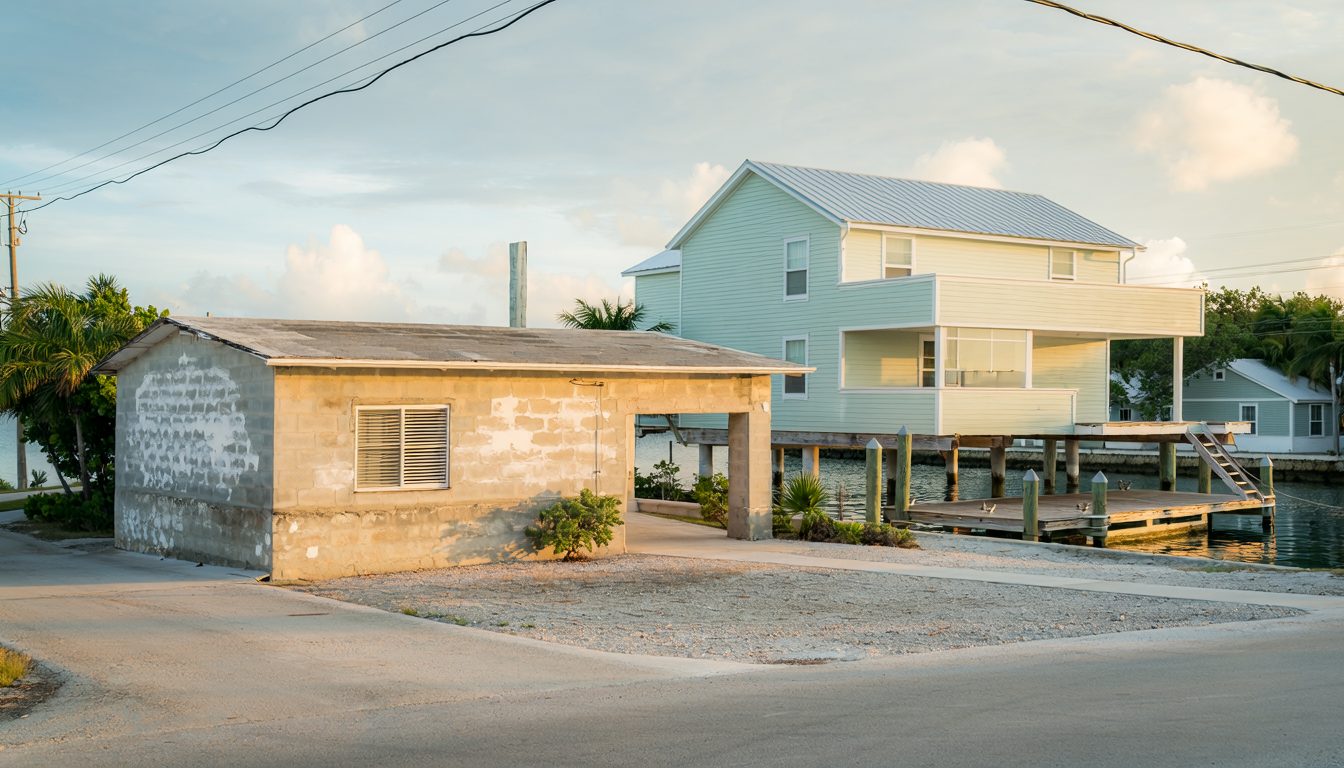
The properties being acquired for redevelopment sit at the bottom of the value range. Ground-level conch houses, older fish camps, small frame homes, and mobile units built decades before current code. Many have flooded, some repeatedly.
“By removing older homes, tiny homes, small fish camps, and mobile homes from our inventory and replacing those with a brand new home, just naturally we are going to be elevating the average price point of this community,” Tuttle said.
The replacement product carries metal roofs, impact-rated windows and doors, and elevation above the base flood. It costs more to build, and it insures for less, which compounds the gap between what came down and what went up.
The Effect On Reported Values
The statistical consequence is that average and median prices in affected neighborhoods rise without any individual property appreciating. A $500,000 ground-level home leaves the inventory, and a $1.6 million elevated home enters it. The neighborhood average moves. Nobody’s house went up in value.
For sellers holding older stock, this produces a confusing signal. Published appreciation figures reflect inventory replacement as much as price movement, and a seller pricing an unimproved 1980s canal home against those figures will sit on the market.
Where The Building Right Sits
The variable that determines whether a property is a candidate for this is not condition or price. It is whether the parcel carries a ROGO exemption, meaning it previously held a legally and lawfully established residential unit and has public utilities.
A parcel with that history retains a building right permanently. The existing structure can be demolished and replaced without entering the allocation system, and the replacement is not restricted to the original footprint or square footage. Current building codes and property setbacks are the only limits.
That distinction is not visible in a listing. Two adjacent lots at similar prices can differ entirely on this point, and the one carrying the exemption is worth materially more to a buyer planning to build.
What Follows
Monroe County anticipates roughly 588 of the 900 allocations authorized chainwide, released at approximately 40 per year across at least a decade. Against a vacant land inventory in the thousands of parcels, that is a small fraction, and the scoring will prioritize owner-occupied, affordable, and workforce housing.
The implication is that redevelopment of existing parcels, rather than construction on raw land, will account for most new homes in the Lower Keys for the foreseeable future. The value attached to a lot carrying a building right is likely to continue separating from the value of whatever is standing on it.
About the Expert
Sandra Tuttle is the founder of Island Welcome Real Estate, a local boutique real estate brokerage based at 24437 Overseas Highway, Summerland Key, Florida. She has lived in the Florida Keys since 1997 and has worked in Keys real estate for 22 years. Her practice mainly focuses on canal-front and waterfront residential property in the Lower Keys and Middle Keys, but they service all of the Florida Keys, from Key West to Key Largo.
This article is based on information provided by the expert source cited above. It is intended for general informational purposes only and does not constitute legal, financial, or real estate advice. Readers should conduct their own research and consult qualified professionals before making any real estate or financial decisions.