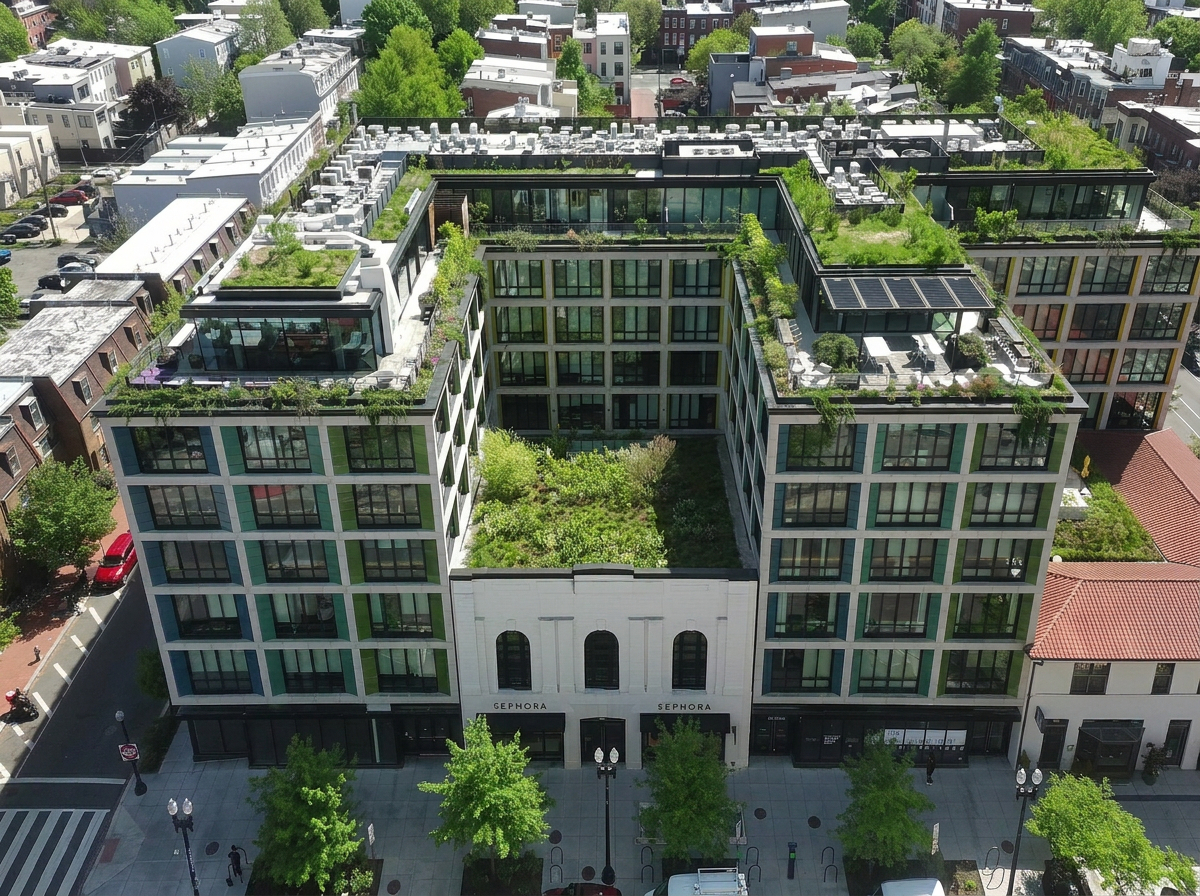
In a market where most luxury listings tell a version of the same story – high ceilings, a European kitchen, a desirable neighborhood – a handful of properties each cycle offer something genuinely different. The penthouse at 1711 14th Street NW in Washington, DC, is one of them, and not primarily because of its price.
The property is listed at $3.25 million. It sits atop a building with 78 rental units below it. It was originally designed as the personal residence of Ron Kaplan, co-founder of Five Squares Development. The architect is Selldorf Architects, whose other work includes the Frick Collection renovation, Gagosian Galleries worldwide, and private residences for serious collectors. The landscape design is by Thomas Clime Landscape. Two outdoor showers. A garage within a garage. Walls of glass that open entirely at the push of a button. A terrace with a fire pit, a water feature, and, briefly this spring, nesting geese.
Representing the listing is Daryl Judy of Washington Fine Properties. The way Judy talks about this property – and about the challenges of marketing it – offers an unusually clear window into what it actually takes to sell a trophy asset in a city where almost nothing can be torn down, and every extraordinary property carries its own complexity.
What Makes a Trophy Property
Judy is precise about the difference between an expensive house and a trophy property. The buyer for a property like this is not looking for just a functional space. They are looking for something that cannot be replicated – privacy at the center of the city, a design that commands attention, and a physical experience that separates it from everything else at the price point. “This is someone who wants to showcase the power of uniqueness,” Judy says. “They want to be in the middle of the city with privacy, and this glass house on top of a building delivers that.”
The physical experience of the penthouse matters here. The unit sits on a peninsula-like configuration, meaning there are no neighbors to the left, right, or in front. The building is poured concrete, so street noise on the seventh floor is minimal despite its location in one of DC’s most active corridors. Views extend to the Washington Monument, the National Cathedral, the Scottish Rite Temple, the Basilica of the National Shrine of the Immaculate Conception, and for miles across the city in multiple directions.
Inside, the design approach is what Judy describes as yacht-like: almost no exposed drywall, hidden panels throughout concealing storage, electrical panels, and appliances, teak vanities, and seamless pour-in-place flooring that runs continuously from living spaces through the showers. The kitchen is Bulthaup, fitted with Miele, Sub-Zero, and Gaggenau appliances. A Crestron smart home system controls everything from shading to the outdoor stereo. Entire walls of glass open at the push of a button, collapsing the boundary between interior and terrace entirely.
The Complications No Listing Sheet Explains
What makes this property genuinely challenging to sell is its structural uniqueness. The penthouse is not a standard condominium. It sits above 78 rental units in a building that also houses commercial tenants, including ground-floor retail. That configuration raises immediate questions for buyers about control, costs, and the trajectory of monthly fees over time.
Judy walks every serious buyer through the same set of concerns: how the ownership structure works, what protections exist against fee increases, and how the penthouse fits within a building that operates primarily as a rental property. The developer built in a CPI-linked cap – meaning fee increases are tied to the Consumer Price Index – which limits how much the monthly payment can rise. The current fee is also lower than comparable luxury buildings with similar services. For buyers sophisticated enough to understand the structure, those are genuine advantages. But the education process takes longer than with a straightforward listing.
At $3.25 million, Judy expects the transaction to be an all-cash purchase. The buyer pool is self-selecting toward individuals for whom the acquisition is a lifestyle decision, not a financing exercise.
The History That Changes the Story
What Judy mentioned almost as an aside may ultimately be the most compelling thread in the whole story. The building is called The Liz, named after Elizabeth Taylor. The site was previously home to Whitman-Walker Health, a clinic founded in the 1980s to provide healthcare for people with HIV/AIDS at a time when many institutions refused to see them. Taylor became a prominent fundraiser for the organization, and the building’s name honors that connection. A portion of the proceeds from the building continues to support Whitman-Walker’s operations, which remain active across multiple DC locations, including a site in Anacostia.
The building is co-owned by its developer and Whitman-Walker Health. The clinic receives the majority of its income from the building’s rental units, which helps sustain its operations across multiple DC locations, including a site in Anacostia. For buyers who weigh a property’s provenance and social history alongside its design, this dimension of the offering is one that no square footage figure captures.
Who Buys This Property
Judy’s read on the likely buyer is specific: someone with multiple residences who will use the penthouse as a pied-à-terre, with a high appreciation for design and a preference for owning something that cannot be found anywhere else. The experiential quality of the property – the ability to host guests in a space that feels unlike anything else in the city – is central to its appeal at this level.
The property has already received coverage in the Washington Business Journal. But the combination of architectural pedigree, an unusual provenance story, and a limited set of physical comparables in the city means the eventual buyer is unlikely to arrive through a listing portal. They will come through a relationship, a referral, or because an agent who knows Judy’s work made a call.
That is how the top of the DC market works. And it is why, for properties like this one, what happens off-market matters as much as what gets published.
Daryl Judy is an Associate Broker at Washington Fine Properties, specializing in luxury residential real estate across DC, McLean, Arlington, Alexandria, Chevy Chase, and Bethesda. View his full profile at wfp.com or via his agent listing.
This article is based on information provided by the expert source cited above. It is intended for general informational purposes only and does not constitute legal, financial, or real estate advice. Readers should conduct their own research and consult qualified professionals before making any real estate or financial decisions.