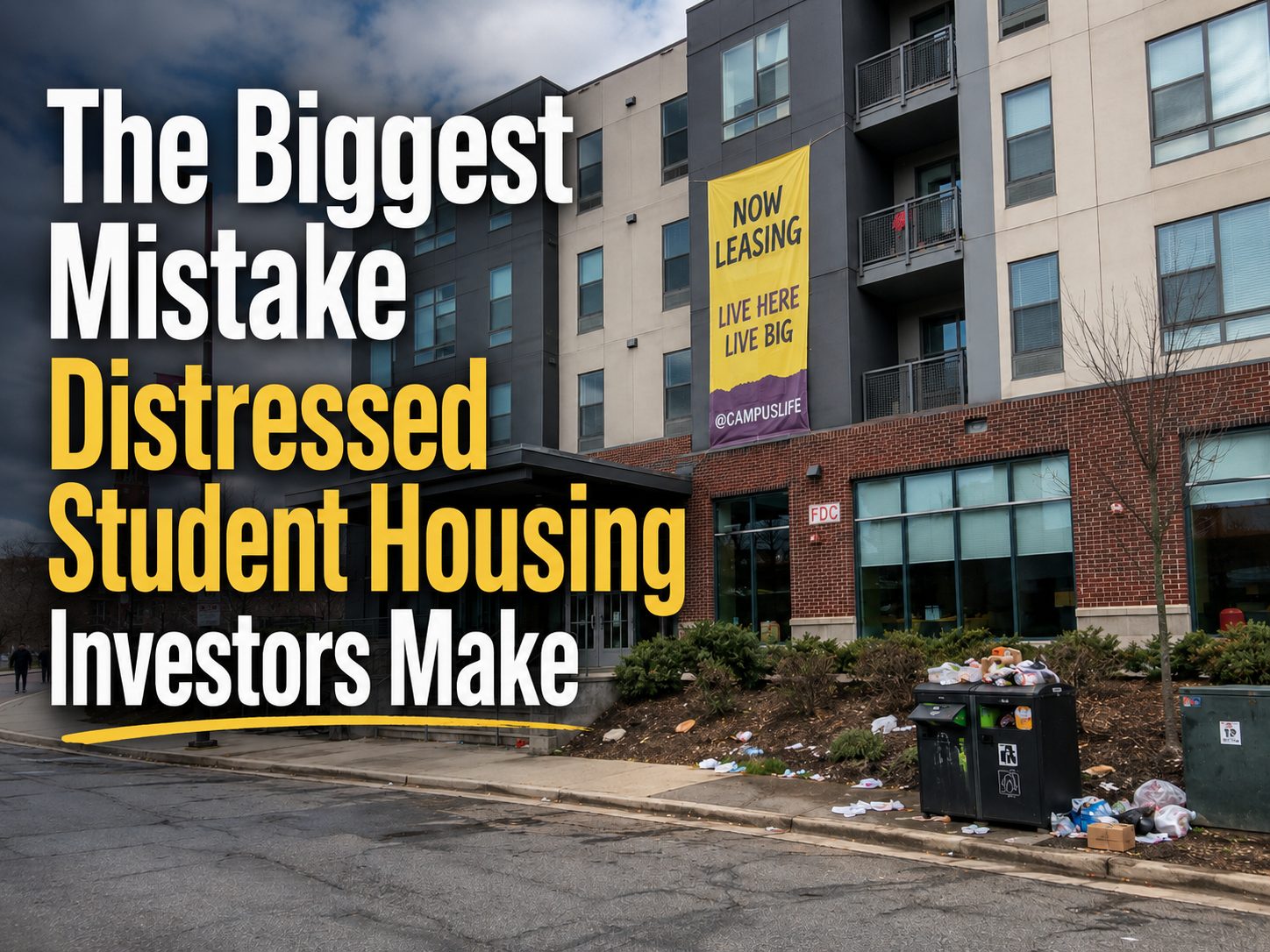
Buying below market cost per bed is necessary for distressed student housing deals – but it is nowhere near sufficient. The gap between those two things is where capital underperforms.
HH Red Stone, a property management company with experience in student housing acquisitions and operations, argues that the most common mistake distressed investors make is treating the discount itself as the investment thesis. Low cost per bed attracts capital. But without a clear diagnosis of what is actually broken and a specific operational plan to fix it, distressed deals frequently become value traps rather than value creators.
“The biggest mistake is assuming the discount is the strategy,” HH Red Stone says. “Buying cheap is not enough.”
Operational Problems Are Fixable. Structural Problems Are Not.
HH Red Stone draws a clear line between two categories of distressed assets and argues that the entire investment thesis depends on which category a property falls into.
Operational problems – poor management, weak leasing strategy, pricing mistakes, reputation damage, bad communication, poor turn execution – are hard but fixable with the right plan and team. A property underperforming because of these factors can represent a genuine opportunity.
Structural problems are different. Bad location, obsolete layouts, significant deferred maintenance, life safety issues, a market that does not support the housing type, or a cost basis that still does not work even after the discount – these are problems the market has often already correctly identified and priced. Buying them cheaper does not change the underlying rejection.
“Low cost per bed by itself does not make a deal attractive,” HH Red Stone says. “You have to understand why it is low.”
This diagnostic question – operational or structural? – is, in HH Red Stone’s framing, the most important work that happens before any distressed acquisition. Investors who skip it, or who answer it optimistically without evidence, are the ones who end up carrying underperforming assets through multiple leasing cycles.
The Chain of Compounding Problems
Distressed student housing assets rarely have a single identifiable problem. More often, according to HH Red Stone, they have accumulated a chain of smaller problems that compounded over time – delinquency that was not addressed, maintenance that was deferred, a leasing strategy that was never updated, a reputation that deteriorated without anyone responding.
This matters for underwriting because the fix is rarely as simple as replacing management or refreshing marketing. The new operator inherits not just the current state of the asset but the accumulated consequences of decisions that were not made – and in student housing, those consequences can take more than one leasing cycle to fully unwind.
“A lot of distressed assets do not have one problem,” HH Red Stone says. “They have a chain of small problems that have been allowed to compound.”
HH Red Stone argues that the first move after acquisition should be diagnosis, not renovation. Before capital is deployed, the operator needs a clear picture of the real leasing position, rent roll quality, delinquency, concessions, renewal performance, maintenance backlog, online reputation, staffing, traffic sources, and how the property compares to its competitive set. Only after that diagnosis can a credible operating plan be built.
The Timing Risk Distressed Investors Underestimate
The student housing leasing calendar is compressed and largely unforgiving. Properties lease for the following academic year within a defined window, and if an operator misses that window – because the acquisition closed late, because the diagnosis took longer than expected, because the leasing strategy was not in place – the mistake does not get corrected until the following year.
“In student housing especially, timing is unforgiving,” HH Red Stone says. “If you miss the leasing window, you may be carrying that mistake for an entire academic year.”
This creates a compounding risk that does not exist in the same way in conventional multifamily. A distressed conventional apartment can be stabilized on a rolling basis as units turn over. A distressed student housing asset that misses its leasing window is locked into underperformance for twelve months – with all the carrying costs, reputation consequences, and deferred value creation that entails.
HH Red Stone argues that sophisticated distressed investors price this timing risk explicitly. They know when the leasing window opens, they know what has to be true operationally before that window, and they structure their acquisition and transition timelines accordingly.
Value Creation Through Operations, Not Renovation
HH Red Stone’s distressed acquisition approach centers on operational improvement rather than capital-intensive renovation. Buyers at exit are paying for stabilized income, clean operations, and a believable rent roll – not for fresh paint or new furniture. Value creation happens by improving leasing strategy, reducing concessions, increasing renewals, cleaning up bad debt, improving utility recovery, adding systematic ancillary revenue, and making targeted improvements in areas where residents actually notice.
“The goal is not to make the asset look expensive,” HH Red Stone says. “The goal is to make the asset operate better.”
The exit story is built on demonstrated operational performance. A property that can show NOI growth, stabilized occupancy, controlled expenses, and a clear market position is a compelling acquisition for the next buyer, regardless of whether it received a full renovation.
HH Red Stone‘s perspective suggests that the distressed student housing opportunity set is real but narrower than the volume of capital chasing it implies. The deals that work are the ones where investors accurately distinguish operational problems from structural ones, build a specific plan before closing, and execute against the leasing calendar with precision. The deals that fail are the ones where the discount was mistaken for the strategy.
HH Red Stone is the property management arm of HH Group, managing approximately 10,000 beds across multiple asset classes, including student housing, multifamily, affordable, and mixed-use properties nationwide. After a decade of exclusively managing HH Group’s owned portfolio, the company launched its third-party management vertical to serve other owners with the same institutional-grade approach it applies to its own assets. HH Red Stone’s operating philosophy centers on “functional hospitality” – treating residents as CEOs and maintaining operations with the discipline and consistency that drives sustainable success.
This article is intended for informational purposes only and does not constitute legal, financial, or investment advice. The views and opinions expressed herein reflect those of the individuals quoted and do not represent an endorsement of any company, product, or service mentioned. Readers should conduct their own due diligence and consult qualified professionals before making any investment decisions.