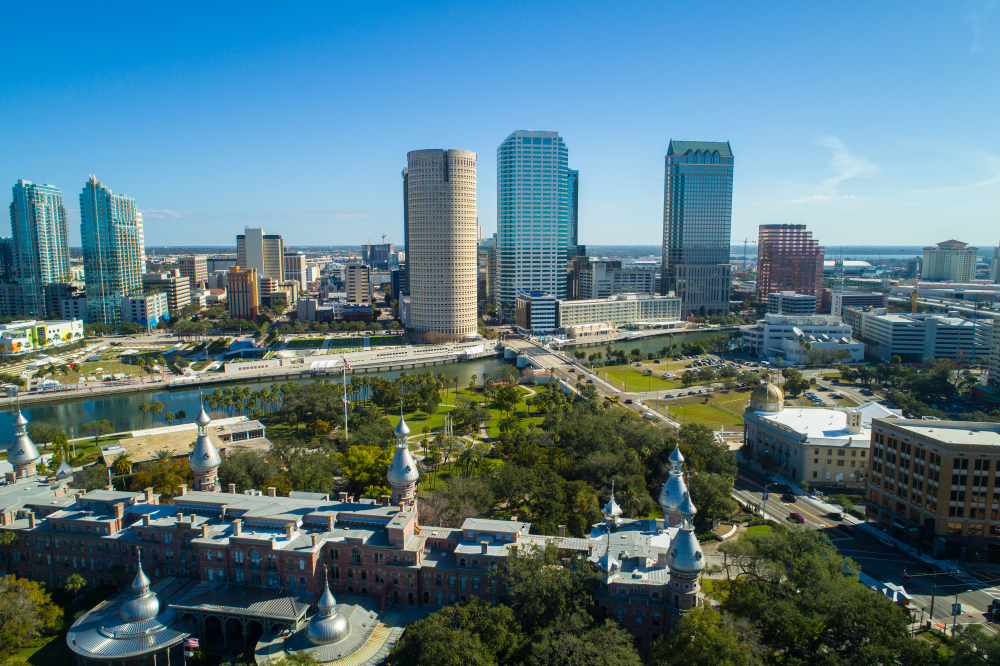
Daven Henry, a licensed real estate specialist at LPT Realty, says Tampa’s most profitable investment opportunities are no longer in the city’s established neighborhoods. Henry points to overlooked areas near major development projects that are still under construction. His core argument: once a neighborhood’s appeal becomes obvious, the biggest gains are already gone.
“You gotta focus around those areas that haven’t got populated, because now you can’t buy anything near Armature Works — everyone’s already been there, but Gas Works isn’t done yet,” Henry says. He targets neighborhoods on the edge of large, unfinished developments, investing before widespread recognition drives up prices. This strategy relies on identifying a window after infrastructure investment is underway but before the market has fully priced in future value.
How Development Drives Appreciation
Henry points to Tampa Heights as a clear example. When Armature Works, a major mixed-use development, opened in 2018, nearby Tampa Heights saw a surge in home values. Investors who bought in before the project was complete secured substantial appreciation. Those who waited until the development was finished paid much higher entry prices, leaving little room for further gains.
“The fringes in between those, like Riverside Heights, Tampa Heights — because Armature Works blew up, then Tampa Heights blew up,” Henry says. He describes a recurring sequence: a major development is announced, construction begins, the project is completed, and the surrounding neighborhood appreciates. This cycle creates a window for investors willing to act before the transformation is widely recognized.
Currently, Henry focuses on properties near Gas Works, an ongoing development in Tampa’s Channel District. He also invests on the edge of Ybor City, close to Water Works and downtown Tampa, where billions of dollars have been committed. The full impact on surrounding neighborhoods is still unfolding.
“The locations that I like are Ybor fringes, because it’s on the outskirts of Water Works and downtown, and billions have been put into those areas,” Henry says. “There’s still that gap of completion and finished product and growth.”
Established Neighborhoods Offer Less Upside
Henry draws a clear line between investing in proven, stable neighborhoods and positioning for the next phase of appreciation. Areas like South Tampa, Carrollwood, and East Tampa offer stability but not significant upside. For investors seeking strong returns, these neighborhoods represent safety, not opportunity.
“Those are areas that have been there forever,” Henry says of Tampa’s established neighborhoods. Investors looking for appreciation must accept higher initial risk by buying in areas where change is underway but incomplete. This approach requires confidence and patience during the construction phase, when a neighborhood may still seem transitional.
Local knowledge is essential. Outside investors often arrive late, after a neighborhood’s transformation is obvious and prices have already risen. At that stage, future returns are compressed. Investors who lack familiarity with Tampa’s development pipeline and neighborhood dynamics are unlikely to spot these openings early enough to benefit.
“You’ve got to go five to 10 years ahead,” Henry says, describing the long-term perspective needed to capture meaningful appreciation.
A Repeatable Fringe Strategy
Henry has applied this strategy in his own rental portfolio, concentrating on properties adjacent to major developments rather than within completed projects or already-popular neighborhoods. He sees this as a repeatable model, provided investors can accurately identify which projects will be completed and which neighborhoods will experience real change.
This approach carries risk. Not every announced development is finished, and some neighborhoods fail to transform even if adjacent projects succeed. Investors must evaluate whether a development has enough capital, political backing, and market demand to reach completion. They also need to assess whether the surrounding area has the fundamentals — walkability, solid housing stock, and proximity to jobs — that will attract residents once the project opens.
Henry mitigates some of this risk by focusing on fixer-uppers and distressed properties in fringe areas, allowing him to buy at lower prices and create value through renovations. “I’ve always loved the whole wholesale and the fixer-uppers and properties that were distressed and have equity and both parties win,” he says. By improving undervalued properties in neighborhoods likely to appreciate, he benefits from both property upgrades and broader neighborhood transformation.
Where Tampa Returns Are Headed
As Tampa, Florida continues to attract new residents and major investment, Henry’s strategy points to where the next wave of returns may be found. Rather than chasing fully realized developments, he argues that investors should position themselves in overlooked neighborhoods where infrastructure spending is already committed but the market has not yet priced in future appreciation.
For investors willing to study the development pipeline, take calculated risks, and commit to a longer time horizon, Tampa’s fringe neighborhoods could offer the strongest opportunities for growth in the years ahead.