Sedona’s broader housing market has gone soft. Existing homes now sell below replacement cost, and high interest rates and elevated prices have left most buyers with limited purchasing power, according to Paul Galloway, broker at Galloway Realty and builder with Galloway Custom Homes in Sedona. But at the very top, new construction at $1,000 to $1,200 per square foot, the upper limit of the Sedona market, has stayed active. Demand there comes from wealthy baby boomers buying second, third, and fourth homes. For Galloway, who now builds more than he brokers, that split determines when to break ground, what to build, and who to build for.
Galloway has brokered residential real estate in Sedona for more than two decades and now focuses primarily on luxury custom home development. His current project, Sky Ridge Estates, is a 19-lot subdivision in central Sedona where he plans a residence club. In that hospitality-style model, homes will rent at resort-level rates of around $3,000 per night, supported by amenities like room service and a clubhouse. He expects to break ground on homes there within six months, with construction taking roughly two years.
Building Into a Downturn
Galloway’s timing rests on his read of the economy: he believes the country has entered a recession, though official GDP figures have continued to show growth. “I think we’re in a recession right now,” he says. “I really do. They’re not going to talk about it for a while, but I’ve been through enough of them.”
His response is to build, not wait. In his view, labor and materials cost less during downturns, and a two-year build cycle means finished homes arrive as conditions improve. “You want to build and develop in a recession because labor is cheaper and materials,” he says. “When they come on in two years, I’m hoping this recession will be passed and things will be coming back.”
He acknowledges the risk plainly. “It’s very speculative, just so you know. It’s risky.”
That willingness to break ground during a pullback reflects a longer view of market cycles. Over 30-year periods, Galloway says, markets move “two steps forward, one step back.” He believes the current period is that one step back, and that building now positions finished inventory for the next upswing.
Who’s Still Spending
The bet works only because a specific group of buyers keeps spending through the slowdown. These are baby boomers with net worths well above $10 million who pay cash for homes they may occupy for only a few months each year. They are not sensitive to interest rates and are not looking for bargains.
“They don’t care about interest rates – they pay cash,” Galloway says. “They’re not even going to live in the home. It’s like a third home.”
He describes showing clients a $2 million existing home at $500 per square foot, a beautiful property available at a fraction of new construction costs, only to have them decline. “They go, ‘Nah, we want brand new.’ They’ll pay twice that. They want brand new contemporary.”
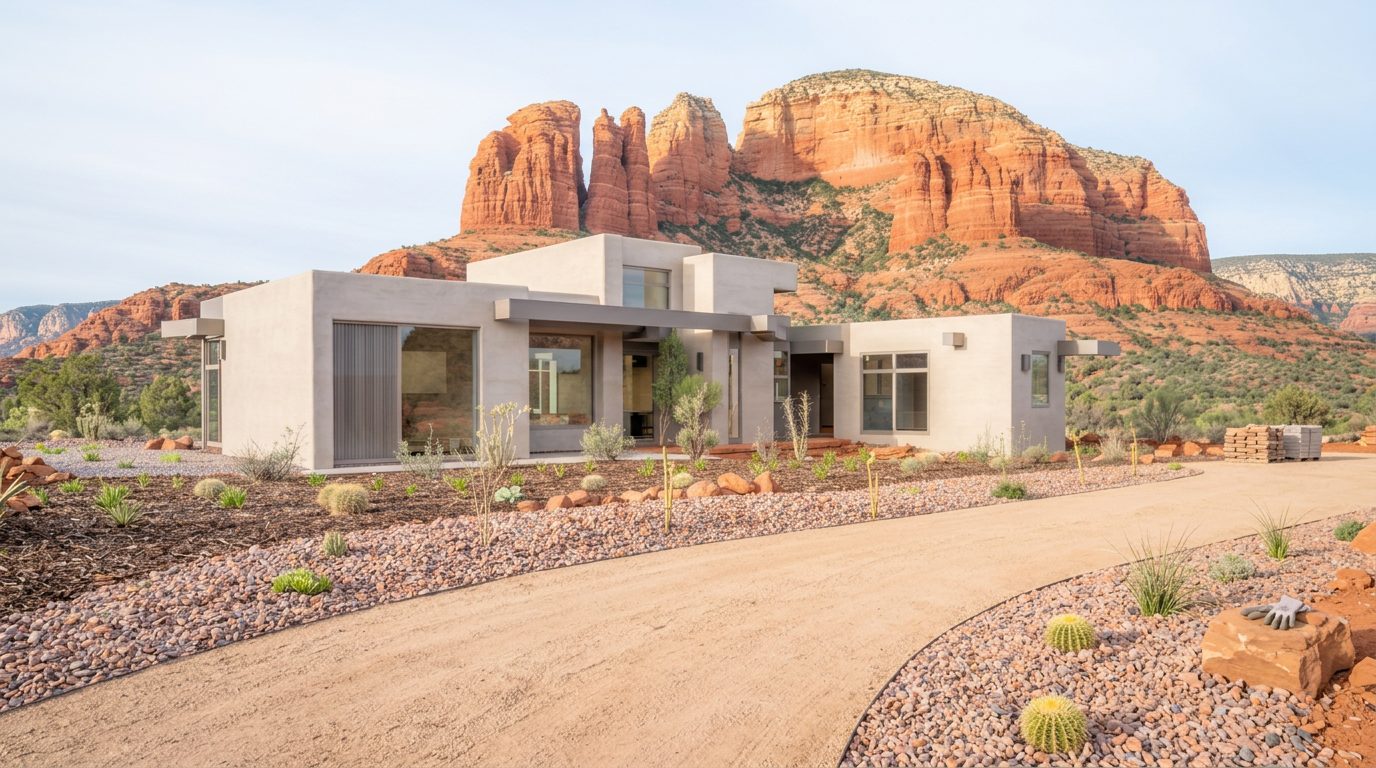
That preference also defines what Galloway builds. Buyer taste has moved decisively toward contemporary design, with steel, glass, and minimalist finishes replacing the Tuscan aesthetic that dominated Sedona for years. Galloway now builds almost exclusively in this style, drawing on newer, more efficient building materials entering the market.
The willingness to pay a premium for new construction is what makes the economics work. Between land and construction, Galloway estimates roughly $1 million in net profit per home on builds in the $4 million to $5 million range. Matching that return through brokerage alone would require $40 million in sales volume, he says.
The wealth driving this segment stands in sharp contrast to conditions elsewhere in the market. “That really high-end market all over the country is driven by these rich baby boomers,” Galloway says. Meanwhile, he adds, “the other 99” percent of buyers face a much harder environment.
A Regional Corridor Taking Shape
Beyond the buyers themselves, Sedona’s luxury market draws strength from its proximity to a growing economic center. Galloway points to the Phoenix area’s expanding semiconductor industry as a driver of regional job growth that is pulling high-net-worth buyers northward.
“People are realizing that Sedona is an hour and 45 minutes away,” he says. “They want that country life.” Part of the appeal is climate: Sedona’s higher elevation keeps summer temperatures roughly 10 to 15 degrees cooler than the Phoenix metro. Part of it is cost. New builds at $1,000 to $1,200 per square foot in Sedona compare favorably to Paradise Valley, where Galloway says comparable construction trades at $1,500 to $1,600 per square foot and available lots have essentially disappeared. Builders there now purchase tear-downs at around $5 million each just for the land.
A friend of Galloway’s recently bought eight such properties in Paradise Valley in a single week. All are older homes he plans to demolish and replace with roughly 10,000-square-foot houses selling at $15 million each. That market, Galloway says, is holding up even as the rest of the residential sector slows.
A Buyer’s Window
For buyers outside the ultra-luxury segment, the same pullback that makes building attractive creates an opportunity. “Good buyer’s market. Time to make a low offer,” Galloway says. He estimates the window could last another year to 18 months before prices level out. “If you’re going to buy a house, the next year is a good time.”
Homes in Sedona are currently available below replacement cost, meaning a buyer can purchase an existing property for less than it would cost to build the same house today. Galloway’s own development timeline mirrors this window: build while costs are lower, finish when the market stabilizes. “Keep an eye on it though,” he says. “See if it keeps coming down.”
About the Expert: Paul Galloway is a broker at Galloway Realty and a luxury custom home builder with Galloway Custom Homes, based in Sedona and Scottsdale, Arizona.
This article is based on information provided by the expert source cited above. It is intended for general informational purposes only and does not constitute legal, financial, or real estate advice. Readers should conduct their own research and consult qualified professionals before making any real estate or financial decisions.