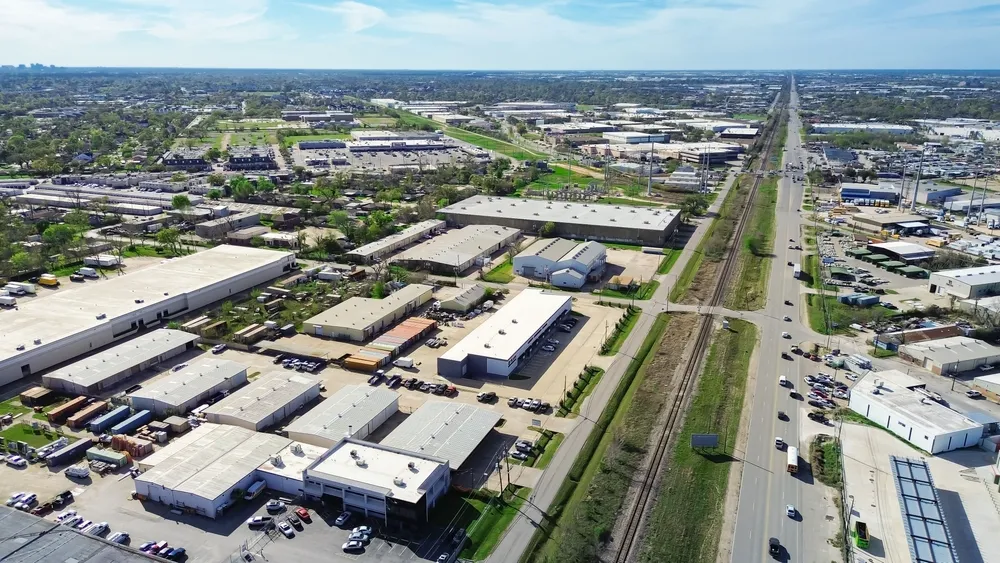
Interest rates get most of the blame when commercial real estate deals stall. But in Houston’s industrial market in 2026, a different problem is collapsing deals that survive months of due diligence: federal policy that changes direction without warning. According to Shahin Naghavi, Managing Partner and Principal Broker at Riverside Equity Group, a boutique firm focused on industrial flex and land development across greater Houston, deals are falling apart because buyer confidence evaporates overnight, not because the underlying numbers changed.
Naghavi says he has watched this pattern repeat throughout the first half of 2026, with “quite a few transactions fall through at the 12th hour.” Financing or investor nerves are usually the visible cause, but government policy is what sets them off. He describes the environment bluntly: “Today, there’s a tariff. Tomorrow, there isn’t. Today, there’s a war. Tomorrow, there’s not.”
For anyone trying to buy or sell industrial property in Houston right now, this means longer timelines, higher fall-through rates, and the real possibility that a deal under contract will unravel for reasons entirely outside either party’s control. Sellers who take their property off the market after going under contract may find themselves having to restart the process from scratch. Buyers who hesitate may find the next opportunity harder to locate in an already inventory-starved market.
Who Gets Hit Hardest
The uncertainty disproportionately affects small and midsize operators. A national logistics company with diversified supply chains can absorb a shift in tariffs. A local manufacturer who imports raw materials from a single source cannot. These smaller operators are precisely the buyer pool that dominates Houston industrial transactions right now. Naghavi notes that most current purchasers are owner-occupants who need the space for their own business, not institutional investors. That makes sense financially, since an investor typically cannot make the numbers work at current interest rates. At the same time, an owner-occupant has an operational need that justifies the purchase regardless of cap rate math.
High interest rates compound the problem but are not its root. Rates move in known directions on known schedules. Policy whiplash offers no such clarity. A buyer cannot price in a tariff that may or may not exist next week or model the cost impact of a trade war that starts and stops without warning.
Why Inventory Makes Waiting Risky
Naghavi says people looking to invest in Houston industrial properties are often surprised by how little is available for sale. Investors expecting a selection comparable to retail centers find far fewer options and often worse condition than anticipated. The lack of inventory is already a constraint, and when confidence does return, pent-up demand could collide with limited supply and push prices higher.
This scarcity also means listings that do come to market often move fast, sometimes drawing competing offers within days rather than the weeks sellers might expect in a slower cycle. For buyers still weighing whether to wait out the policy uncertainty, that speed itself signals that hesitation carries a real cost, not just a theoretical one.
There is no clean path here. Acting now means accepting elevated uncertainty. Waiting means betting that the right property will still be available when confidence returns, in a market that already offers little to choose from.
Where Demand Persists
Even in this climate, well-located industrial property still attracts serious interest. Naghavi identifies West Houston and the ship channel corridor as the strongest submarkets. The ship channel serves as a major logistics hub, while suburban western markets serve transportation and distribution needs. In both areas, deals are still getting done; they just take longer to reach closing.
Much of this resilience comes down to buyer type rather than location alone. Owner-occupants in these corridors are typically driven by regional distribution or operational needs rather than international trade exposure, which insulates them somewhat from the tariff and geopolitical swings rattling other buyers.
When Confidence May Return
Naghavi points to 2027 or 2028 as a more realistic window for a pickup in development and acquisition activity, not necessarily because interest rates will be dramatically lower, but because the policy environment may settle enough for buyers and developers to commit with confidence. “We really need consumer confidence to kind of come into the market,” he says.
That timeline tracks a broader pattern in how Houston’s industrial growth tends to unfold. Light industrial development typically follows residential rooftops, with master-planned communities drawing retail first and industrial space arriving once population and consumer demand are established in an area. Until then, the same policy unpredictability rattling buyers today is likely to keep new development decisions on hold as well.
For buyers and sellers navigating this market through the rest of 2026, the practical adjustment is building longer contingency timelines into contracts and accepting that some deals will stall or fail for reasons unrelated to the property itself. The person on the other side of a transaction may be just as exposed to tomorrow’s headlines, and just as likely to flinch.
About the Expert: Shahin Naghavi is Managing Partner and Principal Broker at Riverside Equity Group, a Houston-based firm operating across both industrial real estate development and brokerage with a focus on flex and light industrial space.
This article is intended for informational purposes only and does not constitute legal, financial, or investment advice. The views and opinions expressed herein reflect those of the individuals quoted and do not represent an endorsement of any company, product, or service mentioned. Readers should conduct their own due diligence and consult qualified professionals before making any investment decisions.