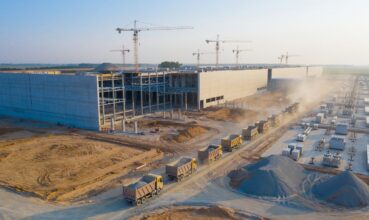
Policy uncertainty and shifting market forces are slowing U.S. construction activity, even as companies across the industry report healthy balance sheets. Developers are holding off on new projects, waiting for clearer signals on economic and regulatory policy before breaking ground.
Eric Gaus, chief economist at Dodge Construction Network, has tracked this shift using an extensive database of nationwide construction activity dating to 1967. The long-term data allows analysts to measure how policy-driven uncertainty is disrupting traditional market cycles and slowing the pace of construction.
Long-Term Data Reveals Shifting Timelines
Dodge Construction Network data offers a detailed view of how projects move from planning to groundbreaking.
According to Gaus, decades of data allow for a deeper understanding of how market forces play out over time. This historical insight is especially important during periods of uncertainty, when standard market indicators may not reflect conditions on the ground. The firm’s clients include building products manufacturers, equipment rental firms, and commercial real estate financiers — businesses that rely on accurate data to make informed decisions across the construction value chain.
Policy Delays Project Timelines
While much of the public discussion about construction focuses on interest rates and material costs, Gaus points to economic policy uncertainty as the main factor slowing the industry today. The time between identifying a project and breaking ground has steadily increased across all sectors.
Gaus attributes this delay largely to policy announcements, such as tariffs and trade negotiations, that have unsettled market confidence. Each round of policy changes and reversals has made developers more cautious, stretching timelines for breaking ground.
Instead of advancing multiple projects at once, many are now concentrating on fewer, higher-certainty initiatives. This reflects a shift from aggressive expansion toward risk management, as firms prioritize projects with more predictable returns.
Regional Labor Gaps Persist
Labor availability remains a challenge, but the impact of immigration enforcement and workforce trends varies sharply by region and trade. In states like Florida, Texas, California, Pennsylvania, New Jersey, and New York, about half of construction workers are foreign-born. In contrast, many Midwestern and Northern states see single-digit percentages.
The effect is also uneven across types of work. Trades such as roofing, siding, and masonry rely more heavily on foreign-born labor than certified or licensed specialties. As a result, some subcontractors in certain trades and regions face significant shortages, while general contractors may not feel the impact as directly. This disconnect can lead to differing views on labor conditions within the construction hierarchy.
Sector Activity Varies Widely
Not all parts of the construction market are moving at the same pace. Over the past year, multifamily housing, warehouses, and manufacturing projects have slowed substantially. This drop-off is most pronounced in markets that saw rapid pandemic-era growth and are now adjusting to post-boom conditions.
In contrast, retail and hospitality construction has seen some improvement, but much of this activity is driven by renovations rather than new builds. Renovation projects move through planning and permitting faster, which can suggest a market rebound without a real increase in new construction starts.
Mega-Projects And Local Markets
A notable trend shaping local construction markets is the emergence of billion-dollar projects, especially in data centers, energy, and healthcare. Recent examples include hospital projects exceeding $4 billion, such as one in Texas last year. These developments have disproportionate effects on local labor markets and supply chains, often absorbing significant resources and disrupting nearby smaller projects.
The presence of mega-projects can create a fragmented market. In some areas, suppliers and subcontractors report a shortage of orders, while others face overwhelming backlogs tied to high-profile developments. This uneven distribution complicates planning for suppliers and contractors, making resource and timeline forecasting more difficult.
Key Risks on the Horizon
Several major events could significantly alter construction activity. Sustained oil prices above $100 per barrel would raise costs across the industry, as construction depends heavily on diesel for machinery and transport.
Two developments expected in mid-2026 could be especially important. First, USMCA recertification could affect the flow of critical materials, particularly Canadian lumber used in residential construction. Second, changes in Federal Reserve leadership could introduce new uncertainty around monetary policy, affecting financing costs and market stability.
Gaus outlines three possible outcomes for the Federal Reserve transition, ranging from a smooth handover to scenarios that could raise concerns about central bank independence. Each possibility carries different implications for construction financing and investor confidence.
Forecasting Tools Get an Upgrade
Dodge Construction Network is responding to market volatility by upgrading its forecasting tools. The move is toward monthly predictions instead of quarterly updates, with scenario analysis covering conditions such as sustained high energy costs or varying rates of AI adoption.
Rather than replacing human expertise with AI, Dodge Construction Network says the focus is on using technology to enhance efficiency and support better decision-making. The goal is to provide more timely and actionable insights while maintaining the value of experienced analysts’ interpretation of results.
Strong Balance Sheets, Cautious Outlook
Despite the current slowdown, most construction firms are in a strong financial position. Gaus says company balance sheets remain healthy, positioning the industry to ramp up quickly once external uncertainties such as policy changes and economic volatility are resolved.
“The financial positions of pretty much every business in the construction industry are very strong. The problem is just being able to push stuff out the door.” — Eric Gaus, chief economist, Dodge Construction Network.
The industry’s challenges stem not from internal weaknesses but from the broader economic and policy environment. When policy clarity returns and market confidence improves, construction activity could rebound sharply as firms deploy available capital. For now, decision-making remains cautious, and many projects are on hold until there is greater certainty around costs, regulations, and financing conditions.
What This Means for Professionals
For real estate and construction professionals, understanding these dynamics is critical. The current environment calls for more careful project timing, realistic market positioning, and flexible planning. Traditional indicators may not fully reflect the complexity of today’s market, making it essential to monitor both policy developments and sector-specific trends.
The industry’s ability to adapt to evolving risks from policy, labor, or supply chain disruptions will determine how quickly construction activity recovers. Those with the best data and most adaptable strategies will be best positioned to seize opportunities when the market turns.
About the Expert: Eric Gaus is the chief economist at Dodge Construction Network, where he analyzes nationwide construction activity using one of the industry’s most comprehensive databases of project data. His research focuses on how broad economic and policy trends translate into real-world construction activity across commercial and residential sectors.
This article is based on information provided by the expert source cited above. It is intended for general informational purposes only and does not constitute legal, financial, or real estate advice. Readers should conduct their own research and consult qualified professionals before making any real estate or financial decisions.