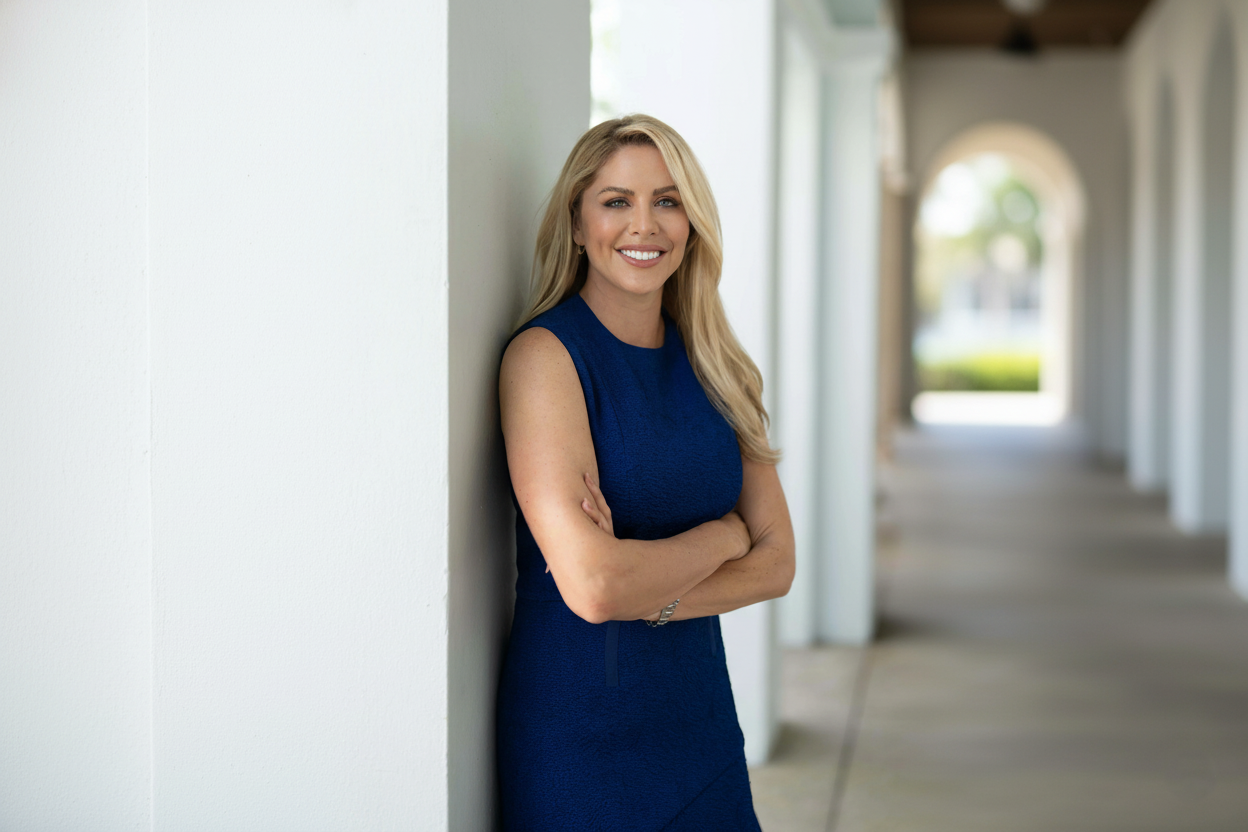
The ongoing transformation of Palm Beach County into what locals now refer to as “Wall Street South” continues to reshape Florida’s luxury real estate market, according to Jessica Julian, a luxury real estate specialist working with Douglas Elliman who has observed the region’s evolution over the past 12 years.
Julian, who works closely with hedge fund executives and private equity professionals through her partnerships with the Palm Beach Hedge Fund Association and Wall Street South, says the financial sector migration to South Florida remains strong despite broader economic uncertainties.
“It is not decelerating at all,” Julian says. “If you read the headlines, you’ll see we have developers here that are very bullish on what West Palm Beach can be and Palm Beach County in general. They’re still building buildings for office space, and they’re still promoting these companies to move here.”
Recent announcements, including a major firm bringing about 10,000 jobs to the West Palm Beach area, highlight the continued corporate expansion in the region. This ongoing growth challenges the notion that the post-pandemic migration wave is slowing down.
Breaking with Seasonal Norms
Traditional seasonal patterns in the local real estate market, which typically see slower activity during the summer, have been disrupted by persistent demand. Julian notes that this past summer exceeded expectations, with 13 houses going under contract within a two-week span in just a 1.5-mile radius of West Palm Beach.
“We’re past that COVID hangover, and you would think we’re going to pre-pandemic type seasonality where summers are usually slower, but we’ve had quite a few sales,” she says. “I have a feeling it’s going to be a busy season this season.”
The luxury segment, particularly properties over $10 million, experienced a 21% increase in sales last year. Julian attributes this growth in part to new construction.
“Buyers are willing to pay higher prices for something turnkey, brand new, absolutely,” Julian says. “We have a lot of new construction that has come out and is available now because developers were buying these little houses and tearing them down. In the last couple years, they’ve been building these new construction homes in that price point.”
Profile of the Ultra-Wealthy Buyer
Working with C-suite executives and financial professionals has given Julian insight into how this demographic approaches real estate. These buyers expect a seamless process and often rely on house managers, estate managers, or assistants to handle transactions.
“They’re looking for that experience. They want to know that you know exactly what you’re doing and you’re leading them to exactly what they’re looking for,” Julian explains. “Those C-suite executives are usually the best in their field, and they want to be working with somebody that’s equally the best in my field.”
Interest rates, which have affected many segments of the real estate market, have minimal impact on these buyers. Julian notes that ultra-wealthy purchasers view current rates as moderate and make financing decisions based on opportunity cost rather than monthly payments.
“They realize that this is a pretty moderate interest rate. It’s really the lower price point buyers that are worried more about this interest rate because they’re counting every penny,” she says. “For wealthier buyers, it’s an equation: can their money make more money in the market somewhere else? If the answer is no, or it’s even, then they’ll use the bank money.”
Beyond Tax Incentives
While Florida’s tax advantages are a significant draw, Julian identifies other factors influencing the migration. Political environment concerns, particularly regarding policies in states like New York, continue to drive relocation decisions. The recent wealth tax discussions in New York have generated considerable attention among her Florida-based clients.
Quality of life is also a major factor. “Our quality of life here is pretty amazing. I’ve lived in five different states, and I feel like we’re in a bubble, a beautiful bubble of a little slice of paradise,” Julian says. “You can still work, you get a lot done, you can still make a lot of money and be very successful. And then you’re also golfing and tennis, and you’re on the boat, and we have the ocean.”
Insurance and Hurricane Issues
Despite media coverage of insurance challenges and hurricane risks, Julian reports these concerns rarely stop transactions. Out-of-state buyers express more concern than Florida residents, who have become accustomed to hurricane warnings.
“People that have lived in Florida a long time know they have hurricane parties instead of getting worried about it,” she says. “The very wealthy typically just self-insure. If something happens, they’re going to pay for it.”
For those who do require insurance, Julian has not encountered significant obstacles in securing coverage, though costs vary depending on property condition and age. New construction homes with impact windows and updated systems often command lower insurance premiums, increasing their appeal.
Market Preferences and Pricing
The luxury market shows a strong preference for turnkey properties. Older homes requiring updates, especially those needing new roofs or impact windows, are spending more time on the market as buyers opt for move-in-ready options.
“The buyers I’ve been seeing really don’t want to do work on a house, especially those wealthy buyers. They want something turnkey,” Julian says. “I’m seeing older homes sit longer than they have during the years right after the pandemic.”
The price premium for Palm Beach Island compared to West Palm Beach remains significant. West Palm Beach offers value with larger lots and more new construction, while Palm Beach Island maintains its prestige.
“The island is still the main game at the end of the day,” Julian says. “There’s still that prestige to living there. If somebody says ‘I live in Palm Beach,’ and somebody goes ‘Well, where in Palm Beach, West Palm Beach or Palm Beach?’ They’re going to have little pinkies up: ‘Oh, Palm Beach.’”
Waterfront properties with direct boat access, despite their rarity, have not moved as quickly as expected. Properties priced in the high twenties with boats in the backyard are experiencing slower sales compared to water-view homes across the street that trade around $10 million.
Investment Activity and Long-Term Outlook
Beyond primary residences, Julian observes ongoing investment activity among high-net-worth clients. The region’s rapid growth has created opportunities for those looking to participate in the area’s expansion.
“Because we are growing so rapidly, people that can afford it want to be part of that,” she says. “If they see an opportunity to invest and be able to hold that asset while it grows around it, then they’ll do that for sure.”
Some neighborhoods are experiencing concentrated investment, with buyers acquiring properties for both rental income and long-term appreciation as gentrification continues.
The market has also seen some adjustment as pandemic-era buyers who purchased second homes return to their primary markets due to return-to-office requirements. Julian notes several Chicago-based clients have sold their Florida properties as work obligations require their presence in their home cities.
Looking ahead, Julian anticipates continued growth driven by ongoing corporate relocations and the lifestyle advantages that initially attracted the financial community to South Florida. The infrastructure investments and office developments currently underway suggest the “Wall Street South” reputation will only grow.
For real estate professionals and investors, the Palm Beach phenomenon is more than a temporary migration, it signals a fundamental shift in how America’s financial elite view geography, lifestyle, and business operations in the post-pandemic era.
This article was sourced from a live expert interview.
Every month we conduct hundreds of interviews with active market practitioners - thousands to date.
“It’s just as easy to do something big as it is to do something small. So you might as well pursue something that truly excites you,” says Matthew Aitchison, quoting Blacks...
The transition from military service to civilian careers often presents challenges, but for Shane Burgman, his decade in the Navy provided a strong foundation for building a successful real ...
The broadcast media brokerage market has changed dramatically since the 2008 financial crisis. Transaction volumes have fallen nearly 80% from 2019 levels, and large-scale deals are far less...
As real estate fraud continues to rise, some companies are shifting from reactive alerts to proactive protection. EquityProtect is one such firm, aiming to detect and deter fraudulent activi...
Northern Nevada’s commercial real estate market is experiencing strong demand but faces significant headwinds from limited infrastructure and challenging financing conditions. Despite ...
“Housing is a day-to-day problem and an existential threat to the ability of so many residents to stay in the community they love,” says Jess Coleman, a City Council candidate fo...