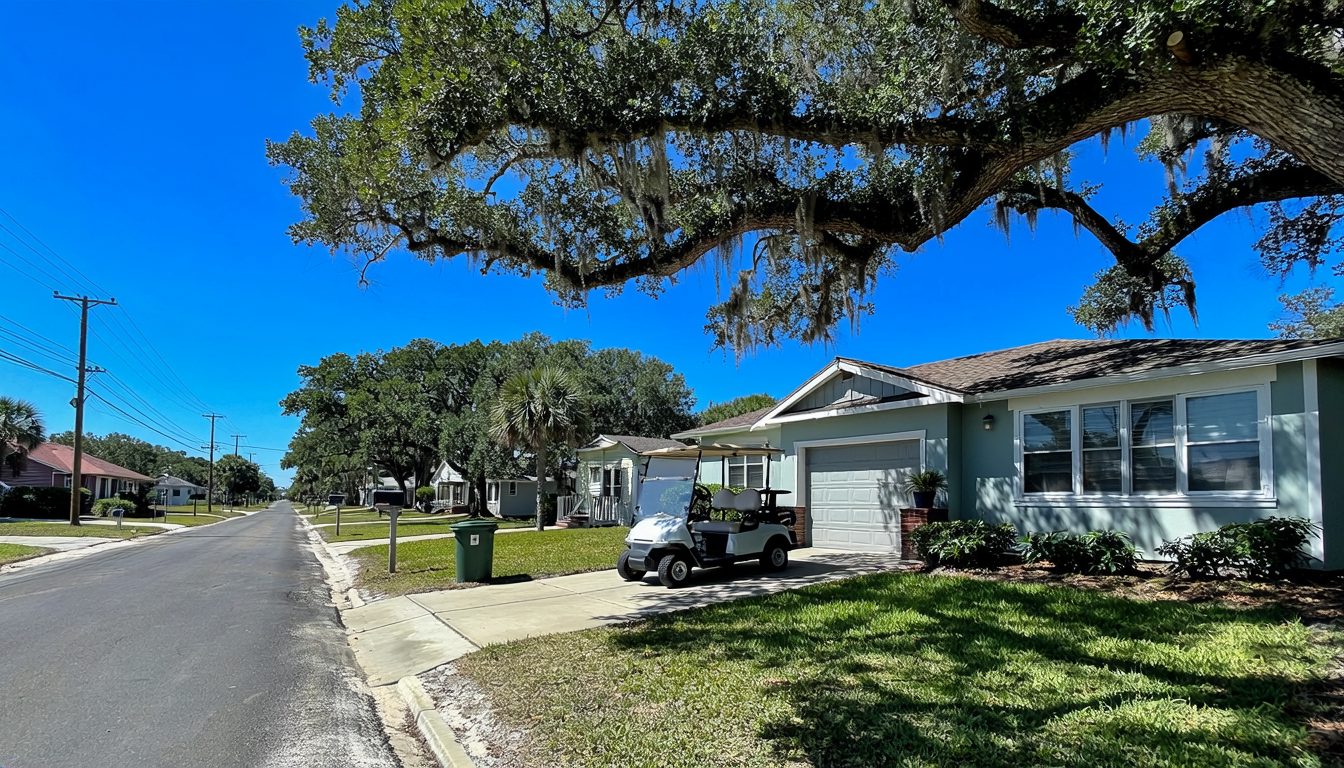
Age-restricted communities in Northeast Florida no longer belong only to retirees. In St. Johns County, some buyers who have barely reached the minimum age now treat these neighborhoods as a lifestyle choice: a smaller home, active amenities, and no yard to worry about while they travel.
Sarah Olson, a team leader at First Coast Collective with RE/MAX Unlimited in Ponte Vedra, sees the change in who is buying. “It’s just a lifestyle change for many,” she says.
Lifestyle, Not Retirement
Younger buyers have changed what a 55-plus community means in this part of Florida. Olson says the old assumption – that moving in means living among neighbors decades older – no longer matches who is buying. “It’s becoming a younger demographic buying into the neighborhood because the amenities they offer are very active,” she says.
Those amenities run well beyond a pool and a card room. Del Webb Nocatee’s 22,000-square-foot Canopy Club includes a zero-entry pool, pickleball courts, a fitness studio, and an on-site tavern and grill, and residents also share Nocatee’s greenway trails, kayak launch, and splash park.
The homes themselves suit buyers who spend part of the year elsewhere, including the seasonal residents Olson says the area draws each winter. Olson says houses in these communities run smaller and leave owners free of yard work. For people who like to travel, she adds, that arrangement comes close to ideal. “You can just pack up and go,” she says.
Federal law leaves room for that shift. Under the Housing for Older Persons Act, a community qualifies as age-restricted as long as at least 80% of its occupied homes have at least one resident 55 or older. A 53-year-old buying with a 55-year-old spouse fits that rule, though each community sets its own policies on younger residents.
Seasons Without the Extremes
The pull of these communities depends partly on where they sit. Northeast Florida gives buyers a gentler version of the state’s climate, with something close to real seasons. In late October, Olson says, the humidity has lifted, and that weather holds until about May. Climate records bear her out: the Jacksonville area’s hot season typically runs from late May to late September, while January highs average around 65 degrees.
That climate draws seasonal residents who want Florida without its hottest months. Many snowbirds, Olson says, choose not to go farther south because of the heat. She also passes along a local observation about who settles where: “The further south you go in Florida, the more northern it gets.”
Location offers another advantage. Olson says the area usually escapes the worst of the hurricanes that hit the Gulf Coast and southern Florida, and the historical record supports her. Hurricane Dora in 1964 remains the only hurricane on record to make direct landfall on Jacksonville, largely because the concave curve of the coast from northern Florida to South Carolina tends to keep storms moving parallel to shore.
However, that protection covers wind more than water. Hurricanes Matthew in 2016 and Irma in 2017 both caused serious flooding in Jacksonville without making landfall nearby, so flood-zone status still matters for any individual home. Beyond climate, the Jacksonville area offers professional football, an arts scene, golf, the ocean, and freshwater springs within reach for day trips.
Out-of-State Buyers
Climate and storm protection matter because so many of the area’s buyers come from somewhere else. Olson credits Florida’s tax advantages with drawing many of her buyers from out of state, and IRS migration data shows the scale of that movement: St. Johns County gained a net 10,642 residents through relocation in 2022–2023, with New York, California, and New Jersey sending the most.
What’s more, those newcomers arrive with more money than the residents they replace. Households moving into the county reported average incomes of $130,600, compared with $97,713 for those leaving – a gap that matters with Freddie Mac’s average 30-year fixed mortgage rate at 7.40% in mid-October, up from 6.34% a year earlier.
In Olson’s experience, the market has split along price lines as a result. “The higher price market has been pretty good,” Olson says. “The lower price is hard. It’s hard for a lot of people to afford housing anywhere.”
Growing Supply Tests Prices
That price divide bears directly on the 55-plus segment. Homes in these communities mostly sell well below $1 million – the median across the county’s tracked 55-plus communities is about $476,000 – which places them in the range where Olson sees affordability pressure falling hardest. Supply adds to that pressure. “There’s just been a lot of them available,” she says.
Builders keep adding to that supply. Construction began in 2024 on Del Webb St. Johns, a 55-plus community of up to 761 homesites in the northern part of the county. Prices in the established communities show the strain unevenly: over the past year, the median fell about 9% at Del Webb Ponte Vedra, Nocatee’s original, fully built-out 55-plus community, and at San Salito in St. Augustine, while it rose about 9% at the newer Del Webb Nocatee.
For buyers, the added supply means a good house in a 55-plus community at a reasonable price, according to Olson. For sellers, it means competing for buyers who, across St. Johns County, have grown less sentimental about what they buy. “Buyers don’t seem to be emotionally attached to houses anymore,” Olson says.
About the Expert: Sarah Olson is a real estate agent and team leader at First Coast Collective with RE/MAX Unlimited in Ponte Vedra, Florida. She works with buyers and sellers in St. Johns County.