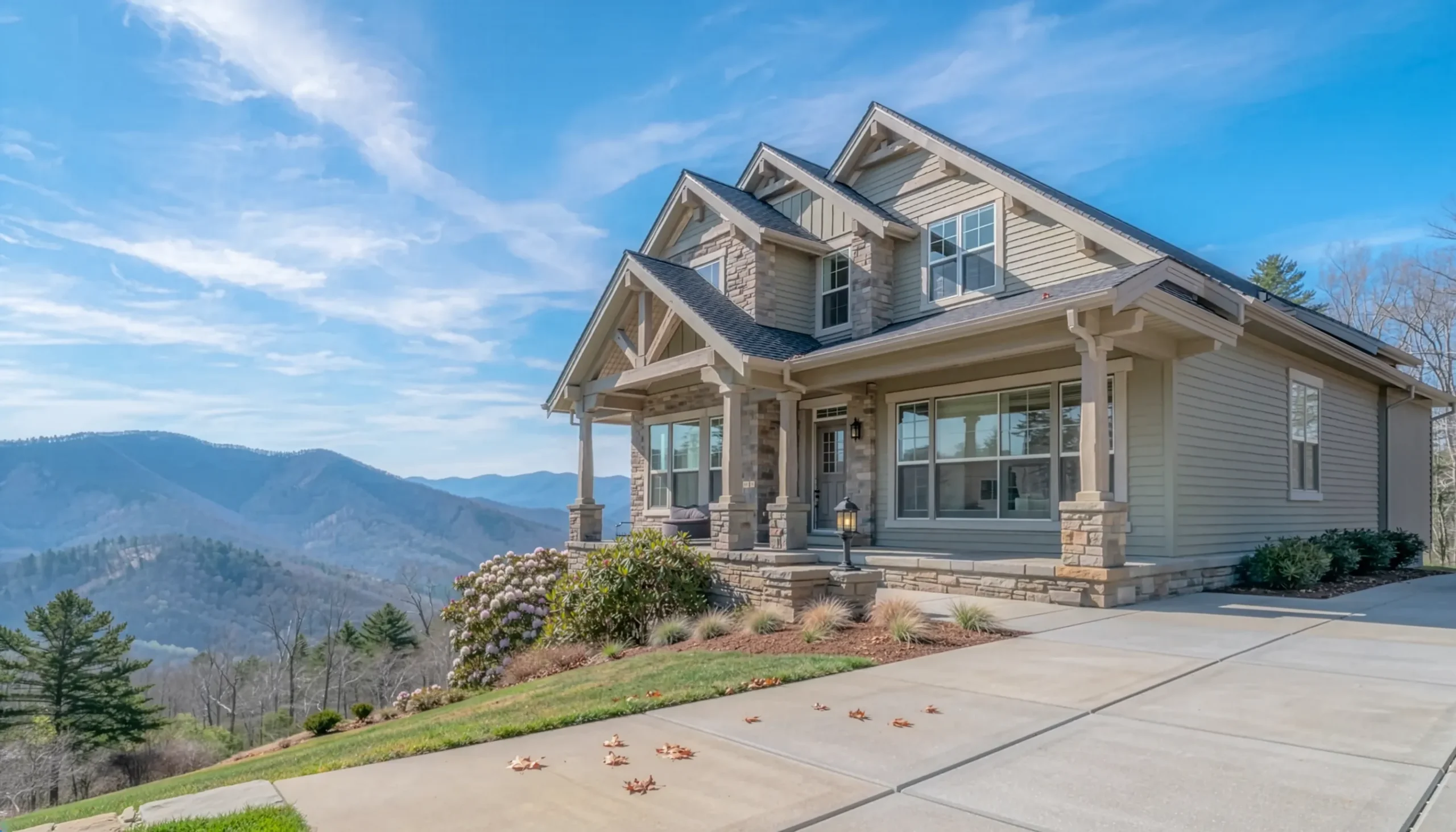
Most housing markets are shaped by job growth, commute patterns, and local wages. North Carolina’s High Country – anchored by Boone, Blowing Rock, and Banner Elk in the state’s northwestern mountains – operates on a different set of drivers. Roughly 75% of homes sold in the region are second or third homes, purchased by buyers who live elsewhere and visit seasonally, according to Leslie Eason, a 19-year veteran of the market and team leader at Keller Williams High Country. That ratio creates a market where transaction volume depends less on interest rates and employment than on discretionary wealth, lifestyle preferences, and how far buyers are willing to drive for cooler weather.
Eason says the region’s buyer base has shifted over the past decade. The traditional pipeline – retirees migrating from Florida, known locally as “halfbacks” because they started in the Northeast, moved to Florida, and eventually settled halfway back – has been supplemented by in-state buyers, particularly from Charlotte, about two hours south. “If you live in Charlotte, you can be two hours away, be here to your weekend home,” Eason says. “It’s a completely different world. It’s 15 degrees cooler.”
Where the Dollar Volume Comes From
The High Country’s total residential sales volume is approximately $1.2 billion, according to Eason – modest by metro standards, but the composition tells a specific story. Single-family home sales over $1 million account for about 24% of transactions in the two-county area that includes Boone, Blowing Rock, and Banner Elk, yet they represent 54% of total dollar volume. The market’s financial weight sits in the luxury segment, and many of those transactions are cash purchases.
That concentration has practical consequences. Luxury cash buyers are less sensitive to interest rate movement, which insulates the upper end from the financing headwinds affecting buyers in the $500,000 to $700,000 range. Those mid-range buyers – often purchasing their first second home with a mortgage – feel rate changes directly. “Interest rates mean a lot for the people who are dabbling in their first second home,” Eason says.
The Vacation Rental Correction
The pandemic turned the High Country into what Eason calls an “escape to market.” Demand for short-term rentals surged, and investors followed. “My joke is if it had four walls and a roof, they were putting it in a vacation rental program,” she says. Low interest rates and high occupancy made the math work for a time, even as a pure investment.
That math has since changed. The supply of rental properties expanded sharply while demand softened as travelers resumed international trips and air travel. A home that once generated $70,000 in annual rental income might now bring in $40,000, Eason estimates. She advises buyers to think of a purchase as a second home first, with rental income covering operating costs rather than fully servicing a mortgage. Buyers arriving with pure-investment expectations are told early that the numbers no longer support that approach.
Rental restrictions add another layer. Within the town limits of Blowing Rock and Boone, rentals of fewer than 30 days are prohibited. Some subdivisions originally built without explicit rental rules have had to rewrite their covenants after becoming de facto rental neighborhoods during the pandemic. That information does not appear on major listing platforms. “You can’t find it if you search online on Zillow or Realtor.com,” Eason says. “We have that button to check on our MLS search.”
Helene’s Ongoing Footprint
Storm history has become a front-of-mind concern for buyers. North Carolina property disclosures now include expanded questions about FEMA claims and flood insurance history. Eason describes listing a home on 32 acres along a 1,400-foot creek frontage where every prospective buyer’s first question is about what happened during Helene. Revised floodplain maps are expected, and her team is watching those closely. In some cases, post-storm repairs have improved properties – new roofs, updated systems – but sellers who could not afford those repairs face tougher inspections and more scrutiny from buyers.
Stable but Uncomfortable
Despite buyer caution and seller anxiety, the market’s actual performance has been remarkably consistent. Transaction volume and new listing counts are tracking almost identically to the prior year, according to Eason. Inventory sits at roughly six months, a textbook balanced level. She projects prices will continue rising at 1 to 2% annually absent a broader economic downturn.
The disconnect is perceptual. “There’s an attitude that the market is really going down,” she says. “People kind of fixate on landmark times. If you’re comparing it to Covid, of course it’s down from that.” Sellers sometimes price as if it is still 2021, while buyers negotiate as if a correction is imminent. The result is longer negotiation periods and more friction around inspections and repairs.
Condition has become a sharper sorting mechanism. Two comparably priced homes can see very different outcomes – one selling quickly, the other sitting – largely based on whether the home has been updated. Post-pandemic reluctance to take on major renovations has made move-in-ready properties significantly more competitive. “People, since Covid, when it was hard to get contractors, they’re hesitant to take on massive renovations on their own,” Eason says.
Eason expects the market to hold its current trajectory unless an economic downturn pulls second-home buyers to the sidelines. “Unless we have a real economic downturn, then some of the second home buyers are probably going to bow out for a little bit, and we might see some correction,” she says. For sellers, pricing realistically on day one – rather than anchoring to pandemic-era peaks – remains the clearest path to avoiding months of stagnation.
About the Expert: Leslie Eason is team leader at Keller Williams High Country, covering Boone, Blowing Rock, and Banner Elk in North Carolina’s High Country, and has worked the market for 19 years.
This article is based on information provided by the expert source cited above. It is intended for general informational purposes only and does not constitute legal, financial, or real estate advice. Readers should conduct their own research and consult qualified professionals before making any real estate or financial decisions.