
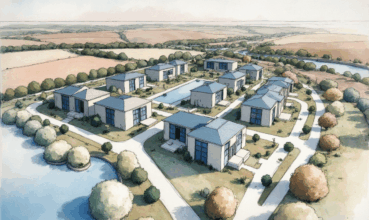
The master-planned community sector has changed notably over the past decade, driven by shifting demographics, evolving lifestyle preferences, and economic pressures. At the forefront of thi...

Jacksonville’s Market Reality Check from a 30-Year Veteran on Florida’s Changing Real Estate

Written by:
Date:
20 Oct 2025
Share via Facebook

Share via Linkedin

Share via X

Copy to clipboard


The Jacksonville real estate market is undergoing a significant transition as the pandemic-driven migration boom recedes and traditional market dynamics return. After several years of rapid sales and frequent bidding wars, the local market now reflects patterns that experienced professionals have seen before.
Maria Raymer, a broker associate and team leader with RE/MAX Specialists PV who has worked in Jacksonville real estate for three decades, offers a perspective shaped by multiple market cycles. Her team, ranked in the top 1% nationally, provides insight into how Florida’s real estate landscape is evolving beyond headlines.
The Domino Effect in Market Dynamics
Jacksonville’s current market challenges are rooted in what industry professionals refer to as the “move-up market” disruption. This segment includes buyers who do not have to move but choose to upgrade for lifestyle reasons, and it has traditionally driven a large share of transaction volume.
“Move-up market is when the market’s healthy enough for people who don’t have to move, but they move anyway,” Raymer explains. “It can be for little things, I want a bigger yard, I want that extra bedroom, I want a little bit more square footage.”
This discretionary activity sets off a chain reaction. First-time buyers purchase entry-level homes, allowing those owners to move up to mid-range properties, which then enables mid-range homeowners to buy higher-end homes. When any part of this sequence stalls, the entire market slows.
At present, higher interest rates and elevated prices are keeping many first-time buyers out, disrupting the foundation of this progression. “Right now we’re seeing where the first-time home buyers are slow to come to the table because of the interest rates, because of the cost of real estate, and that affects that mid-range, because those middle market people can’t move unless they have that low end in the market,” Raymer notes.
Interest Rate Lock-In Shapes the Market
A major factor limiting market activity is the “lock-in effect.” Many homeowners secured mortgages at record-low rates between 2020 and 2022, with some paying just 2-3%. These owners are hesitant to sell and take on new mortgages at today’s rates, which are around 6-7%.
“Even though in years past 5% and 6% were great rates that didn’t scare anybody away, now you have so many homeowners locked in between 2% and 3%,” Raymer observes. “Even if we never see those rates again, it’ll be a while before those people are willing to let go of their homes, or they’re forced to sell because of life circumstances.”
As a result, many potential sellers are staying put, not because they are content with their homes, but because they are reluctant to give up favorable mortgage terms.
Migration Patterns Normalize
The surge of out-of-state buyers that characterized the pandemic era has largely ended. During the height of COVID-related relocations, Jacksonville saw more buyers coming from outside the area than from within, which was unprecedented for the region.
“During that time, more people were coming in from outside the market than internally,” Raymer recalls. “I would say now it’s probably back to normal, where maybe 40% come from out of town, and 60% are local moves.”
Motivations for moving have shifted as well. During the pandemic, many relocated to Florida for fewer restrictions and remote work. Now, with more companies bringing employees back to the office, the reasons are more traditional: retirement planning, lifestyle choices, job transfers, and cost-of-living factors.
Current Market Conditions
Jacksonville’s market today is more balanced compared to the strong seller’s market of recent years. Properties that once sold within days now typically remain on the market for three to six months, which Raymer points out is closer to historical norms.
“Before we could sell a house in a day in that time when everybody was doing the mass migration to our area, we could put a listing on and have 10 offers 48 hours later,” she explains. “Now, if you put a house on the market, you don’t expect it to sell in a day. You don’t expect multiple offers. They may sit for two, three, four, five, six months even.”
This environment offers opportunities for buyers willing to manage current interest rates. Sellers are more open to negotiation, and the intense competition seen in recent years has eased considerably.
Builder Incentives and Market Response
Home builders have adjusted to the new market by offering significant incentives to attract buyers. The most notable of these are interest rate buydowns, where builders subsidize mortgage rates to make financing more affordable, sometimes reducing rates to around 4%.
“They are buying the rate down because they know that’s a trigger for buyers,” Raymer notes. Builders are also providing price reductions and decorating allowances, but the financing incentives are the most valuable for buyers facing affordability issues.
Market Outlook and Professional Perspective
Looking forward, Raymer anticipates that the rest of 2025 will remain relatively subdued, with improvement likely in spring 2026. Her outlook is informed by both market fundamentals and patterns of human behavior observed over her career.
“I think people can only hold off with their plans so long to see what’s going to happen,” she observes. “They’ll wait only so long, and then they become used to and very tolerant of the new rates and say, ‘Look, this is it. So I either want to move or I don’t, and if I do, I’m going to go ahead and go forward with that.’”
The primary indicator Raymer monitors is interest rate movement. Recent drops below 6% have provided some encouragement, but lasting improvement will require rates to stabilize in the mid-5% range or below.
Strategic Guidance for Buyers
For those considering a home purchase now, Raymer advises a practical approach: “Don’t be too caught up in interest rates, because it’s temporary. You date the rate, you marry the house.”
Her rationale is that purchase prices are fixed, while interest rates can be changed later through refinancing. Buyers who act now in a less competitive environment may secure better prices and can refinance when rates fall. Waiting for lower rates may mean higher prices, offsetting any benefit from improved financing terms.
This viewpoint reflects Raymer’s long-term perspective. “Real estate is still one of the best, most secure investments that you can make,” she emphasizes, contrasting real estate’s general stability with the volatility of the stock market.
Regional Strengths Support Long-Term Prospects
Despite current challenges, Northeast Florida retains key advantages that support its long-term growth. The area offers greater affordability than much of the state, strong schools, and proximity to St. Augustine’s historic attractions.
“The affordability here is better than most areas in the state,” Raymer notes. “It’s a great place to raise a family, and we have a good, diverse cultural scene: arts, music, markets, festivals.”
These attributes suggest that while the market may face continued softness in the near term, the underlying drivers of real estate demand remain strong.
Jacksonville’s market today reflects broader national trends while maintaining its regional identity. As the effects of the pandemic fade and traditional dynamics return, the area appears positioned for gradual improvement as interest rates stabilize and buyers adjust to new conditions.
Similar Articles
Explore similar articles from Our Team of Experts.