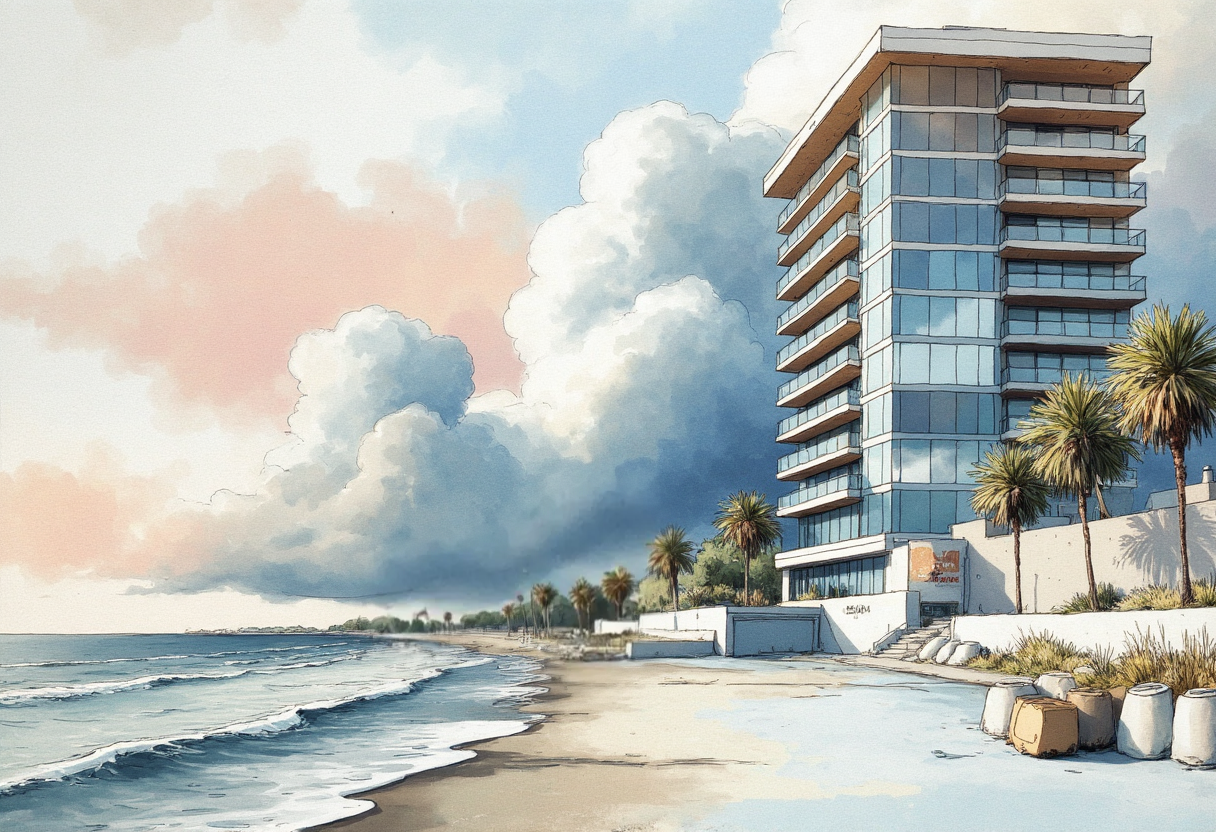
Rising insurance costs in coastal markets are fundamentally reshaping commercial real estate investment strategies, with some property expenses reaching unprecedented levels, according to Joel Miller, Managing Partner at Wall Street Capital Partners and a host of Mornings with Joel: Commercial Real Estate Podcast.
“There’s times where the insurance can be higher than the taxes, which is insane,” Miller says, highlighting a dramatic shift in the economics of coastal property investment. “The next storm that comes through, they’re just gonna jack the rates again.”
The Insurance Crisis Creating No-Win Scenarios
Miller points to a recent case in Texas that illustrates the severity of the problem. “We had a client where a storm blew through and did major damage to about a third of the units in this complex, about 100 units,” he explains. “In order to keep the insurance costs down, he had a high deductible. Well, the cost of the deductible was the same as the repairs.”
This creates an impossible situation for property owners, Miller argues. “How many people really want to write a seven-figure check to just do some repairs on a property?” he asks. “That’s what insurance is for. But in some cases, because of the pricing, it doesn’t even make sense.”
Strategic Market Shifts
These insurance challenges are driving significant changes in investment strategy, according to Miller. His firm has begun actively avoiding certain traditionally attractive markets due to insurance concerns.
“The Gulf states can be really challenging because of hurricanes,” Miller notes. “Parts of Florida, mainly because of insurance costs, has been a major factor as of late.”
Instead, Miller says investors are increasingly focusing on inland markets less prone to severe weather events. While hurricanes typically affect either the Gulf or East Coast, inland areas offer more predictable cost structures and lower risk profiles.
The East Coast Exception
Miller notes that even along the East Coast, risk calculations differ significantly from the Gulf region. “Fortunately, once those storms kind of get past Florida, they turn out to sea,” he explains. “Obviously there’s been exceptions to that, we’ve seen New York City get hit with Sandy and things like that. But historically, that has been more rare than the norm.”
This geographic risk assessment has led Wall Street Capital Partners to focus primarily on key markets along the eastern seaboard, while pausing expansion in Texas despite continuing to evaluate specific opportunities there.
Looking Ahead
Miller suggests these insurance-driven market shifts may represent a longer-term realignment rather than a temporary adjustment. As climate-related risks continue to affect coastal areas, the fundamental economics of property ownership in these regions may need to be reconsidered.
For now, Miller’s firm is adapting by focusing development and acquisition efforts on markets where insurance costs remain manageable relative to property values and potential returns. This strategic shift could signal a broader industry trend as other investors face similar cost-benefit calculations in coastal markets.