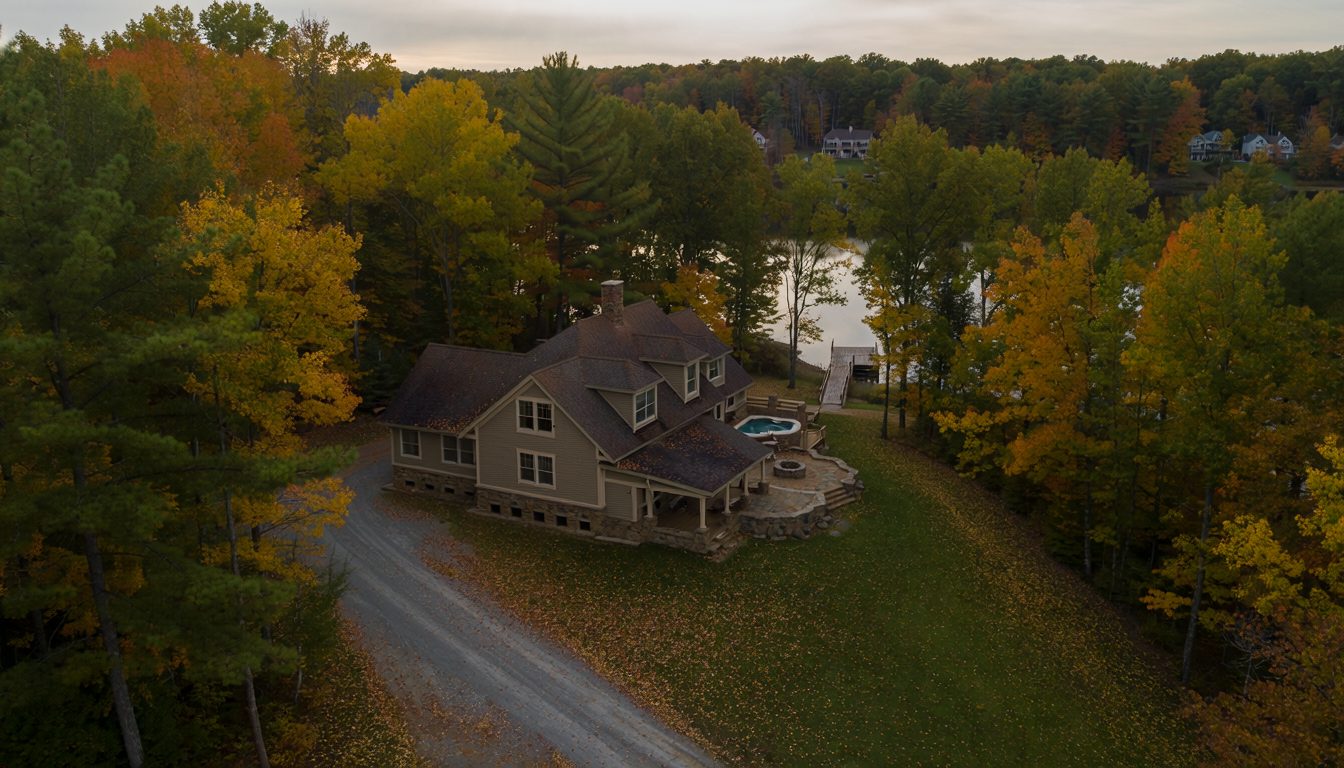
A three-bedroom cabin in a man-made lake community used to be the standard Poconos investment – a modest second home rented out on weekends to visitors driving in from New York or Philadelphia. That model still exists, but according to Mark Shay, it is no longer where the money is.
Shay, a licensed broker, leads The Mark Shay Team, also known as Pocono Vacation Home Sales, a four-person team that specializes in helping investors buy short-term rental properties. He says the region’s vacation rental market is splitting into two tiers. Properties run as professional hospitality operations are earning more each year, while casually operated rentals are losing ground.
The underlying draw has not changed. The Pocono Mountains Visitors Bureau estimates that 27 to 30 million people visit the region each year, counting day-trippers, and tourism supports nearly a third of all jobs in the four-county area. But the investment landscape has grown more complex – shaped by a patchwork of local regulations, a growing premium on professionally run properties, and a widening gap between operators who treat rentals as a business and those who do not.
The Rise of “Super Properties”
The Poconos rental market was historically dominated by three-bedroom, two-bath homes of 1,200 to 1,500 square feet in man-made lake communities, Shay says. They were second homes, never designed as investments. As Airbnb grew, buyers began arriving with an investor focus, looking for higher returns and larger scale.
The result is what Shay calls “super properties” – homes with six, seven, or eight bedrooms that can host large groups celebrating milestones. Some bring in $300,000 to $500,000 a year in rental revenue, he says, because they target group bookings and high-end stays, operating as what he describes as “micro resorts of their own.”
Shay says licensed short-term rentals in the region are declining even as nightly rates and overall revenue grow, as casual and seasonal operators drop out and professionals move in. In Pocono Lake, one core rental area, active listings fell nearly 28 percent between August 2025 and August 2026, according to AirDNA, while revenue per available rental night rose about 35 percent.
Shay rejects the idea that the market is saturated. “I think it’s competitive and it has gotten very competitive,” he says. In his view, properties that rank in the top 20 percent on Airbnb and operate like a business are doing well, while those run without a business focus are struggling.
Regulation Is Reshaping the Map
The Poconos is not one rental market – it is a patchwork of municipalities, each with its own rules. Communities near the New Jersey border, such as Stroudsburg and East Stroudsburg, have become bedroom communities for New York-area commuters, Shay says, and have mostly added restrictions that make short-term rentals harder to run. Both boroughs and neighboring Stroud Township adopted licensing or permit ordinances in 2020 and 2021.
That pressure has pushed the investor market further west. The stretch “starting at Mount Pocono and heading west out to Lake Harmony” is now “kind of the epicenter of the vacation rental industry,” Shay says.
His team maintains what it calls “STR scorecards” – red, yellow, and green indicators showing whether a given homeowners association or township permits short-term rentals. Of roughly 1,600 homes for sale in the local MLS at the time of the interview, about 550 were eligible for short-term rental use, according to Shay. Being on the wrong side of a township line can make a home worth 10 percent less, he says.
Because many of the communities where rentals are concentrated were built as vacation home communities, Shay says the debate over short-term rentals and affordable housing is muted here. “Here in the Poconos, the debate about STR and affordable housing doesn’t seem to be too emotional,” he says.
The Turnkey Premium Problem
Homes that are already licensed and furnished, with strong listings, good reviews, and a proven rental history, can sell for 15 to 25 percent more than an average comparable home, Shay says. That premium creates a problem: lenders typically do not want to finance furnishings, hot tubs, and business value built into a purchase price.
Many buyers turn to DSCR (debt service coverage ratio) loans, which factor in a property’s earning potential, Shay says. The bigger decision is whether to pay the premium or buy a cheaper home and build the business themselves. “Everybody would love to get a house full of free furniture,” Shay says. “But in reality that furniture comes at a cost. That business premium comes at a cost.”
Occupancy rules are another part of the due diligence. Most properties in the region rely on private septic systems and well water, and the restrictions attached to short-term rental licenses also cover those systems, which can limit how many guests a home may host.
Demand in a Downturn
Shay says the Poconos has historically run countercyclical to the broader economy. When times are good, travelers tend to fly to more exotic destinations; when conditions tighten, they still vacation but drive instead. He is careful to add that he is not predicting a downturn. “Those people are going to take vacations whether they can afford to fly or whether they can just drive,” he says.
For now, Shay says demand remains strong and the number of younger and first-time visitors appears to be growing, while competition is pushing operators to do “bigger and bolder things.”
Running It as a Business
Shay’s advice for anyone considering the market is to treat a vacation rental as an active business, not a passive investment. Property managers can help, but directing a rental’s day-to-day operations still takes time, and he is candid that the model does not suit everyone.
For owners who do take it on, success comes down to building a place guests want to return to. “You’re opening a hospitality business … The more you can draw repeat guests, have returning guests, build your own brand, then the more likely you are to succeed at this,” he says.
About the Expert: Mark Shay is a licensed Realtor and team leader with The Mark Shay Team in Pennsylvania’s Pocono Mountains, where he works with investors buying and selling short-term rental properties in markets from Stroudsburg and Mount Pocono west to Lake Harmony and Jim Thorpe.
This article is intended for informational purposes only and does not constitute legal, financial, or investment advice. The views and opinions expressed herein reflect those of the individuals quoted and do not represent an endorsement of any company, product, or service mentioned. Readers should conduct their own due diligence and consult qualified professionals before making any investment decisions.