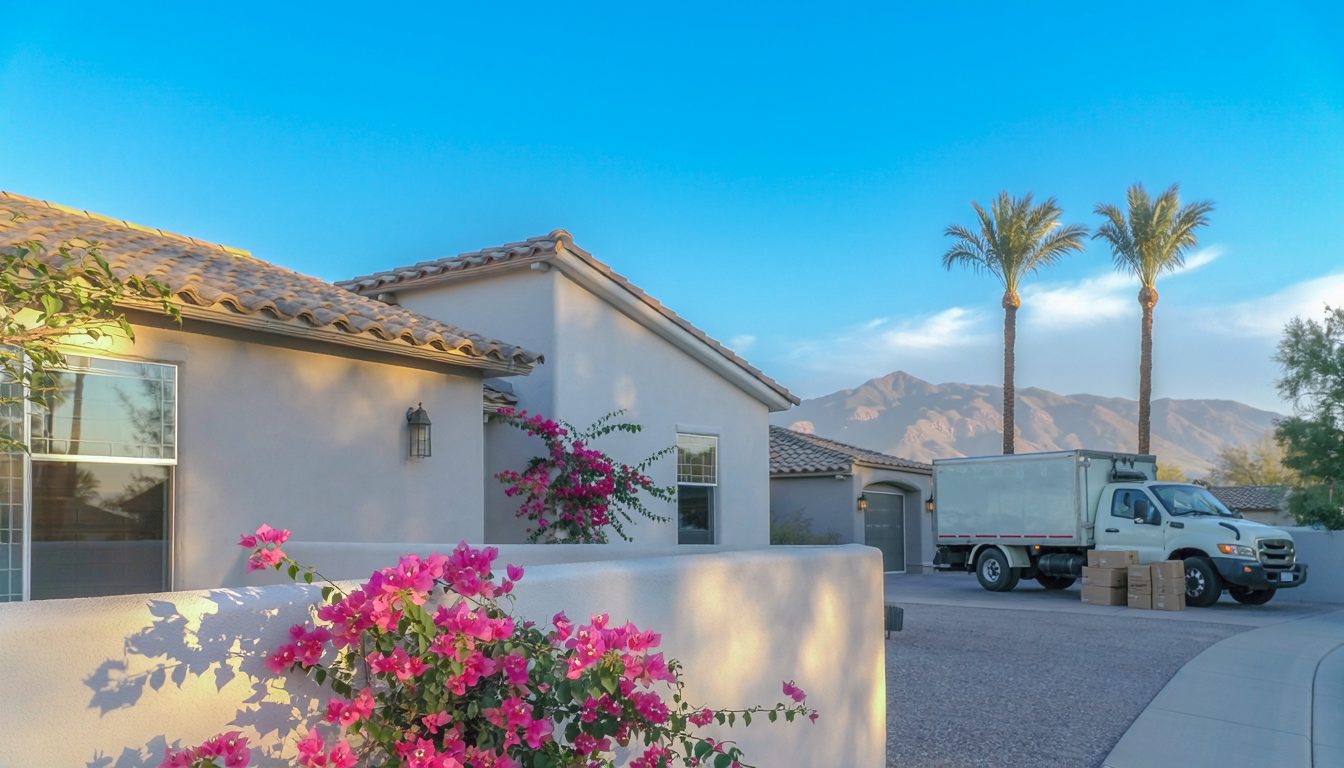
Most housing markets draw from a mix of local move-up buyers, downsizers, and newcomers. In Yuma, Arizona, relocation dominates. Situated in the state’s southwestern corner near the Mexican border, roughly three hours from Phoenix, Yuma draws many of its residents through employment – military assignments, federal postings, and Border Patrol positions. That relocation dependency shapes who buys and sells, according to Ashley Layton, an agent with The Layton Team at Keller Williams Realty Yuma. It also shapes pricing conversations, concession expectations, and where investor capital lands.
“If you’re coming to Yuma, you’re coming to Yuma for a reason,” Layton says. Most of her transactions involve a relocation in one direction or the other – people arriving for work or to be near family, and sellers leaving because they’ve been reassigned or are retiring closer to relatives. Her business splits roughly evenly between buyers and sellers, with first-time homebuyers and retiring veterans among her most common clients.
Border Patrol moves have been especially visible this year. Layton says she has worked with a lot more agents, though she sees much of it as turnover: agents transfer out to posts in California or Texas, and new ones arrive to fill their spots.
Concessions Have Become the Norm
Yuma’s current market tilts toward buyers, and one of the clearest signs is how often sellers contribute to buyer costs. Layton reviews local closing data weekly or every other week and estimates that roughly 90 percent of recent Yuma sales have included seller concessions, typically between 2 and 4 percent. She sets that expectation early with both sides of a transaction.
“I want to make sure that expectation is very clear to all my sellers when we’re meeting,” she says. “And I’m having the same conversation with buyers.”
Some buyers need the help; others simply prefer not to cover closing costs. Either way, Layton treats concessions as the local standard and makes sure every party knows it going in.
The typical sale price in Yuma currently sits between $300,000 and $325,000. Layton’s own buyers have averaged between $450,000 and $475,000. Clients who rent typically pay between $1,800 and $2,500 per month, depending on the home’s size and whether it has a pool.
Comfort Over Qualification
With military buyers, Layton doesn’t start with the basic allowance for housing, or BAH. She anchors the conversation around what a buyer is comfortable spending each month, then works with their lender to find homes that hit that number.
“I don’t care what their BAH is. I care what they can afford and what they are willing to spend,” she says. “There are too many people that look and say, ‘Oh well, I’m pre-qualified for $600,000,’ but that doesn’t hit their $1,500 mark. I’m not going to push them for the $600,000 home. I’m going to push them towards the $300,000 home because it gets them to their $1,500 mark.”
The same thinking applies to neighborhood fit. Commute distance is usually the first filter. Buyers stationed at Yuma Proving Ground, which sits about 24 miles north of the city, typically want to be within 30 minutes of work, which points the search toward the foothills. Those assigned to MCAS Yuma often want to stay within 10 to 15 minutes of the base. After commute, family needs – a particular school district, proximity to ballfields or swimming pools, even a preferred church – drive the rest.
BAH varies by rank and time in service, so two families assigned to the same base may have very different budgets. Some of Layton’s clients have a BAH of $1,500 but are comfortable spending $2,000 a month. Others prefer to stay below their allowance, such as a family with an $1,800 BAH that wants to spend $1,500. Some starter homes sit near common BAH price points, but military demand doesn’t stay in a single price band – it spreads across the market depending on each family’s circumstances.
The Two-Year Threshold
Interest rates have made some buyers more hesitant over the past year, but Layton says assignment length usually decides whether a military family buys or rents. Buyers expecting to stay in Yuma more than two years are typically still purchasing, while those with shorter assignments are more likely to rent. “This past year I have had a few who have decided to rent instead of purchasing, but it’s more specifically because they’re not staying here for more than two years,” she says.
That two-year line shapes demand on both sides of the market. Short assignments keep a steady stream of military families in the rental pool, while longer-tenured buyers continue to purchase despite higher rates. Layton says those who work with the right lender and agent are still able to make the numbers work.
What Moves a Listing
Layton points to three factors that determine how long a listing stays on the market: price, amenities, and the seller’s situation. Some sellers can’t afford updates but still list at a higher price point. Others anchor to a neighbor’s past sale rather than current data.
“They know that the neighbor’s house sold for 400, so they want 400,” she says.
Pricing to current data matters more as homes take longer to sell. According to Redfin, Yuma’s median days on market averaged about 85 days in the first half of 2026, up roughly 15 days from a year earlier – leaving less room for a listing priced off a neighbor’s past sale. Buyer urgency varies too, and Layton notes that an investor’s mindset is very different from a first-time buyer’s.
Where Investors Are Placing Bets
Among investors, Layton has seen a clear preference for four-bedroom homes. Most, if not all, of the investors she worked with in 2026 bought four-bedrooms, which have rented for more than three-bedroom properties.
Pools are where investor and tenant preferences split. Many tenants are looking for pool homes, but many investors avoid them because of the upkeep. “It just depends on how motivated the investor is on wanting to purchase a pool and taking over the liability and the maintenance of a pool,” Layton says.
What’s Ahead
Layton sees potential for Yuma’s buyer pool to grow beyond its military and federal base if new commercial projects arrive, including a proposed spaceport. The city has pursued a site east of San Luis for launching small rockets carrying communications satellites, though the project still needs federal approval and officials have said it could be five to 10 years away.
“If that does end up coming to fruition, then yes, we will end up seeing a lot more job opportunities for individuals here and we’ll also see a lot of people relocating here,” she says.
For now, Yuma demand remains tied closely to government employment decisions – who gets stationed here, who transfers out, and how long each assignment lasts. Buyers staying longer than two years are still purchasing, often with seller concessions covering closing costs. Sellers who price to current data rather than a neighbor’s past sale are better positioned in a slower market.
About the Expert: Ashley Layton is an agent with The Layton Team at Keller Williams Realty Yuma in Yuma, Arizona, where she works with military families, veterans, and federal employees relocating to and from the area.
This article is intended for informational purposes only and does not constitute legal, financial, or investment advice. The views and opinions expressed herein reflect those of the individuals quoted and do not represent an endorsement of any company, product, or service mentioned. Readers should conduct their own due diligence and consult qualified professionals before making any investment decisions.