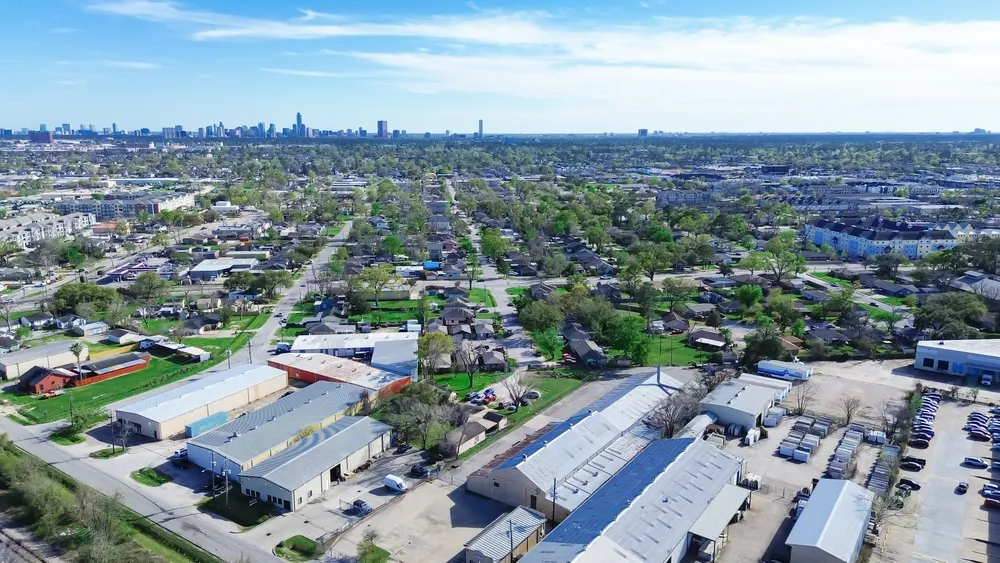
The conventional image of industrial real estate, massive distribution centers, six-figure square footage, institutional capital, does not match what is actually happening on the ground in Houston. While national coverage focuses on large speculative builds near ports and logistics corridors, a different pattern is playing out in the city’s flex and light industrial segments: demand is being driven by individual entrepreneurs who need as little as 2,500 square feet.
That compression has direct consequences for how developers size new projects, how investors evaluate the market, and why deals keep stalling despite strong underlying demand.
Shahin Naghavi, Managing Partner & Principal Broker at Riverside Equity Group, has watched tenant demand compress significantly in recent years. The firm handles both development and brokerage across Houston’s industrial market, giving it a dual view of what tenants want and what is available.
Since the pandemic, Naghavi says, the firm has seen a significant increase in small independent entrepreneurs seeking space. Where tenants once needed 50,000 square feet, many now need only 2,500. “Lots of people are betting on themselves, becoming entrepreneurs, starting their own businesses, and needing smaller startup spaces,” he said.
That compression has changed how Riverside approaches its own development pipeline. The firm now focuses on smaller footprints designed for businesses in their earliest stages. For tenants searching for affordable first spaces, this means more options built specifically for their scale, but only in submarkets where developers like Riverside have identified the gap and chosen to build.
Brokerage as a Demand Signal
Operating both a brokerage and a development business means tenant searches reveal supply gaps in real time. When a client needs a specific type of space in a submarket, and nothing exists, that becomes a development signal.
“If we see a demand in a submarket when a client’s looking for a space or type of structure that’s not available, that oftentimes will tell us we should maybe try to consider building this type of product in this area,” Naghavi said.
This feedback loop – brokerage activity informing acquisition decisions – offers a practical alternative to relying solely on market reports or vacancy data, which may not reflect conditions at the small-bay level where Riverside operates. The limitation is speed: identifying a gap and delivering new construction to fill it takes time, during which the tenants who signaled the need may settle elsewhere or outgrow the requirement.
Interest Rates Freeze Investor Capital
Despite strong demand from end users, investor activity in Houston industrial has slowed considerably. The reason is straightforward: deals do not pencil at current interest rates.
“An investor typically can’t make the numbers work with the current interest rates,” Naghavi said. What the firm sees instead are owner-occupiers, businesses that need warehouse or flex space for their own operations and are buying out of necessity rather than yield calculations.
This creates an unusual market condition: demand is real, but the buyer pool is narrow. Investors who want to diversify into industrial from retail often arrive expecting comparable inventory levels and find very little available. The combination of low inventory and compressed returns at current rates has effectively sidelined a large portion of potential capital. For business owners who need space now, the practical effect is reduced competition from investors, but also fewer new buildings coming to market, since investor capital funds much of the speculative construction pipeline.
Policy Uncertainty
Beyond rates, a second constraint is shaking buyer confidence. Naghavi described multiple transactions falling apart late in the process due to shifting government policy signals.
“We’ve seen quite a few transactions fall through at the 12th hour, and normally it’s because of some sort of financing or investor getting kind of nervous about the market,” he said. “One day saying there’s a tariff here and another day saying there’s not, going in and out of wars, creates a lot of uncertainty for investors and owner-occupiers.”
Better deal structure cannot solve this problem. When the policy environment changes week to week, even motivated buyers with financing in place pull back, not because the deal is bad, but because the ground feels unstable.
Where the Strength Is
Within Houston, Naghavi pointed to West Houston and the ship channel area as the submarkets where industrial demand feels strongest. He also offered a heuristic for investors trying to identify future industrial opportunity: follow residential rooftops. Master-planned communities attract retail first, and light industrial tends to follow.
Naghavi also pushed back on the perception that Houston’s economy – and by extension its industrial market – is a single-sector story. “Even when oil and gas prices are low, we still see really good growth,” he said. “It’s consistent, and people are attracted to that because it gives them more security.”
For businesses evaluating where to lease or buy industrial space, this diversity means Houston’s demand base is less vulnerable to commodity price swings than outsiders often assume. The medical, technology, and AI sectors are all contributing to population growth and, consequently, to demand for small flex space.
Looking Ahead
Riverside is not aggressively deploying capital right now. Naghavi said the firm is looking toward 2027 or 2028, hoping for lower interest rates and improved consumer confidence to make deals more attractive.
Demand at the small-bay level is not going away; Houston’s population growth and entrepreneurial activity continue to generate it. But new supply depends on financing conditions that remain unfavorable, and policy uncertainty continues to delay transactions that would otherwise close. Until both constraints ease, the gap between what small tenants need and what the market can deliver will persist.
About the Expert: Shahin Naghavi is Managing Partner and Principal Broker at Riverside Equity Group, a Houston-based firm operating across both industrial real estate development and brokerage with a focus on flex and light industrial space.
This article is based on information provided by the expert source cited above. It is intended for general informational purposes only and does not constitute legal, financial, or real estate advice. Readers should conduct their own research and consult qualified professionals before making any real estate or financial decisions.