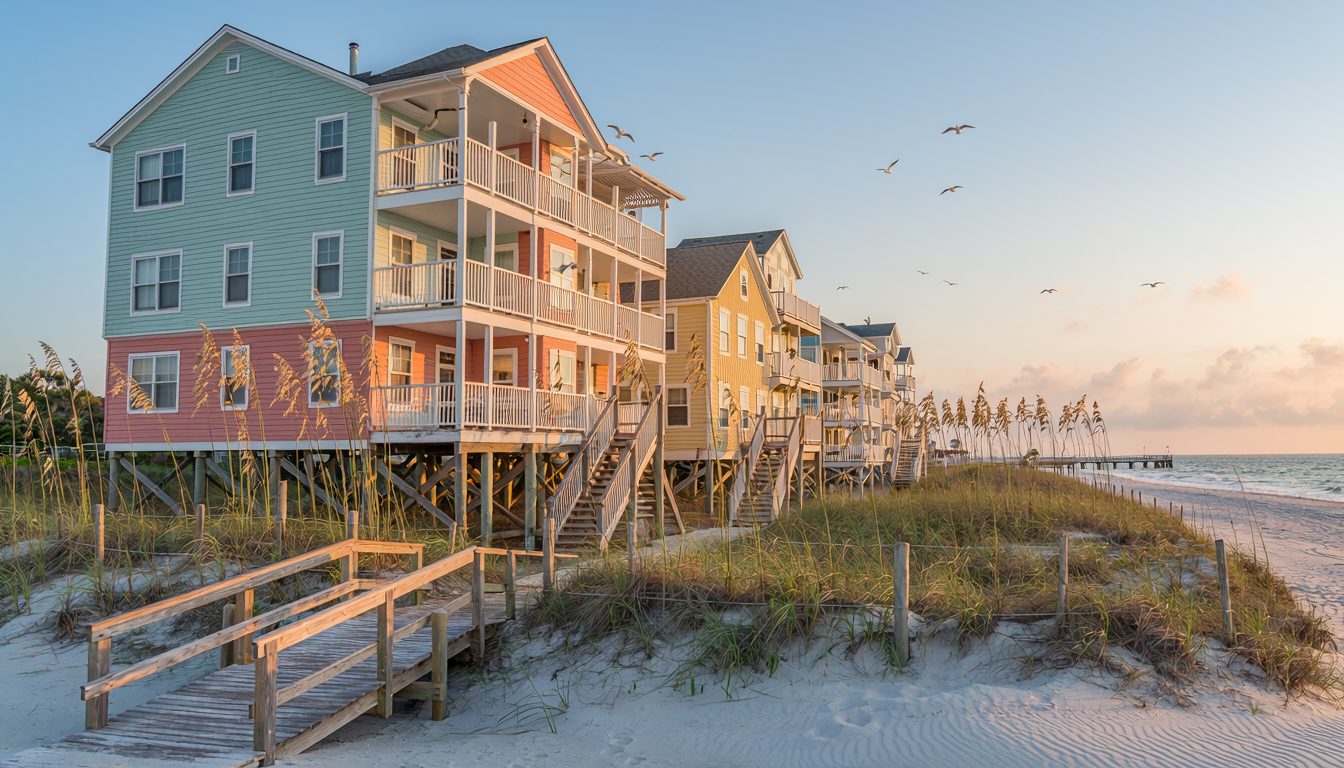
Growth and market health are not the same thing, and Brunswick County, North Carolina, shows the difference. The county keeps adding residents at one of the fastest rates in the country: its population grew 4.7% between 2024 and 2025, the fastest pace in North Carolina and sixth-fastest nationally, adding nearly 8,000 people.
Yet the coastal market that growth feeds has slowed. Colleen Teifer, a broker with Silver Coast Properties who works primarily in southern Brunswick County, believes the market has now shifted toward buyers. Condominiums face the steepest climb, because a national lending change has exposed financial weaknesses in many condo associations.
The shift did not happen overnight. “We’ve been a market in transition for a couple years,” Teifer says. “I think we’re officially more in a buyer’s market now.”
How Buyers Behave
The current slowdown traces back to how buyers responded to the post-pandemic market. After Covid, buyers had few homes to choose from. When interest rates later eased, more sellers listed, and buyers suddenly had options. Buyers grew selective then, and Teifer says they have stayed that way. “Buyers who have to buy are still buying,” she says. “Buyers have gotten very picky.”
Rising rates have reinforced that caution. Freddie Mac’s 30-year fixed average reached 7.40% in mid-October, up from 6.95% a month earlier, the highest level since 2023. Rising rates split buyers into two camps. Some wait. Others buy sooner, expecting rates to climb further and planning to refinance or recast their loans later. Even buyers in that second group take their time, because the county’s inventory gives them room to compare. New construction adds to that inventory. Many communities in the county consist of production-built homes, and those builders can offer incentives that individual resale sellers cannot match.
The countywide numbers capture the slowdown, though not yet a full buyer’s market. Through September, single-family homes averaged 88 days on market year to date, up 17.3%. Over the same period, months of supply fell from 6.4 to 5.3, and year-to-date closed sales rose 13.0%. Those figures predate October’s rate spike, and longer selling times are the shift Teifer describes. “Houses are staying on the market longer and there have been sellers that have had to do price reductions,” she says.
The county’s buyer profile magnifies that sensitivity to the broader economy. Most buyers here are retirees, and they react to their portfolios as much as to mortgage rates. “Even though the money isn’t in their wallets right now, if they see their 401(k) or IRAs take a big dip, they don’t feel compelled to go run out and buy a property,” Teifer says. “They wait.”
A Lending Change
The slowdown hits condominiums hardest. In September, townhouse and condo closings fell 21.6% from a year earlier, and the median price dropped 11.2%, to $279,240. Teifer attributes much of that decline to a change at Fannie Mae. Lenders once could evaluate many established condo projects through a streamlined “limited review.” For applications dated on or after August 3, 2026, every condo loan in a project with more than ten units requires a full review, and Freddie Mac retired its equivalent streamlined review on the same date. A full review examines a project’s physical condition, finances and reserve accounts in depth.
That scrutiny has exposed a problem many associations created for themselves. As insurance premiums climbed in recent years, many boards absorbed the increases rather than raise dues. The trade-off meant less money went into reserve accounts. Fannie Mae requires projects to hold a minimum level of reserves and to contribute to them every year. “They’ve accidentally put themselves in a bad spot,” Teifer says. The bar will soon rise further, with a 15% reserve minimum scheduled for January 4, 2027.
Building condition compounds the reserve problem. Some insurers will not cover a project whose roofs exceed a certain age. Associations without adequate reserves may need special assessments to replace those roofs. Teifer stresses that associations must keep up their buildings for both reasons: insurers demand it, and lenders demand it. If they fall behind, sellers find that buyers cannot get loans. The effect shows in the inventory. Townhouse and condo supply held at 6.5 months in September, against 5.3 for single-family homes. In Teifer’s market, condos are sitting longer, and she expects fewer buyers to consider them at all. She does not know how long the segment will take to recover.
Retirees Shape the Market’s Rhythm
The buyers moving through this market are overwhelmingly retirees, part of the continuing wave of baby boomers leaving the workforce. Many come from high-salary careers in the Northeast. Others arrive from the Midwest and California. The county also draws Florida residents who are moving back up the coast to escape high insurance costs and hurricane risk. For transplants from New York or New Jersey, the location has another advantage: home is a day’s drive away, which Florida cannot offer.
That buyer base produces an unusually long sales cycle. Buyers often start searching two to four years before they retire. Many can buy without selling their homes up north, which eases the psychological strain of the move. It also raises new logistical questions. Owners need someone to watch the property until they arrive, and a plan if a storm hits while they are away.
Buyers of land are acting on the same timeline as everyone else. A few years ago, some bought lots as investments to hold. Today, buyers in communities that sell lots generally build right away. Even so, a quick start can stretch out, because review and permitting can take up to a year before ground breaks.
An Unfamiliar Landscape
Because so many buyers come from elsewhere, much of an agent’s work here is education. Newcomers used to ordinary neighborhoods find a market built around communities with HOAs, amenities and dues structures they have to learn. St. James stands apart as a truly private community, with a large initiation fee and membership plans for amenity access. Towns such as Sunset Beach, Calabash and Ocean Isle put beaches, golf courses, groceries and health care within minutes. Some mid-county communities sit farther from those conveniences. Buyers accustomed to large rural parcels often don’t mind the drive. Golfers want courses close by, and fitness-minded buyers rule out communities without a gym.
Insurance and flood risk require their own education. In some areas, lenders require a wind and hail rider on top of a standard homeowners policy. Lower property taxes usually more than offset that cost. “I get people who have $20,000 a year or more in taxes,” Teifer says. “When their taxes are reduced to two or three thousand dollars a year, they don’t mind paying the extra seventeen hundred dollars for insurance.” Island buyers accept higher insurance and maintenance costs as the price of a beach house. On the mainland, insurance rarely changes a decision. Flood risk does not track distance from the ocean, however. Brunswick County is low-lying, and inland swamps can put properties miles from the beach in flood-prone areas. Buyers “may have some mistaken beliefs about where they may be safe,” Teifer says.
Pricing Decides Who Sells
Selective buyers and ample inventory make pricing the decision that matters most for sellers. An overpriced home sits, and a home that sits draws suspicion. “People say, well, what’s wrong with it? Well, nothing’s wrong with it,” Teifer says. “It was just priced incorrectly, and a seller thought they could get more out of it than they could.”
Teifer sees no single local threat to the market. The forces that move it come from elsewhere: interest rates, the stock market and buyers’ confidence in the broader economy. Agents cannot control those forces. A correctly priced home sells within them, while an overpriced one sits, gets cut, and draws the very suspicion its seller hoped to avoid.
About the Expert: Colleen Teifer is a broker with Silver Coast Properties in Ocean Isle Beach, North Carolina. She represents buyers and sellers in residential sales in southern Brunswick County and is licensed in North Carolina and South Carolina.