
The broadcast media brokerage market has changed dramatically since the 2008 financial crisis. Transaction volumes have fallen nearly 80% from 2019 levels, and large-scale deals are far less...

Higher Rates and Remote Work Are Weighing on Commercial Real Estate

Written by:
Date:
23 Dec 2025
Share via Facebook

Share via Linkedin

Share via X

Copy to clipboard

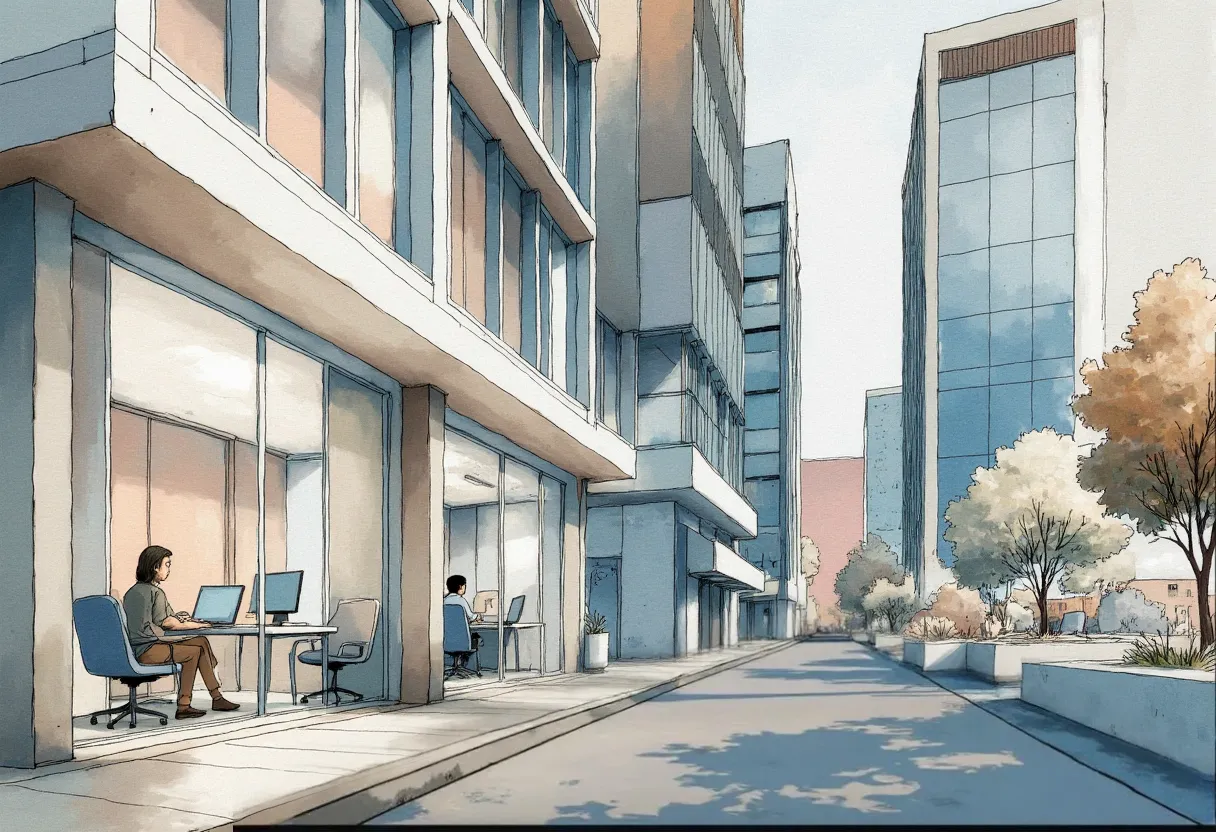
The widespread shift to remote and hybrid work has left office and retail real estate with more space than companies now need, creating a long-term oversupply that persists regardless of return-to-office mandates. As interest-only commercial loans mature, owners face a refinancing crisis intensified by sharply higher rates.
Chad Cummings, a managing attorney at Cummings & Cummings Law, says this is not a typical market downturn but a lasting economic mismatch that makes many commercial properties financially unworkable.
“I’m quite pessimistic. I don’t see a whole lot of reason to be optimistic in the commercial real estate markets right now,” Cummings says, noting that the problem has been building for nearly three years.
The Refinancing Trap
Cummings explains that most commercial real estate is financed with interest-only loans, meaning owners pay only interest during the loan term and expect to refinance into a new loan when the term ends. This approach worked when interest rates were low or stable. But with rates more than doubling from recent lows, the economics have shifted drastically.
“If your rate was previously 3% and now you’re paying 7%, that doesn’t pencil out. Maybe that’s not an asset you want to own anymore,” Cummings says.
This situation is not just a temporary liquidity crunch. The basic demand for office and retail space has decreased, making it unlikely that waiting for better market conditions will solve the problem. As loans mature, many owners will find that refinancing at higher rates makes their properties unprofitable.
A Permanent Drop in Demand
Cummings believes the shift to remote work is a lasting change that will keep demand for office space permanently below pre-pandemic levels. “Yes, a lot of people have returned to the office after COVID, but there is a structural difference, such that certain office space will never be as in demand as it was before COVID,” he says.
He points out that both companies and employees have shown they can work remotely, which means the need for traditional office space has permanently declined. “Now that we know how to work remotely, you’re going to have a continuing overabundance and glut of office space, particularly retail. The same problem for the same reasons.”
This creates a double challenge for owners: higher financing costs and lower income from properties with reduced demand. The old strategy of simply refinancing when loans mature no longer works when both key variables—interest rates and occupancy—move in the wrong direction.
Diverging Asset Classes
Not all commercial real estate is affected equally. Cummings sees industrial and warehouse properties, especially fulfillment centers, as exceptions to the current struggles. “Industrial is a bright spot. I think you’re going to continue seeing very robust fulfillment and warehouse spaces. So I certainly continue seeing demand for that,” he says.
In contrast, office and retail face the steepest challenges. Even residential real estate, according to Cummings, remains weak outside a few high-demand neighborhoods. “I still see that the market has further to fall. I don’t see prices rising dramatically in 2026 in Florida or Texas, perhaps outside of very, very niche sub markets,” he says, naming Highland Park in Dallas, Coral Gables in Miami, and select areas of Palm Beach as rare exceptions.
Cummings shares a personal example: “I have a single-family home I’m working on selling right now. It’s been on the market for about a year, in perfect condition. Nothing’s wrong with it. I think we’ve gotten two offers in 12 months, so we’re taking it down.”
Interest Rates Set the Recovery Threshold
Cummings identifies interest rates as the key factor that could eventually stabilize the market. “Until we get those interest rates back under 5%, I don’t see a lot of change,” he says. He argues that refinancing will only become economically viable for most properties if rates fall to this level.
However, he cautions that even if rates do drop, the oversupply of office and retail space is likely to persist. Lower borrowing costs may help some owners, but they cannot fix the gap between the amount of space available and what the market actually needs after the shift to remote work.
Investment Strategy in a Changed Market
For investors, Cummings sees a much narrower set of viable options than before the pandemic. “If I was an investor, I’m not looking at hospitality right now. I’m not looking at retail. I’m not looking at office space. I’m not looking at single-family residential,” he says.
He sees potential in using Florida’s Live Local Act to create high-density residential projects and in continued investment in industrial and special-use properties. These, however, represent a much smaller pool of opportunities than the broader market did in the past.
Cummings concludes that the combination of lasting oversupply and higher financing costs marks a permanent reset for commercial real estate, not just a cyclical downturn. Investors and owners who continue to rely on pre-pandemic assumptions about demand and refinancing may face ongoing losses as the market adapts to new realities.
Similar Articles
Explore similar articles from Our Team of Experts.