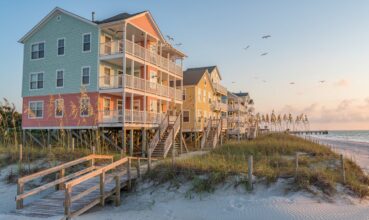
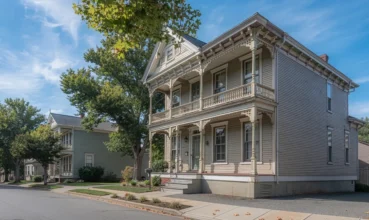
In an industry where 70% of Realtors closed zero transactions last year, PROACTIVE Real Estate stands out with knowledgeable local agents averaging 17 transactions annually—more than four times the local and national average. Founder Jabin Norris is so invested in this concept that he trademarked the term “Hyperlocal®” to reflect the company’s distinctive methodology.
This remarkable performance stems from a deliberate strategy focused on accountability, service guarantees, and a Hyperlocal® approach that has transformed the company from a two-person operation to a market leader in southeastern North Carolina.
From Housing Crash to Market Leader
Norris entered real estate in 2006 at age 21, obtaining his license just before the housing market crashed. Unlike many in the industry, he didn’t come from a real estate background—his father was a plumber, and many family members were commercial fishermen in the small shrimping community of Varnamtown near Holden Beach.
“I wanted something I could build upon,” Norris explains. “Real estate in this beach area seemed to reward hard work proportionally… [Real estate] is essentially an equal opportunity endeavor.”
The timing couldn’t have been more challenging. As a tourism destination driven by second homes and vacation properties rather than jobs or schools, Brunswick County was hit particularly hard by the housing crash, and its recovery lagged behind other areas.
“I cut my teeth in the housing crash,” Norris recalls. “I postponed many experiences in my 20s to build for the future. I was working seven days a week while most people my age were traveling and enjoying themselves.”
That dedication paid off. Even during the market downturn, Norris achieved top 1% status on the Real Trends ranking and became the top producer in his franchise for the state. By 2013, he was ready to launch his own firm, starting with just himself and one other person.
Strategic Expansion Across Multiple Verticals
What began as a small brokerage has evolved into a comprehensive real estate services company. In late 2014, Norris expanded into vacation rentals. By 2016, the company had grown enough to purchase its own 7,000-square-foot headquarters.
Today, PROACTIVE boasts 25 real estate brokers, holds the number one market position in its headquarters zip code with approximately one-third market share, and ranks among the top firms in the tri-county area encompassing Brunswick, New Hanover, and Pender counties.
The vacation rental program has grown from 16 properties to 270 houses. Norris has also added a mortgage company and a relocation company to create what he describes as a “one-stop shop” for all real estate needs.
“All of that’s been organic growth,” Norris emphasizes. “There’s been zero M&A and zero debt to achieve this expansion.”
The Secret to Productivity: Accountability and In-House Resources
When asked how PROACTIVE maintains such high productivity levels, Norris points to several key factors. First is the work ethic established during the housing crash, when he personally averaged about 150 transactions per year as a solo producer.
“That’s the work ethic we embedded in the company from the beginning,” he says. “We employ full-time brokers, maintain accountability, and prioritize service. We implement service guarantees across both sales and rentals.”
Another significant advantage is PROACTIVE’s in-house marketing capabilities. Rather than outsourcing, the company has built its own internal marketing team with capabilities including WordPress coding, website development, and SEO.
“We handle everything internally,” Norris explains. “We don’t experience delays waiting for external vendors, and we can provide services at wholesale cost. We extend these advantages to our brokers, allowing them to leverage these resources.”
The Evolving Role of Realtors
Norris sees current market conditions accelerating trends that have been underway for years, particularly the consolidation of business among fewer, more productive agents.
“Many people enter real estate with misconceptions about what the industry requires,” he observes. “Some expect easy money or believe they can travel while occasionally answering calls, but fundamentally, this is a sales profession, and it’s demanding.”
He predicts the industry will see more team structures emerging, where those who appreciate real estate but struggle to generate business independently will work under team leaders in more structured roles.
“This business has two components: revenue generation and administration. Many people default to administrative functions, but the core responsibility is revenue generation—assembling deals, prospecting, and other activities that many find challenging.”
Looking Ahead: Replication and Expansion
After nearly 12 years in business, PROACTIVE has created a template for success that it’s now beginning to replicate in new markets. The company has recently opened a new office in Oak Island and plans several other locations over the next five years.
“Our goal is simply to replicate our existing model,” Norris says. “We’ll apply this template in new communities, maintaining our Hyperlocal® approach in each market.”
Rather than viewing current market challenges as obstacles, Norris sees them as opportunities. “Market uncertainty can be advantageous. I’m most comfortable during volatile periods, so I’m not concerned about current conditions. If anything, this environment might accelerate our growth.”
For Norris, who built his career during one of the worst housing crashes in history, the current market represents familiar territory—one where hard work, local expertise, and adaptability create competitive advantages that technology alone cannot replicate.
This article was sourced from a live expert interview.
Every month we conduct hundreds of interviews with active market practitioners - thousands to date.
Growth and market health are not the same thing, and Brunswick County, North Carolina, shows the difference. The county keeps adding residents at one of the fastest rates in the country: its population grew 4.7% between 2024 and 2025, the fastest pace in North Carolina and sixth-fastest nationally, adding nearly 8,000 people. Yet the coastal ...
For Brian Rudderow, the case against single-family wholesaling came down to what the work cost him relative to what it paid. His wholesale margins have thinned, seller expectations remain high, and squatter-occupied properties have added a problem no spreadsheet captures: occupants who stretch timelines, raise the risk, and can consume two months of work for ...
Most of the country’s housing markets have cooled since the pandemic boom. Bradford County, Pennsylvania, has not. More than six years after the pandemic reshuffled housing demand, sellers there still hold the advantage, because the county’s market runs on its own timeline rather than the nation’s. “We are still in a seller’s market and we ...
When Cambridge removed single-family zoning citywide, headlines split predictably between housing breakthrough and neighborhood teardown. Neither version captures what Ed Feijo, a luxury real estate agent with Coldwell Banker Realty and Team Partner at Gail Roberts who has focused on Cambridge for more than two decades, is seeing on the ground. Development activity has accelerated, ...
Small landlords have held up better than the market around them. Larger investors have pulled back from single-family housing over the past few years, but owners with fewer than 10 purchases have kept buying. According to Realtor.com, they accounted for about 63% of investor home purchases in 2025, the highest concentration in more than 15 ...
For the better part of five or six years, sellers in Sioux Falls, South Dakota, had the upper hand. Inventory was tight, offers came in fast, and negotiations were brief. That era appears to be ending. Homes are coming off the market unsold at rates the city hasn’t seen in some time, buyers are negotiating ...