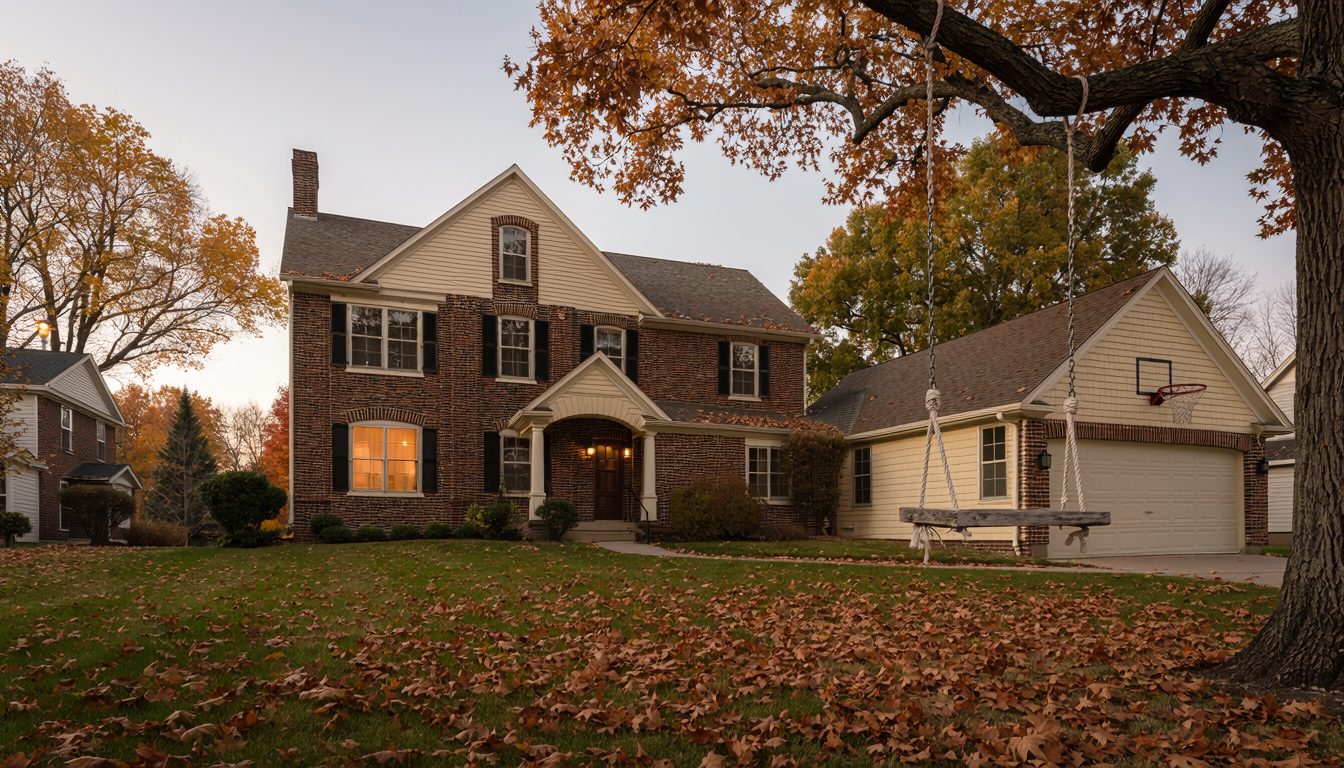
Across the U.S., empty-nest baby boomers own a far larger share of family-sized homes than millennials raising children, even though millennials are now the country’s largest generation of parents. Much of that comes down to money: many boomers have paid off their mortgages or locked in low rates years ago, so selling would mean trading a small or nonexistent payment for a new loan at today’s rates. Many also prefer to stay near friends, family, and long-held routines.
Homeowners are also staying in their homes longer than ever before selling. Part of that is the lock-in effect of low-rate mortgages, and part is age: many of today’s sellers have owned a family home for decades and are only now reaching the stage of life when a move makes sense. Without a clear reason to go, most owners stay put.
In Hamilton County, Indiana, the same calculation is playing out in Carmel’s established neighborhoods. Shelly Walters-Cifelli of the Shelly Walters Realty Group says long-time owners are weighing what their equity would actually buy and deciding to stay. “They’re not leaving their houses as much,” she says.
That choice shapes a market where inventory is already rising, and buyers are growing more selective. It also keeps a group of potential sellers on the sidelines just as the county heads into a seasonal slowdown.
The Downsizing Math Fails
The problem is arithmetic. Many long-time owners bought years ago, before the run-up in prices, and have since built up substantial equity. On paper, that equity looks like freedom: sell the family home, take the gain and move somewhere smaller and easier to maintain.
In practice, the gain does not stretch as far as it once did. Because prices have climbed across the board, a smaller home now costs nearly as much as the larger one sells for. An owner can spend most or all of the sale proceeds on the next house and still end up with noticeably less space. Once moving costs, closing costs, and the effort of uprooting are added in, the trade can leave an owner no better off financially and worse off in day-to-day comfort.
For owners without a pressing reason to move, that is a hard trade to accept. Unless staying put means losing money or giving something up, there is little reason to leave, so most simply stay.
Options Exist, Urgency Doesn’t
Hamilton County does not lack places for older buyers to go. Walters-Cifelli points to several active-adult neighborhoods around the county, built for people who want less house and less upkeep, and empty nesters are free to move into them if they choose. The option is there for anyone who wants it.
What is missing is a reason to act. In Carmel, Walters-Cifelli’s read centers on price: when buying again costs nearly what selling brings in, the move stops making sense.
When older owners do move, family tends to drive the decision more than the market. For buyers later in life, many of them retired, being close to children, grandchildren and friends now matters more than a short commute or a bigger lot. That changes the calculation for an empty nester in Carmel. If family, friends and daily routines are already nearby, a move across town to a newer, smaller home offers little that the current house does not, and downsizing becomes compelling mainly when it brings an owner closer to the people they want to be near. That may help explain why the availability of active-adult neighborhoods nearby has not been enough on its own to draw long-time owners out of their homes.
The Cost of Staying
Staying put is also relatively inexpensive in Indiana. Walters-Cifelli lists low taxes alongside schools and cost of living as reasons people are drawn to Carmel. The state’s constitution caps how much homeowners can be taxed relative to the value of the home they live in, so even as home values have climbed, a long-time owner’s annual bill has stayed in check.
Recent state legislation has added to that cushion. Starting this year, every homeowner receives a credit that takes a portion off the property tax bill. The same law replaced an older deduction for seniors with a direct credit and widened access to a separate protection that limits how quickly taxes can rise on a senior’s home, for households below set income limits.
None of these changes is large enough by itself to decide whether someone sells. But for an owner who has paid off the mortgage or holds a low rate, property taxes are often one of the highest remaining costs of living in the house. When that cost is capped and predictable, the case for staying in a family-sized home gets stronger, even after the children have moved out.
Supply That Stays Home
The result is housing that exists but is not changing hands. Walters-Cifelli describes it as pent-up supply: homes that will stay with their owners until something forces a move.
That is happening even as inventory across Carmel and its neighboring towns climbs. More homes are for sale than a year ago, but long-time owners who would otherwise be trading down are largely missing from the new listings. Supply is growing, just not from the households most likely to downsize.
The homes being held back also tend to sit at the upper end of the market, where demand is still strong, and well-priced listings can draw several offers and sell quickly. In the more affordable range, buyers are taking longer to decide and negotiating harder. Empty nesters who stay put are holding much of the type of property buyers are still competing for.
What Could Shift It
As Walters-Cifelli describes it, what eventually moves these owners is need rather than opportunity. Until they have to move, the equity stays where it is.
Over a longer horizon, demographics may do what market conditions have not. As the population of older homeowners grows, more of them will reach the point where a move becomes necessary or appealing, and many will have the equity to make it happen. Owners who have spent decades in a family home are only now arriving at the stage of life when trading down makes sense. If that pattern holds in Hamilton County, the larger homes now held by long-time owners would likely return to the market gradually rather than all at once.
The wider market is entering its seasonal pause. Some sellers are pulling listings to relaunch in the spring, and few new ones are arriving before January. Walters-Cifelli says the open question for 2027 is whether the inventory build that began in mid-June continues, and next spring will be “very interesting” for finding out.
About The Expert: Shelly Walters-Cifelli leads the Shelly Walters Realty Group, a family team with F.C. Tucker Company based in Carmel, Indiana. She focuses on residential sales across Hamilton County and lakefront properties in Brown County.
This article is based on information provided by the expert source cited above. It is intended for general informational purposes only and does not constitute legal, financial, or real estate advice. Readers should conduct their own research and consult qualified professionals before making any real estate or financial decisions.