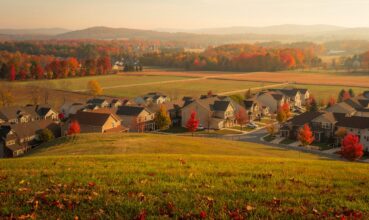
Columbia County, the northernmost part of New York’s Hudson Valley, has been recalibrating after an intense period of outside attention. The pandemic brought in a wave of city dwellers seeking space and quiet. In many cases, that wave has since receded. What remains is a market that is more locally grounded, and in some areas, more active than before.
Daniel ‘Dan’ Mahar, founder and principal broker of Mahar Real Estate, LLC, has watched this cycle play out from the ground up. After five years at Coldwell Banker, he launched his own firm in the summer of 2024, building a team of ten agents and a full-time office manager in under a year. His focus is on Columbia County, specifically the city of Hudson. This compact, historically rich river town became one of the most sought-after short-term rental destinations in the Northeast during the pandemic years.
Post-Pandemic Market Correction
The 2020 to 2022 period reshaped Columbia County’s residential market in ways still being absorbed. Prices rose sharply as New York City residents left the city’s dense urban areas. Hudson, in particular, became a destination for second-home buyers, short-term rental investors, and remote workers seeking an alternative to city life.
That wave has now largely receded. According to Mahar, the buyers who came for the moment rather than the long term have largely moved on. “The part-time neighbors that don’t want to be full-time have returned,” he says. What that has left behind is a more stable, if quieter, market. Inventory has returned to normal levels, and year-over-year sales have remained consistent.
Buyer Profile
Interest rates remain a factor, but Mahar is careful to put them in context. For buyers making a genuine lifestyle change, whether relocating full-time, investing in a second home, or deploying capital through an exchange, a percentage point in borrowing costs rarely determines the outcome. “They’re making a 30-year decision. It’s more about the positioning of the property,” he says.
The buyer profile in Hudson skews toward second-home purchasers and investors, many of whom transact in cash or through 1031 exchanges. Rate sensitivity is more pronounced in the surrounding towns, where local buyers are financing purchases more conventionally. Overall, Mahar says, the county has held steady across both groups.
Neighborhood Price Breakdown
Within the city of Hudson, the market operates almost like a separate ecosystem. Warren Street, the main commercial corridor, anchors everything. Properties in the middle stretch, roughly from Third to Seventh Street, are well developed and command premium prices. The residential blocks at either end of that strip, and the parallel side streets, including State, Allen, Union, and Columbia, are where Mahar sees the most meaningful activity right now.
Those mid-block side streets between the 300 and 700 blocks are, in Mahar’s view, the most sought-after properties in the city. They are well-positioned for renovation and attractive to both investors and owner-occupants. To buy a finished, move-in-ready property in downtown Hudson today, buyers should expect to spend at least $1.1 million. The most expensive active listing on Warren Street is currently asking $3.8 million. For buyers willing to take on renovation work, entry points in the $400,000 to $500,000 range exist on the side streets. “If you put the money in, you will get it back,” Mahar says.
The most common deal-breaker in the area is not price or rate but condition. Columbia County’s housing stock skews old. Mahar has sold properties dating back to 1742, and inspection issues reflect that age. Water infiltration in basements, failing mechanical systems, and deferred maintenance on ventilation are recurring friction points. A bathroom exhaust fan venting into an attic rather than outside is a small oversight that creates moisture and mold, and it is the kind of issue that can stall or kill a deal.
Limited New Construction Supply
Unlike counties closer to New York City, where development pressure is constant, Columbia County has seen almost no new residential construction. The population base is not large enough, and job opportunities are too limited, for developers to build at scale. “No major developments are coming through,” Mahar says.
The hospital in Hudson is the county’s largest employer, and most of its workforce is already housed. Remote work has filled some of the gap, but not enough to drive a construction wave. This absence of new supply reinforces the value of existing inventory, particularly renovated properties in desirable locations, and keeps the market oriented around older stock that requires knowledge and patience to navigate.
Short-Term Rental Regulations
Hudson’s short-term rental market remains significant, though it now operates within a regulatory framework that did not exist five years ago. The city requires permits, mandates that owners either live on-site or have a manager nearby, and conducts inspections to ensure basic safety standards are met. Tax collection has been formalized. The infrastructure strain that accompanied the early Airbnb boom, including stress on gas lines, sewer lines, and electrical systems, prompted those changes.
Beyond the city limits, individual towns handle regulation differently. Hillsdale, for example, caps short-term rental use at 99 nights per year before a property is treated as a commercial lodging operation. Buyers considering income-generating properties need to conduct town-specific due diligence before committing. The underlying demand that made Hudson an Airbnb destination has not disappeared. The town draws visitors from New York City via a two-hour train ride, and the mix of antique shops, restaurants, hiking at Olana State Park, river access, and proximity to the Catamount ski area keeps seasonal traffic flowing year-round.
Local Expertise Drives Results
With broader economic and geopolitical uncertainty hanging over 2026, Mahar is watching conditions with measured attention. He notes that periods of anxiety in New York City have historically produced temporary upticks in Hudson Valley interest, followed by a return to baseline. The buyers who matter most, he suggests, are not the ones reacting to headlines.
“The serious buyers, not just from New York but locally as well, haven’t left. They are educated. They are more selective,” he says. Mahar’s approach relies on ground-level knowledge: knowing what is coming to market before it lists, understanding which blocks are gaining momentum, and being able to walk a property with a buyer and explain what they are actually looking at. That instinct led him to win a listing on a 3,000-square-foot ranch house that had not sold since 1999, price it at $725,000, and watch it close at $750,000 within 12 hours to a buyer who flew in from Santa Fe. “I firmly believe that most properties do not have to rely on the market. They rely on the marketing.”
About the Expert: Daniel ‘Dan’ Mahar is the founder and principal broker of Mahar Real Estate, LLC, a Columbia County firm he launched in 2024 after five years at Coldwell Banker. He specializes in the Hudson, New York market and leads a team of ten agents focused on residential sales, investment properties, and short-term rental acquisitions across the Hudson Valley.
This article is based on information provided by the expert source cited above. It is intended for general informational purposes only and does not constitute legal, financial, or real estate advice. Readers should conduct their own research and consult qualified professionals before making any real estate or financial decisions.