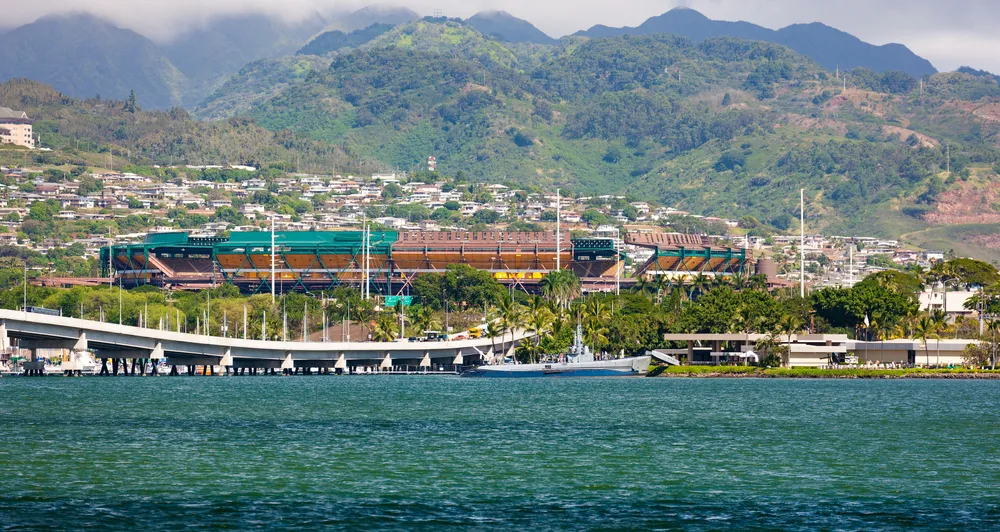
Hawaii has almost no institutional experience with public-private partnerships. The state has completed, by one account, a single P3 in its history, a small apartment complex near the university. A planned P3 for a segment of Honolulu’s rail system was withdrawn during procurement. Now the state is attempting to execute what may be its most complex development project ever, a 98.5-acre mixed-use district anchored by a new stadium, using a procurement model its own government has barely practiced.
That gap between ambition and institutional readiness is the central tension running through the Aloha Stadium redevelopment, a project that combines demolition of a condemned 1975-era stadium with construction of a new venue and surrounding district that includes 4,500 apartment units, mixed-use retail, and two hotels totaling a thousand rooms.
Island Realities
One of the early friction points involved how the state’s outside attorneys – based in Los Angeles – structured the project’s legal agreements. The mainland approach called for three separate documents: a master development agreement, a ground lease, and a shared infrastructure agreement, each treated independently to maximize state protection against developer insolvency.
Michael Yadao, Interim Stadium Manager and Executive Director overseeing the project for the state, pushed back on that framework. On the mainland, separating agreements protects against a development partner declaring bankruptcy and leaving the state. “That doesn’t happen in Hawaii because there’s no place else to go,” Yadao said. “We’re an island.”
The resolution folded the ground lease and shared infrastructure agreement into the master development agreement as attachments, a structure more consistent with how Hawaii handles real estate agreements. The stadium authority’s board has approved execution of the consolidated agreement, with attorneys finalizing details.
Rent as the Core Negotiation
The most time-consuming negotiation point was rent. The state committed $400 million to the stadium build – $49.5 million for pre-construction planning and $350 million as a direct payment to the development team, Aloha Halawa District Partners. The private side contributes $300 million of its own capital to deliver a stadium valued between $650 and $700 million. Beyond the stadium, the district buildout is entirely privately financed.
The challenge was structuring rent so the state could reach net zero on stadium maintenance costs without charging levels that would undermine the developer’s ability to finance infrastructure. “The stadium is the obligation for AHDP. The district is the opportunity,” Yadao said. The negotiation also had to address what happens if the developer sells assets, ensuring the state recoups its investment in the partnership.
Those rent negotiations ran roughly two months past the original target, wrapping in May and June rather than March and April.
Logistics on an Island With One Heavy Crane
Demolition began in February 2026, with contracts signed the previous October. The east and west sections of the old stadium are gone, and the south end zone is nearly cleared. Full demolition is expected by November, with groundbreaking on the new stadium in December or January.
The physical constraint slowing the work is the availability of equipment. The north and south end zones used heavier steel girders than the moveable east-west sections, requiring a specific heavy-duty crane – the largest on the island – to remove pieces individually. That crane rotates between construction sites across Oahu.
“We hacked away the end zone closest to us because we had the crane for a couple months, but then I have to loan the crane out to another construction site for a little bit,” Yadao said. “And now I’ve got to wait for that crane to come back.”
The Timeline Question
The contract requires delivery by spring 2029 for football season. After June or July 2029, monthly financial penalties begin unless the agreement is amended. Hawaii’s reputation for construction delays – driven by supply chain constraints, weather, and labor competition from military projects – makes outside observers skeptical.
Financing posed an early challenge. According to Yadao, every time state government publicly signaled uncertainty about the P3 model, the development team’s ability to attract mainland venture capital took a hit. Once the government committed firmly, “people are falling out of the woodwork to invest and be here,” he said.
Permitting, Hawaii’s other notorious bottleneck, has not yet caused delays, a result Yadao attributes to direct support from the governor and the mayor of Honolulu. He noted that a recent university renovation elsewhere on the island took 18 months to get a permit that should have taken half that time, suggesting the broader permitting environment has not changed even if this project has benefited from political attention.
Yadao estimates the current pressure breaks down to roughly 60 percent infrastructure coordination and 40 percent financing and permitting combined.
What the Project Signals
The stadium authority is positioning this project as a template for how expedited permitting and government-private coordination could work across Hawaii’s real estate market. That framing is ambitious for a project that required a new state law just to allow private concessions inside the stadium, bypassing the Blind Vendors Act and lowest-bidder procurement rules that previously governed public venues.
The structural advantages here – three interstate highways converging, rail access, proximity to the airport and Pearl Harbor – are site-specific and cannot be replicated elsewhere. But the legal and procedural precedents being set around P3 contracting, concession flexibility, and consolidated agreement structures could reduce friction for future projects if state agencies choose to adopt them.
The more immediate test is whether a state with essentially no P3 track record can execute a $650-plus million stadium build on schedule while simultaneously managing a swap meet generating $5 to $7 million annually, hosting concerts for over 10,000 attendees, and coordinating with the Navy on shared infrastructure. The next 12 months, as demolition wraps and vertical construction begins, will show whether the institutional learning has kept pace with the project’s demands.
About the Expert: Michael Yadao is Interim Stadium Manager and Executive Director overseeing the Aloha Stadium redevelopment for the State of Hawaii, a 98.5-acre mixed-use district project combining a new stadium with 4,500 apartment units, mixed-use retail, and two hotels.
This article is based on information provided by the expert source cited above. It is intended for general informational purposes only and does not constitute legal, financial, or real estate advice. Readers should conduct their own research and consult qualified professionals before making any real estate or financial decisions.