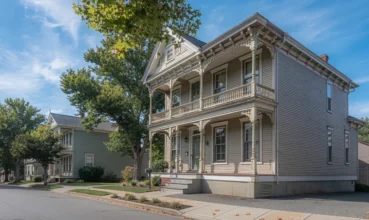
Over the past forty years, the Richmond real estate market has seen major changes in how buyers approach historic homes and luxury properties. Christopher Small, broker and owner of Park27, has observed these shifts firsthand since starting his career at age 18 in 1982.
Small’s entry into real estate was shaped by family experience and targeted education. His father owned a real estate agency, giving Small early exposure to the industry. He later enrolled in Virginia Commonwealth University’s real estate program, which allowed him to build an interdisciplinary curriculum focused on city planning, interior design, and architectural history. This approach, Small says, helped him develop expertise beyond standard sales and contracts, giving him a deeper understanding of preservation and urban development.
Historic Property Buyers
Small specializes in Richmond’s historic neighborhoods, and he has seen a clear change in buyer attitudes since the 1980s. Four decades ago, buyers drawn to these areas were typically comfortable with the quirks and challenges of older homes. Many were willing to put in significant hands-on work, from repairs to renovations, and saw value in restoring historic properties themselves.
Today’s buyers are often attracted to the reputation and aesthetics of historic neighborhoods but are less familiar with the realities of owning and maintaining an older home. Small notes that this lack of understanding can complicate transactions. Features like knob and tube wiring or lead paint — common in pre-1940s homes — are now frequent sources of concern, especially when buyers or their agents lack experience with historic properties. Instead of seeing these as manageable issues, buyers sometimes view them as dealbreakers or evidence of deeper problems, leading to drawn-out negotiations and, in some cases, failed sales.
This gap in buyer education is often made worse when agents are unfamiliar with the technical and regulatory aspects of historic homes. Small says that agents who do not know how to address common features or required upgrades can create unnecessary drama, slowing deals and adding stress for all parties.
Luxury Market Realities
Richmond’s luxury market operates with its own set of expectations, often surprising buyers from larger or more expensive cities. Small recalls working with a buyer accustomed to paying $15–18 million for homes in other markets, who struggled to accept that a premier Monument Avenue property in Richmond was valued at just $2 million. “He just couldn’t understand that it was worth no more than like $2 million,” Small says. “Should be and what it is are completely different.”
This pricing gap, Small argues, reflects Richmond’s status as “one of the most undervalued state capitals on the East Coast.” While some local buyers perceive prices as high, the market remains far more affordable than comparable cities. This disconnect creates opportunities for buyers relocating from higher-cost areas, but it can also create friction for sellers whose price expectations are set by national headlines rather than local realities.
Innovation in a Traditional Market
Despite Richmond’s reputation for traditional real estate practices, Small has prioritized innovation throughout his career. He was among the first in the region to use social media for marketing, building a Facebook following of over 500,000 by adopting the platform early and consistently promoting his brand. This early embrace of digital tools set his firm apart in a market that is often slow to adopt new technologies.
Small’s approach to branding and marketing reflects his broader philosophy: staying ahead of the curve while remaining grounded in the fundamentals of the business. He views innovation not as a one-time adjustment, but as an ongoing process necessary to serve modern buyers and sellers.
Current Market Dynamics
Today, Richmond’s buyer pool remains stable, with most demand coming from the two surrounding counties. While the pandemic brought some migration from higher-cost markets, especially Manhattan, that wave has largely settled. Most newcomers who arrived during the pandemic have chosen to stay, drawn by the city’s quality of life and affordability.
Richmond’s market stability is underpinned by its diverse economic base. State government, universities, and a growing corporate sector have helped the city avoid the extreme booms and busts seen in markets dominated by a single industry. This diversity has allowed Richmond to weather national downturns with less volatility, providing a foundation for steady growth rather than dramatic swings.
Professional Evolution and Business Strategy
After four decades operating under his own name, Small recently rebranded his firm as Park27. He worked with 1000 Watt consulting to create a more modern platform designed to attract agents who value innovation and attention to detail. The rebrand is more than a name change: it signals a strategic effort to build a company culture that rewards forward-thinking approaches, rather than relying on methods that “haven’t evolved since 1980,” as Small puts it.
This shift is also about preparing for future growth. By positioning Park27 as a platform for like-minded professionals, Small aims to expand his reach while maintaining high standards for client service and market knowledge.
Looking Forward
Small is optimistic about Richmond’s prospects for the next several years. He points to recent recognition from Zillow, which included Richmond on its list of top 10 North American housing markets for the year. “Our market is poised for pretty strong growth this year,” Small says. He attributes this strength to Richmond’s location in the mid-Atlantic, convenient access to Washington, D.C., and New York, and steady corporate investment.
The city’s resilience during recent economic uncertainty sets it apart from markets that saw dramatic corrections after the pandemic. Richmond’s diverse job base and manageable price points continue to attract both local and relocating buyers, supporting a healthy level of activity even as other cities cool.
While technology, marketing, and buyer expectations have all changed over the past forty years, Small believes that the fundamentals of real estate remain the same. Listening to clients, understanding the details of each property, and maintaining high professional standards are still the key drivers of success. As Richmond’s market continues to evolve, these principles will remain central to serving clients and building a sustainable business.
Looking ahead, Small sees Richmond’s combination of affordability, economic diversity, and increasing national recognition as a foundation for continued growth. For buyers and sellers willing to adapt to current realities — and for professionals committed to education and innovation — the next chapter in Richmond real estate offers both stability and opportunity.