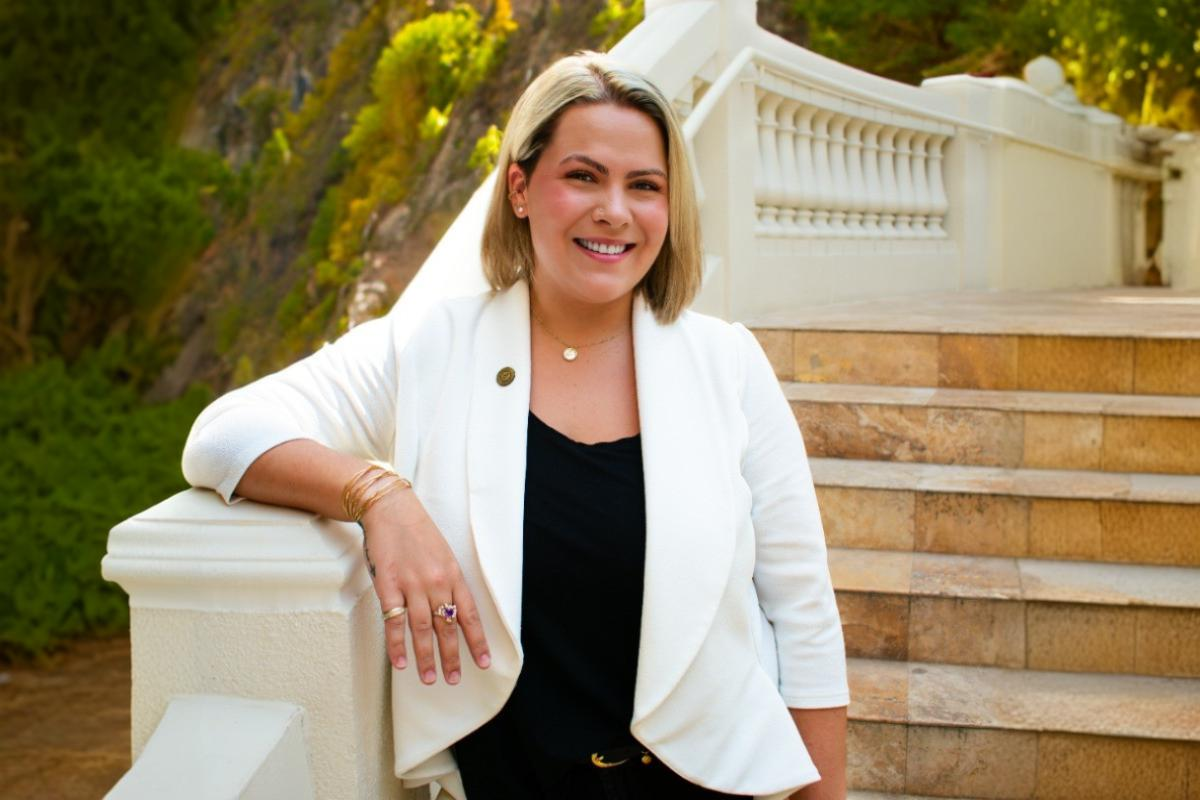
“I got into real estate somewhat by accident. I don’t know anyone who grows up saying ‘I want to be a real estate agent when I grow up,'” says Cora Rasmussen, a real estate agent with Realty ONE Group Emerald Coast who has successfully navigated the diverse Northwest Florida market for five years.
Rasmussen’s journey to real estate began in an unlikely place: professional kitchens. Originally from the Pacific Northwest, she worked as a chef in Seattle-Tacoma until falling in love with an active-duty Army serviceman stationed in Northwest Florida. Her culinary career took an unexpected turn when she arrived in the Sunshine State.
“I went into a Northwest Florida kitchen, and they taught me how to make gumbo on the first day, and handed me a two-by-four, and said, ‘Hey, when you take out the trash, this is to hit the rats,'” Rasmussen recalls with a laugh. “I said, ‘Oh my god, this is not the same.'”
This culture shock prompted a quick pivot to bartending, which she viewed as a temporary solution while her husband was stationed in the area. During this time, she met Jacqui Luberto, who would become her broker and mentor.
“She hired me as her personal assistant. One day, she said, ‘Hey, I’m starting a brokerage. Do you want to come?’ I had no idea what any of those words meant, but I said, ‘Sure, yes. Why not?'” Rasmussen explains.
Initially serving as the Marketing Manager for eight months, Rasmussen eventually obtained her real estate license at Luberto’s encouragement. Her philosophy of saying “yes” to new opportunities has served her well, leading to expertise in both single-family homes and the condo market.
Northwest Florida’s Uniquely Resilient Real Estate Market
Now in her fifth year as a licensed agent, Rasmussen serves a market that stretches from Pensacola to Panama City. What makes this region unique is its diverse buyer pool that creates a protective economic buffer against market downturns.
“We have rental properties attracting investors. We have military buyers, retirees, and a substantial local population,” Rasmussen notes. “The market’s always active because there’s always someone moving somewhere.”
This diversity creates stability even when national trends suggest slowdowns. Her business is approximately 70% single-family residential, with the remaining 30% focused on the rental market, particularly Florida condos. The seasonal nature of the area means March through September represents peak season for rental properties, while winter months typically focus on helping families relocate.
Two Types of Sellers in Today’s Market
Despite the nationwide trend where homeowners with low mortgage rates are reluctant to sell, Rasmussen identifies two primary groups of sellers in her market.
The first group consists of military personnel who typically stay in the area for about three years before receiving new orders. “If they bought within the last two and a half, three years, their rates are high, and the rental market doesn’t currently support what their mortgage payment would be,” Rasmussen explains. “So they sell in favor of maybe breaking even on a mortgage.”
The second major seller group emerged from COVID-era migration patterns. “Florida was wide open. We closed down for a couple of weeks, and then it was, you know, it’s the South. What are you going to do? Tell us what to do? No,” she says with a chuckle. “We were just flooded by people from Indiana, Illinois, California, and a little bit from New York.”
These pandemic transplants, often working remotely, are now experiencing what Rasmussen calls “novelty wear-off.” The area’s small-town feel and limited entertainment options can become challenging for those accustomed to big-city amenities.
“If you’re from one of those big cities, and you move to a small town, it gets old. I’ve been here for eight years, and I’ve done one of everything,” she admits. “If you’re a concert-goer, we don’t have that here.”
Weather expectations have also played a role in some departures. “People thought, ‘Oh, I moved to Florida. No winter.’ We had, I think, eight inches of snow this past winter. So those people said, ‘Oh, bye, we’re going further south.'”
The Condo Market’s Remarkable Recovery
Florida’s condo market faced significant challenges following the tragic Surfside condo collapse in Miami in 2021, but Rasmussen sees clear signs of recovery in her region.
“When the tower fell in Miami, that was a hard stop moment for condos. The whole state had to buckle down, get their SEER reports, and re-evaluate,”she explains. “We have gotten far enough from that where pretty much all buildings are back on track, with the exception of a few. I can think of three in the area that are still having repairs done and seeing special assessments.”
This recovery has led to renewed interest in condo purchases. “I’m getting more inquiries about it than I have in the last two, two and a half years,” Rasmussen notes.
However, the rental income expectations for condo owners have normalized after the pandemic boom. “In 2021-2022, we were about 90% occupancy. Now we’ve gotten back down to what’s normal for us, about 70% occupancy,” she explains. “People that aren’t seeing those big rental numbers are mostly the ones leaving.”
The timing creates additional challenges for these sellers. “The hard part for them is they also bought during a high market, so now they’re having to sell when many others are selling,” Rasmussen points out. “The people that are selling and doing well are either ones that bought a distressed unit and fixed it, or they’re willing to take either a loss or very minimal gain.”
Today’s Buyers: Military Families and Northeastern Transplants
Military buyers continue to dominate the market, accounting for approximately 50% of purchases. Beyond this core group, Rasmussen has observed an emerging trend of middle-aged families relocating from the Northeast.
“There’s becoming a small movement of families where the kids are in middle school, maybe high school. People want to be in a smaller town, want to be closer to the beach, kind of get away from the cities,” she says.
Interestingly, the West Coast migration that was prominent during the pandemic has slowed considerably. “I haven’t helped anyone move from the West Coast in probably two years. Maybe they like Texas, so I guess they’re all going to Texas,” she observes with a smile.
These Northeastern transplants are typically either retirees or “young families coming down and wanting to be at the beach and have activities for the kids to do and be outside.”
The “Accidental Landlord”Phenomenon: Less Common Than Expected
While some markets have seen a surge in “accidental landlords,” homeowners who keep their properties as rentals when they move rather than selling, Rasmussen hasn’t observed this trend as prominently in her area.
“It’s definitely a buyer’s market here. Something might be on the market for three to six months, and sellers are saying, ‘Hey, what’s going on? We can’t keep paying this mortgage,’ and then look at renting out that property,” she explains.
She notes that younger generations seem less inclined toward landlording, despite her own positive experience with it. “I personally am a landlord, and I think it’s great. It’s great passive income,” Rasmussen says, though she acknowledges the challenges, including a tenant who once caused $8,000 in damage.
“I know a couple of my friends are kind of like, ‘Oh, you’re a landlord? You’re bad. Bad Cora, bad landlord.’ So there’s kind of a stigma around it.”
Market Outlook: Cautious Optimism Prevails
Looking ahead, Rasmussen maintains a measured perspective on market predictions. “It is so hard to predict what the market’s going to do. I don’t agree with the people on Instagram reels who say this is going to be a huge year for real estate, rates are going to tank. I don’t think that’s going to happen in the next year.”
What she does see is buyers adjusting to current conditions. “There was a lot of fear last year and the tail end of the year before, where buying a house was a bad idea. What’s the market going to do? What’s going to happen? It’s scary. That fear is diminishing.”
This shift in sentiment leads her to a cautiously optimistic outlook: “I think it’ll be a better year this year than it was last year, but I certainly don’t think it’s going to be tremendous.”
For investors and real estate professionals looking at Northwest Florida, Rasmussen’s insights highlight the area’s unique market dynamics, a diverse buyer pool that provides resilience, a recovering condo market, and a steady military presence that ensures consistent demand regardless of broader economic conditions.
This article was sourced from a live expert interview.
Every month we conduct hundreds of interviews with active market practitioners - thousands to date.
The ripple effects of New York City’s housing costs are changing development patterns across the tri-state area, with Jersey City’s McGinley Square emerging as an unexpected bene...
“In commercial real estate development, having cash tied up in earnest money deposits can be the difference between seizing a prime opportunity and watching it slip away,” says A...
Chicago’s luxury real estate market is undergoing significant changes, driven by the largest generational wealth transfer in U.S. history and a shift in work habits that is redrawing the c...
The real estate media industry is undergoing rapid technological change, and Tom Sparks, the new owner of the We Get Around Network (WGAN), is at the center of this evolution. Sparks has bui...
Northern New Jersey’s real estate market continues to defy national trends, maintaining intense competition and rising prices even as other regions cool. For agents and buyers in this dens...
The private real estate market has operated for decades with a defining limitation: once invested, limited partners are typically locked into syndicates or funds for five to ten years, with ...