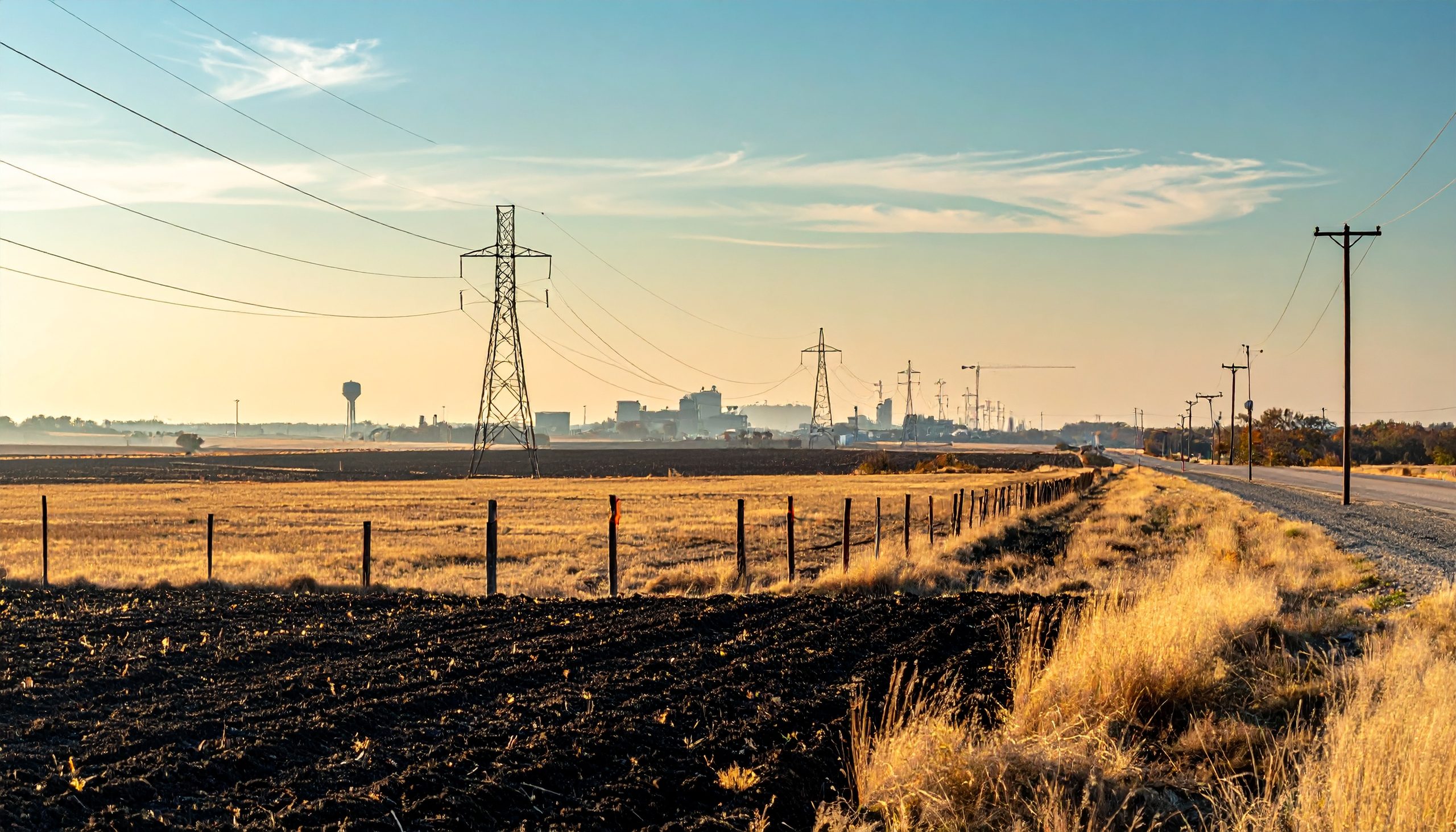
Land deals around Austin, Texas, are picking up in 2026 after roughly three years in which developers largely stopped transacting, according to one land specialist working the market. The tracts moving fastest tend to be the ones that come with documentation proving they can actually be built on. In a region where water capacity, sewer access, and electrical infrastructure vary sharply from one tract to the next, the gap between raw dirt and development-ready land is shaping which properties sell and at what price.
Alice Duffy, who leads the Duffy Real Estate Team and specializes in land around Taylor, Texas, describes the shift directly. “For the last three years, developers have been frozen. They’re not closing things, they’re not putting new stuff under contract, they’re just not transacting,” she says. “And this year we closed a lot of land deals and a lot more under contract.”
Much of that activity is concentrated around Taylor, northeast of Austin, where Samsung’s semiconductor plant is nearing operation after years of delays. According to Duffy, some suppliers and contractors serving the plant must be located within a set distance of it to win contracts, so many are buying nearby land for warehouses and facilities.
Selling Dirt and Paper
Duffy draws a distinction between two components of any land deal in this market: dirt and paper. The dirt is the acreage. The paper is everything that proves the land can be developed, including environmental studies, road agreements, sewer and water capacity commitments, zoning where it applies, and agreements with state regulators.
“What people don’t understand is they want to sell their dirt as if it has paper. And it doesn’t always have paper,” she says. The result, she explains, is a pricing mistake: owners see a nearby tract sell for a high price and assume theirs is worth the same, without realizing the buyer was also paying for the studies and approvals behind it.
The distinction matters because infrastructure in this part of Texas is not uniform. Land outside municipal sewer service lines may require a developer to create a municipal utility district, install a package treatment plant, obtain a land application permit, or use a commercial-grade septic system. Water service around Taylor falls under one of several providers, and Duffy says they do not all have the capacity for every type of development. “You’re not just selling dirt,” she says. “You’re selling the ability to build what you want to build.”
Utilities Drive Land Prices
Data centers show the infrastructure math at its most extreme. According to Duffy, a large tract with strong power access can command a premium from data center developers. Without it, the developer has to bring power in, sometimes from miles away, and may need a transfer station to keep the electricity at full strength over that distance.
“The developer will have to pay for that transfer station,” she says. The land for that station may have to be taken through condemnation, with the owner compensated, and every property the power line crosses needs an easement. Each step adds time and cost, which comes off what the land is worth.
Power is only part of it. Duffy says data centers typically want two separate electric services plus gas, and a large supply of water to get started, though many then recycle that water once running. The demand is real: Taylor has approved several data center projects this year, and the Rockdale area to the east already hosts large operations.
Water limits force pivots in other development types as well. “We sometimes think we’re going to be able to build retail. We can’t. We have to pivot to industrial because it has a lower water usage,” Duffy says. In other cases, developers assemble adjacent tracts because a package sewer plant needs more acreage to make economic sense.
Sometimes the analysis leads to a harder conversation. “Sometimes we have to go to our clients and say this is not commercial land,” Duffy says. Agricultural land tends to sell for less, she adds, but some tracts are best kept in agricultural use.
Pricing Discipline Moves Deals
Accurate pricing and flexible terms are what Duffy sees moving land now. Overpriced land, she says, will not sell, because land buyers are developers and investors who know how a project pencils. “We know what it’s supposed to cost,” she says, adding that the market ultimately sets the price.
Longer due diligence periods are now standard, and sellers have to be willing to accept them. Duffy points to two tracts that drew multiple offers and went under contract after being priced correctly, and a third in multiple offers where terms were still being negotiated.
Her read on the broader Austin residential market points to the same need for local precision. She describes it as “pocketed,” with conditions changing neighborhood by neighborhood. In one, her team listed a home alongside 17 others, about three months of inventory. In another, a coming-soon listing drew six inquiries because nothing else was available.
Taylor Moves in Waves
Taylor’s land market has moved in waves tied to Samsung’s timeline. Duffy says prices spiked when Samsung announced the project, cooled after the first round of buying, and stalled when the plant’s opening was delayed. Signing Tesla as a major customer revived demand by signaling the plant would open and stay busy.
“Once we got the contract from Tesla, things really started heating back up again,” Duffy says. She also holds regular meetings at the local library, where landowners ask how pipelines, power lines, and condemnation, the government’s power to take land for public projects, could affect them.
Local land-use rules have also shaped the market. Duffy says Taylor tried to restrict land use in its extraterritorial jurisdiction, the unincorporated area just outside city limits, in ways she argues state law does not allow, making some tracts harder to sell. She says she consulted on the state law that now lets owners petition out of that jurisdiction.
Frustrated Sellers, Hesitant Buyers
Duffy says sellers are more realistic about price than during the pandemic-era rush but frustrated by how long deals take in a softer market. Buyers, meanwhile, are slow to commit. “There’s analysis paralysis,” she says. “They are believing all the different stories that it may or may not be a good time to buy.”
Her own approach runs against that caution. She says she tries to buy when others are afraid to and sell when others are holding out. “I’m always trying to do the opposite of the crowd because that’s when you make your money,” she says.
The return of land activity carries weight beyond Taylor. Developers plan on longer horizons than most buyers, so their renewed willingness to close suggests confidence in where demand is headed. Duffy says colleagues who specialize in land are reporting their best years even as much of the real estate industry struggles. “Dirt is moving again,” she says. “And that means the economy will wake back up.”
About the Expert: Alice Duffy leads the Duffy Real Estate Team with Keller Williams Lake Travis in the Austin, Texas area. Her team handles residential and commercial transactions across nearly every asset class, and she specializes in land for development in Taylor and surrounding communities.
This article is based on information provided by the expert source cited above. It is intended for general informational purposes only and does not constitute legal, financial, or real estate advice. Readers should conduct their own research and consult qualified professionals before making any real estate or financial decisions.