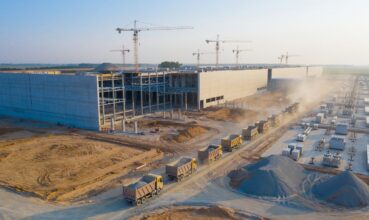
The Treasure Valley’s real estate market is undergoing rapid, large-scale changes as a result of a $15 billion federal investment in semiconductor manufacturing. What started as steady population and business growth has become a complex landscape of opportunity and strain, as developers, investors, and municipalities adapt to the demands of one of the nation’s most significant new industrial projects.
John Starr, partner in land brokerage services at Colliers Idaho, has observed these changes over more than two decades in commercial real estate and residential development. Starr says the region is attracting investment typically reserved for much larger cities, forcing the market to rethink how land deals are structured and which areas are positioned for future growth.
“In a community where we’re just pushing a million people, and we’re making that same kind of investment as larger cities, the change is unimaginable,” Starr says. “We’re starting to realize what this investment means for the greater Treasure Valley community in Southwest Idaho.”
The Micron Expansion
The driving force behind this surge is Micron Technology’s expansion in southeast Boise, enabled by funding from the federal CHIPS Act. Micron, founded in Boise in the late 1970s, is investing $15 billion to build new chip manufacturing facilities. Construction is underway on the second of several planned plants, known internally as “fab two.”
This massive project has triggered a sharp increase in demand for commercial space and land. “The folks executing the project have simply run out of room,” Starr says. Subcontractors working on the new facilities are searching for office space, staging areas, and other operational sites, often beyond southeast Boise when local options are exhausted.
As a result, the demand for industrial and commercial space now extends into West Meridian, Nampa, and Caldwell, five to ten miles from the main Micron site. This spillover is tightening available inventory and driving up prices in areas that, until recently, saw more moderate development activity.
Infrastructure Bottlenecks Slow Development
Despite surging demand, the region is hitting hard limits on infrastructure, especially in southeast Boise. The area lacks sufficient utilities to support rapid expansion, with sewer lines several miles away and local power capacity already maxed out. While water supply and road construction can be addressed, the absence of baseline services such as power and sewer presents immediate obstacles.
“We’re at a point where we need to deliver new land to this market, but we don’t have the resources at the property that can accomplish that,” Starr says. Idaho Power, the state-regulated utility, is unable to invest speculatively to build out capacity in advance of confirmed demand. “All the power needs we’re faced with right now would have been better suited by investing in them 10 or 20 years ago,” Starr adds.
This lack of available power has already cost the region potential deals. When data center operators approached local officials about a year ago, they were told there simply wasn’t enough power available to support their projects, despite having land and water access.
Municipal Pushback and Growth Fatigue
As growth accelerates, local governments are showing signs of strain. After 25 years of steady expansion, some communities are experiencing what Starr calls “growth fatigue.” This is showing up both in higher development fees and in political pushback.
In some cases, local elections have brought anti-growth candidates into office. For example, one Canyon County city recently elected a mayor who campaigned explicitly on restricting growth. This has introduced uncertainty for developers and national retailers, who may reconsider projects in areas perceived as hostile to new development.
“When developers read in the news that a community is anti-growth, they just say, ‘Let’s look elsewhere,’” Starr says. The effect is to discourage investment before negotiations have even begun.
Approval Delays and Staffing Limits
High volumes of new applications are also overwhelming municipal and county staff. Standard due diligence tasks, such as surveying and traffic studies, are now subject to long delays. Starr notes that a recent survey request was met with a two-month wait, and transportation impact studies can take even longer.
These delays are not just the result of political resistance but reflect limited staffing and resources. After the last recession, many local governments avoided overstaffing, leaving them unequipped to handle the current surge in development applications.
Land Scarcity Pushes Development
The supply of developable land is shrinking, especially in the area Starr describes as “the bread basket” of Treasure Valley – between Meridian and Nampa, south of the Boise River. Large tracts of farmland that remain viable for near-term development are now rare.
“You might be able to count on one hand the number of large tract pieces of farm ground in that area that are still in farmers’ hands and viable for development in the short term,” Starr says.
This scarcity is pushing new projects into less traditional areas, such as the desert south of Boise. Colliers Idaho is currently working on master-planned communities totaling several thousand homes, including a 1,700-acre project that could bring 7,000 to 8,000 new homes to the market.
Housing Market Squeezed by Limited Supply
Residential real estate is reflecting these broader constraints. In Ada County, the median home price has reached about $459,000, and there is little inventory available below $300,000. This has created a situation where out-of-state buyers, often with higher budgets, are competing with local buyers for mid-range homes.
Starr explains that buyers who previously would have targeted $2 or $3 million homes are now purchasing properties in the $1.2 to $1.5 million range, pushing up prices for what he describes as “lower quality product” – meaning homes that do not fully meet the expectations of those buyers, even if they are well built.
Investment Trends and the Path Forward
Looking ahead, Starr sees the pace and direction of capital investment as the key factor shaping the region’s future. Much of this investment is influenced by global economic conditions, and the region will require significant new capital to build the infrastructure needed for both industrial and residential growth.
Despite the challenges, Starr remains optimistic for investors who focus on areas with existing infrastructure. He advises targeting service commercial, industrial, retail, and residential projects in locations with existing strong utility and road access, rather than waiting for new infrastructure to be built out.
Lessons for Other Markets
The Boise area’s experience highlights how large-scale federal investment in manufacturing can quickly reshape local real estate dynamics. The $15 billion Micron expansion has created enormous opportunity but has also exposed the limits of infrastructure, the risks of delayed planning, and the political tensions that accompany rapid change.
For real estate professionals and investors, Boise is now a case study in how federal industrial policy and local development realities collide. The market is rewarding those who can move quickly in areas with existing utilities and punishing those who rely on promises of future infrastructure.
Going forward, the region’s ability to address power, sewer, and transportation constraints will determine how much of the current demand can be captured locally, and how much spills over into neighboring communities or is lost to other states. For now, Boise’s semiconductor surge is both a model of federal policy in action and a warning about the importance of planning for growth before it arrives.
About the Expert: John Starr is a partner in land brokerage services at Colliers Idaho, where he specializes in commercial and residential land development across the Treasure Valley region. With more than two decades of experience, he advises clients on how to navigate rapid growth pressures, infrastructure constraints, and shifting investment patterns driven by large-scale industrial expansion.
This article is based on information provided by the expert source cited above. It is intended for general informational purposes only and does not constitute legal, financial, or real estate advice. Readers should conduct their own research and consult qualified professionals before making any real estate or financial decisions.