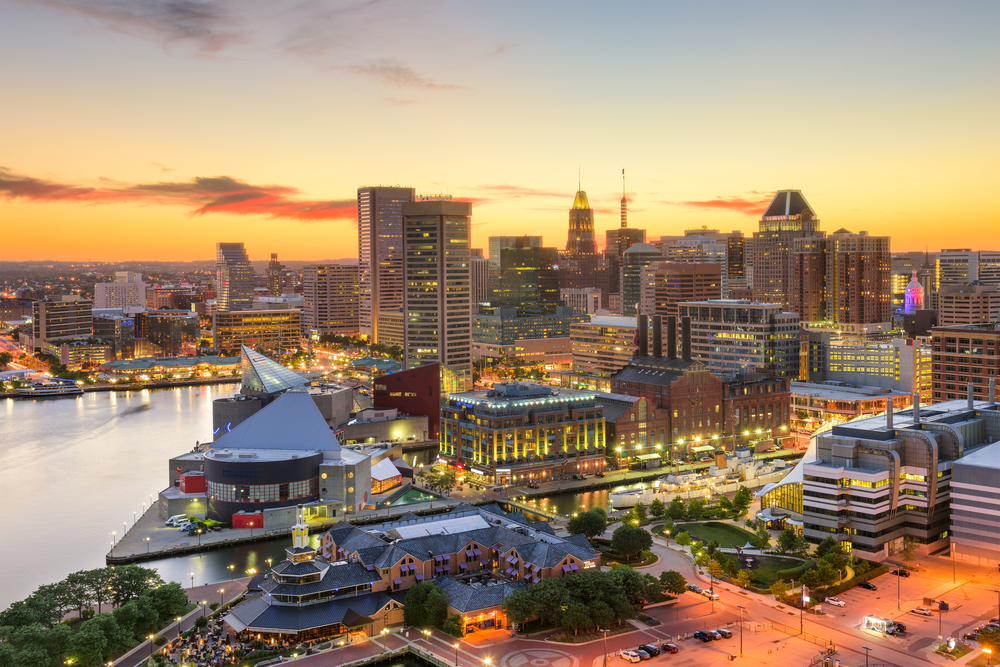
Agents report steady luxury demand and multiple offers in top Baltimore neighborhoods, even as national headlines focus on public safety concerns.
Baltimore’s image problem is creating a gap between perception and reality that often overshadows the city’s economic progress. While national media coverage highlights crime rates and urban decline, real estate agents working in Baltimore’s high-end neighborhoods see strong buyer demand, limited inventory, and frequent bidding wars for well-priced homes. Pitina Stucky De Juan, Team Lead at PS International Team with Monument Sotheby’s International Realty, says this disconnect deters potential buyers who could benefit from Baltimore’s affordable housing, proximity to major job centers, and a growing employment base.
“Baltimore does have a crime problem, but it’s similar to other cities,” Stucky De Juan says. She points out that most of the city is safe and that challenges are concentrated in specific neighborhoods that most residents or newcomers rarely visit. Media coverage rarely distinguishes between these areas and Baltimore’s thriving districts, creating a perception problem that affects property values and migration patterns across the metro.
What Is Driving Buyer Demand
Baltimore’s economic base is expanding in sectors that attract high-income, internationally mobile professionals. Johns Hopkins Hospital continues to draw doctors and researchers from South America, Asia, and Europe, and Stucky De Juan says these relocators make up a significant share of her buyer pool. “Johns Hopkins is a major international draw,” she notes, with many overseas doctors choosing to live in Baltimore’s most desirable neighborhoods.
Beyond healthcare, Baltimore has become increasingly attractive to tech startups, especially those priced out of San Francisco or New York. Stucky De Juan describes the city as a growing hub for companies in health tech and marketing technology, citing lower startup costs and access to a skilled workforce. “It’s cheaper to open a startup here than in those bigger markets,” she says.
Baltimore also benefits from its proximity to major federal employers, including the National Security Agency and NASA, both located within a half-hour drive of the city’s expanding South Baltimore neighborhood. This connectivity is drawing young professionals who want urban amenities without long commutes. “People want to live close to work and don’t want to spend an hour driving every day,” Stucky De Juan explains.
Financial services firms such as Morgan Stanley and T. Rowe Price have also expanded their presence in Baltimore, increasing the pool of high-income buyers. Stucky De Juan says these employers are bringing a new generation of professionals to the city, further strengthening demand for desirable homes.
Where Inventory Is Tightest
Despite ongoing perception challenges, Baltimore’s most sought-after neighborhoods are experiencing inventory shortages and strong competition among buyers. Stucky De Juan identifies seven neighborhoods — Fells Point, Canton, Federal Hill, Guilford, Homeland, Roland Park, and Washington Hill — where homes receive two to four offers and sell quickly.
“In these neighborhoods, there are hardly any homes for sale,” she says. “If you list a property, you’ll get multiple offers because inventory is extremely low.”
Stucky De Juan defines Baltimore’s luxury market as properties priced above $950,000, a segment that has grown as home values rise. Well-priced luxury listings still attract multiple offers, although the post-pandemic pace has subsided. She describes the current market as “more stable,” but notes that buyers are “very sensitive to changes in interest rates,” with even small rate increases affecting demand and negotiating power.
Why Demand Remains Strong
Fears that federal layoffs or budget cuts would weaken the housing market in the Washington-Baltimore corridor have not played out, according to Stucky De Juan. She initially expected uncertainty around government employment to slow buyer activity, but reports that demand has instead remained strong.
“There have been layoffs, but the city is attracting a younger population, and demand hasn’t dropped,” she says. Baltimore’s diversified job base and appeal to young professionals, many of whom prioritize walkable urban neighborhoods, are keeping the market active.
Baltimore’s lower cost of living compared to Washington, D.C., and New York is also drawing buyers who might otherwise settle in more expensive metros. Stucky De Juan points out that property taxes in Baltimore are significantly lower than in Washington, making the city more attractive to both investors and owner-occupants. She describes the return on investment for Baltimore properties as “much more attractive than other cities,” with buyers able to secure larger homes or better locations for the same budget.
City Programs Create New Opportunities
Baltimore is running several programs aimed at reviving distressed neighborhoods through private investment. Stucky De Juan describes city initiatives that sell boarded-up rowhouses to investors for as little as $1, provided the properties are renovated and sold to owner-occupants rather than rented out.
“The city sells these houses to investors who commit to revitalizing them, and then offers incentives to buyers willing to move in,” she explains. The goal is to create new residential communities in previously abandoned areas, increase the city’s population, and boost its tax base while reducing blight.
These efforts are part of a broader strategy to improve Baltimore’s reputation by upgrading physical conditions in visible areas. The programs are creating new opportunities for investors willing to take on renovation risk in exchange for below-market acquisition costs.
One Agent’s Market Approach
Stucky De Juan recently moved from Berkshire Hathaway HomeServices to Monument Sotheby’s International Realty to reach higher-end clients and access expanded marketing tools. She says the firm’s art gallery and event programming will help her connect with affluent buyers who value cultural amenities as much as location.
“Our marketing and events are designed to reach high-level clients,” she says. “Having an art gallery where we can promote artists also helps connect with buyers who appreciate culture and community.”
Her move reflects confidence that Baltimore’s luxury market will continue to grow despite perception challenges. Stucky De Juan has already closed 14 transactions in early 2026, indicating that demand remains strong among buyers who focus on the city’s economic fundamentals.
Baltimore’s Market Outlook
The gap between Baltimore’s reputation and its economic reality has real consequences for the housing market. Negative headlines may deter some buyers, but those who look deeper find a city with expanding job opportunities, a growing tech and healthcare sector, and a luxury market that remains competitive despite national uncertainty.
For sellers, the key is to price homes realistically and emphasize the tangible benefits of Baltimore’s best neighborhoods: walkability, historic charm, and access to top employers. Buyers who focus on fundamentals rather than perception can secure quality properties in a metro area where long-term growth prospects remain solid. As revitalization projects take hold and new residents discover what the city offers, agents like Stucky De Juan say the demand is real and the opportunities are growing.