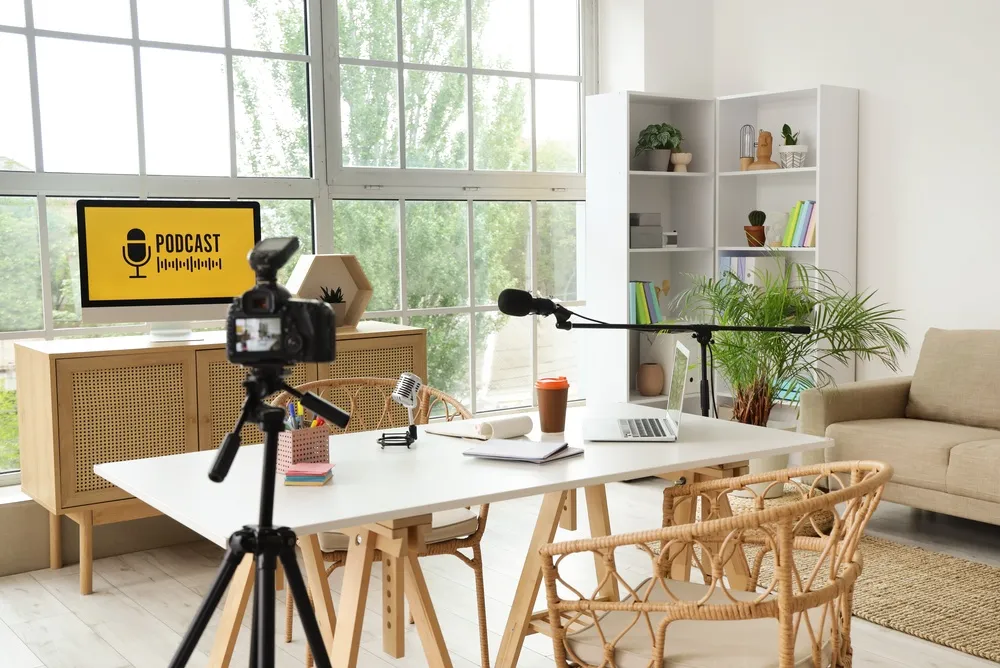
The spare bedroom used to become a nursery, a home office, or a guest room. Increasingly, it’s becoming a podcast studio or a video set, a shift that reflects how content creation has moved from side hustle to income stream for a growing number of homeowners.
Taras Legar, Founder / Principal Designer at Leg Art Studio, has seen this firsthand. Working remotely from North Carolina for building companies in Florida, Legar says he’s now fielding requests that would have been unusual even two or three years ago. “Right now it’s interesting for me when new clients want to change their bedroom to a podcast room,” he says. One recent client runs a YouTube and Instagram channel that generates income. Rather than renting external studio space, the client decided to convert a bedroom into a dedicated production room. “He decided, why do I need to go to some place if I have a good space in my house?” Legar says.
It’s not a one-off. Legar describes a second client – a sports commentator with a YouTube channel – making the same kind of conversion: a dedicated room designed for on-camera discussion with guests. The pattern is the same in both cases: a homeowner generating income from content decides to bring production into the home rather than paying for external space.
Function Is Leading Form
The shift Legar describes isn’t limited to content studios. Clients are thinking about residential space less as a fixed set of traditional room types and more as something that should adapt to how they actually earn and spend their time. “Change in space, it’s the first change,” he says. “Not ordinary.”
This flexibility sits alongside a material preference that has been building for several years but appears to be accelerating. Clients are asking for wood, stone, and other natural surfaces over synthetic alternatives. “People want to make more use of natural materials,” Legar says. “They don’t want any plastics, fake material – they don’t like fake, want more natural.”
The Minimalism Backlash
If the early 2020s pushed residential interiors toward clean, pared-back aesthetics, the current mood is swinging in the other direction, not toward clutter, but toward warmth and personal meaning. Legar describes clients who want spaces that feel lived-in and specific to them rather than polished and generic.
“People don’t want to make too minimalistic an interior,” he says. “They don’t like soulless interiors. They want to have some things with memory or some interesting elements from furniture which can remind them of a place or about some events.”
The result is what Legar calls “very individual space,” rooms designed around specific objects, collections, or experiences rather than around a single aesthetic system. Some clients collect art and want walls designed specifically for display. Others want coastal references that connect to their geography without defaulting to cliché. For a recent project in Cape Cod, Massachusetts, Legar developed a coastal style with modern proportions. “It’s a cozy style,” he says. “If people want to make their house, home, more cozy – normal, good.”
A European Designer Reading the American Market
Legar trained in architecture in Ukraine before pivoting to interior design. He notes a persistent gap between American residential taste and what he sees in European markets. American clients, he says, tend toward more traditional choices, even with access to global design references online. “It’s very different from European interior and American interior,” he says. “Americans are more traditional. Right now a lot of information from the Internet on how others do it, but people prefer to make it more traditional.”
That conservatism coexists with the functional changes described above. Clients may want a podcast room, but they still want it to feel warm and grounded rather than overtly futuristic. The tension between new uses and familiar aesthetics is where much of the design work happens.
Florida, in Legar’s experience, is an exception to the traditional default. “I like Florida because there are a lot of people who want to make some modern design,” he says. “They want to change traditional design or a house from a builder that has just white walls and little furniture.”
What Budgets Reveal
Spending patterns among Legar’s clients vary widely, but the direction of investment has shifted. Earlier clients asked for paint colors and minor surface changes. More recent projects involve natural stone in bathrooms, custom wall treatments for art display, and full room conversions. The common thread is specificity, clients spending on rooms that serve a defined personal or economic purpose rather than upgrading generically.
Legar also notes a gap between home prices and interior quality that surprised him upon arriving in the United States. “When I come to a house for 1 million, it looks expensive” in Ukraine, he says. “Here it’s a big difference. Sometimes it looks very simple, old furniture, cheap furniture, but maybe space is expensive.” That disconnect between what a home costs and how it looks inside may partly explain why Florida clients, in particular, are willing to invest in interior upgrades; the base condition left by builders often consists of white walls and minimal furnishings.
“I think it’s very important to make space where we live, where we work, beautiful,” Legar says. “It’s a vibe which can increase your life even if we don’t realize it happens.”
For homeowners weighing renovation spending, the projects gaining traction share a common trait: they serve a specific function tied to how the occupant earns, relaxes, or expresses identity. The bedroom-to-studio conversion is the most visible example, but the same logic applies to art walls, natural material upgrades, and rooms designed around personal collections. Spending follows purpose, and as more homeowners monetize activities they do at home, the line between residential comfort and functional workspace continues to blur.
About the Expert: Taras Legar is Founder and Principal Designer at Leg Art Studio, a residential interior design firm based in North Carolina serving clients remotely, with a focus on projects in Florida and along the East Coast.
This article is based on information provided by the expert source cited above. It is intended for general informational purposes only and does not constitute legal, financial, or real estate advice. Readers should conduct their own research and consult qualified professionals before making any real estate or financial decisions.