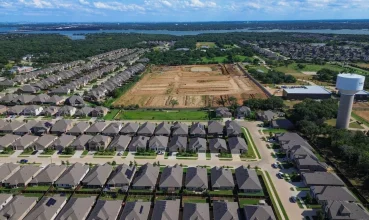
Arizona’s luxury real estate market looks, from the outside, like a single thing: subject to the same forces, responding to the same headlines, moving in one direction at a time. Across most major U.S. markets, what gets discussed as a unified real estate market has fractured into three distinct segments. Each operates by its own logic and responds to different pressures.
David Newcombe, co-founder and associate broker at Compass Arizona, puts it plainly: “The top is buying normally. The middle is waiting, and the lower is very responsive to interest rates.” Understanding which market you are actually in, and what is driving it, may be the most useful thing a buyer or seller can do right now.
Top Tier Buys Freely
The highest tier of Arizona’s luxury market has not slowed down. According to Newcombe, homes priced above $10 million have been selling at a pace that would have been unthinkable five years ago. The buyers driving that activity are largely purchasing second homes, not primary residences, and they are not making decisions based on mortgage rates.
At this level, the question is not what borrowing costs. It is where capital is best placed. These buyers are weighing real estate against other assets. Relative to coastal markets, Arizona still looks like value.
What has changed is who these buyers are and where they are coming from. The pandemic reoriented attention toward Arizona, and that shift has proven durable. International buyers from the UK, India, and elsewhere have been drawn by the state’s expanding tech, medical, and aerospace sectors, as well as its relative affordability compared to coastal markets. The ultra-high end is no longer a local or even national market. It is global.
Middle Tier Waits on Certainty
The segment between roughly $1.5 million and $4 million is where the market’s hesitation is most visible. Buyers and sellers are present, but most are holding their positions, watching for some combination of rate movement, economic clarity, and political resolution that would give them confidence to act. Transactions are happening, but most are driven by necessity: a job relocation, a family change, or a life event that makes waiting impractical.
What keeps this segment frozen is not rates exactly. It is uncertainty. Newcombe is direct about the distinction: rates are a known quantity that buyers can plan around, but uncertainty is something they cannot. A buyer who knows rates are at 7% can decide whether a purchase makes sense at that level. A buyer uncertain about where rates, prices, or the broader economy will be in six months tends to decide nothing.
There is also a debt dynamic that does not get much attention. Many middle-market homeowners who bought at low rates in 2020 and 2021 also took on home equity debt afterward. If they sell and buy today, their effective borrowing cost across all their debt may not differ dramatically from current market rates. That removes one of the main psychological barriers to moving. And yet, that has not yet translated into action at scale. The question is whether that clarity arrives in 2026.
Lower Tier Tracks Interest Rates
Below $1 million to $1.5 million, the market behaves the way most real estate coverage assumes all real estate behaves: it is directly and visibly responsive to interest rates. When rates drop, activity picks up. When rates rise or hold, buyers pull back. The relationship is close to mechanical.
This is the segment most affected by affordability constraints, and the one where financing decisions dominate. Buyers here are typically purchasing primary residences, often stretching to do so, and the monthly payment is the number that determines whether a deal is possible. A shift of half a point in either direction is felt immediately.
For sellers in this range, timing the market is genuinely tempting and genuinely difficult. Rate movements are hard to predict. Listing decisions made in anticipation of a cut that does not materialize can leave a property sitting. The practical implication is sharpest here: pricing to current market conditions, rather than hoped-for ones, is the difference between selling and waiting.
Arizona’s lower luxury tier is not distressed. But it is rate-dependent in a way the segments above it are not. Treating it as part of the same market conversation as an $8 million Scottsdale estate does neither buyer nor seller any favors.
Advice for Each Segment
The most useful takeaway from Arizona’s three-market reality is also the most straightforward: the advice, the data, and the instincts that apply to your situation depend almost entirely on which segment you are in. General real estate commentary about rates, timing, and whether now is a good time to buy is built around a unified market that no longer exists. Applied to the wrong segment, that advice is not just unhelpful. It can be actively misleading.
At the top, the relevant questions are about asset allocation, lifestyle, and long-term value relative to other markets, not rates or timing. In the middle, the relevant question is whether your reason for moving is strong enough to act on without the certainty you are waiting for, because that certainty may not arrive on a schedule that suits you. At the bottom, the relevant question is whether you are pricing and planning around the market as it is, not as it might become if rates move in your favor.
Across all three segments, the factor Newcombe returns to most consistently is uncertainty, specifically the difference between uncertainty as a condition you are managing and uncertainty as a reason to wait indefinitely. Buyers and sellers who tend to come out ahead understand which market they are actually in and make decisions based on that reality, not the one they are reading about.
About the Expert: David Newcombe is co-founder and associate broker at Compass Arizona, specializing in luxury real estate across Scottsdale, Paradise Valley, and Phoenix. A London native who has been active in the Arizona market since 2003, he has sold over $300 million in luxury condominiums.
This article is based on information provided by the expert source cited above. It is intended for general informational purposes only and does not constitute legal, financial, or real estate advice. Readers should conduct their own research and consult qualified professionals before making any real estate or financial decisions.