
Rising regulatory and compliance costs have pushed the per-unit price of subsidized affordable housing above that of market-rate projects, according to Marc Norman, Associate Dean at NYU Sch...

Santa Fe's Economy Looks Like an Hourglass – and That Shape Is Driving Its Luxury Market

Written by:
Date:
12 May 2026
Share via Facebook

Share via Linkedin

Share via X

Copy to clipboard

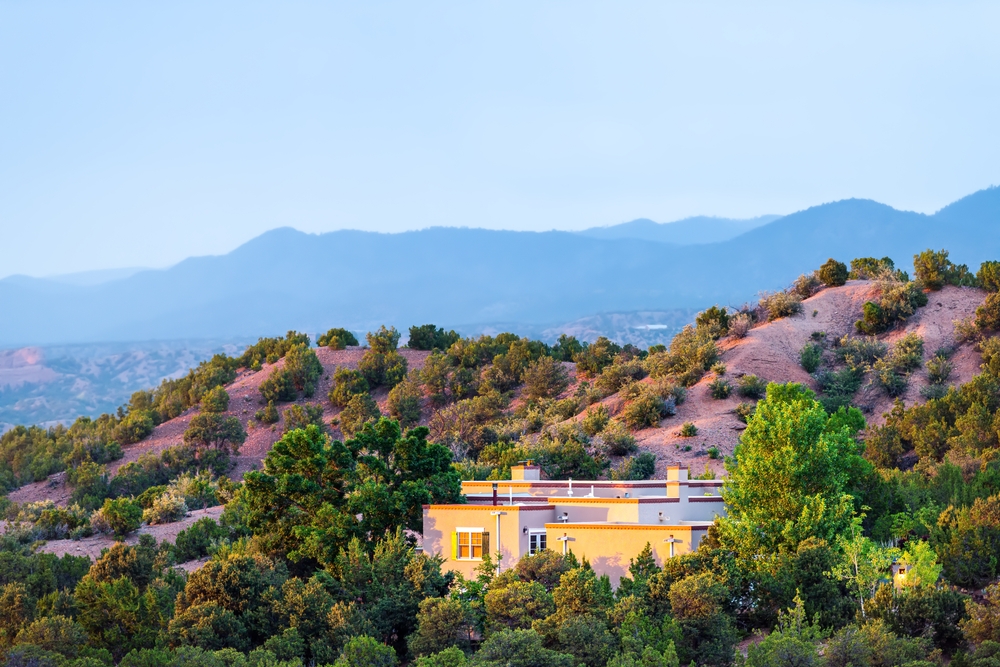
Most American cities follow a predictable economic distribution. Santa Fe, according to one long-tenure market observer, does not, and that structural anomaly has direct consequences for who can buy, who gets priced out, and why the upper tier of the market keeps expanding.
An Inverted Distribution
Chris Webster, CEO and publisher of Leading Estates of the World and a Santa Fe broker since the early 1970s, describes the city’s economic structure in ways that run counter to conventional assumptions about resort real estate markets. Rather than the bell curve most communities exhibit, a small lower class, a small upper class, and a large middle class, Santa Fe resembles an hourglass. “It has a huge lower class, has a huge upper class, nd a very thin, narrow middle class,” Webster says.
That shape reflects the underlying economic structure of the city. Webster identifies the primary engines of the local economy as real estate, art, and tourism, all interconnected and all oriented toward visitors and affluent residents rather than toward generating the kind of stable, mid-wage employment that builds a middle class. The state government provides a baseline of jobs, given that Santa Fe is New Mexico’s capital and the country’s oldest state capital. Still, it does not generate the employment density that would support a robust middle tier.
The result is a bifurcated market. On one end, service workers, government employees, and tourism-industry workers occupy the lower tier. On the other hand, an unusually concentrated population of wealthy buyers, many of them part-time residents, occupies the upper tier. Webster claims that 90 of the Fortune 100 chairpersons have homes in Santa Fe, a figure difficult to independently verify but indicative of the wealth concentration he says characterizes the upper end. “Many of my clients have two, three, five, ten homes around the world,” he adds.
Why the Middle Disappeared
The thinning of Santa Fe’s middle class follows a pattern visible in other high-demand resort communities. As property values rise and the cost of living increases, the professionals who provide essential services, teachers, healthcare workers, and tradespeople find it increasingly difficult to afford housing in the city where they work. Webster draws a direct comparison to markets like Aspen and Jackson Hole, where he says the working population can no longer afford to live because prices have risen beyond reach.
Santa Fe has historically avoided the most extreme version of that outcome because its prices have remained lower than those of competing Mountain West markets. But recent acceleration in luxury prices suggests that the buffer may be eroding. Webster cites an 11.3% year-over-year increase in Q1 2026 luxury prices, compared with a national decline of 2.9% in the same tier. As the upper tier expands and prices rise, the middle class faces increasing pressure from both directions: priced out of ownership by upper-tier demand, and competing for rental housing with lower-income residents.
The hourglass structure also shapes how appreciation moves through the market. In a conventional bell-curve economy, price increases at the top tend to create ripple effects through the middle, as buyers trade up and down the price ladder. In an hourglass market, the two ends operate with greater independence. Upper-tier demand is driven largely by external capital from buyers in California, New York, Texas, and elsewhere who are making discretionary purchases. That demand does not necessarily translate into increased purchasing power or opportunity for middle-income residents.
A Market That Attracts Buyers Who Already Have Options
The typical Santa Fe luxury buyer, as Webster describes them, is choosing the market from a position of strength, not someone who needs to be in Santa Fe but someone who has decided, often after extended consideration, that the city offers something unavailable elsewhere. “The types of people that choose to live in Santa Fe are ones that really get it, and not everybody does,” he says.
That selectivity functions as a stabilizing force. Buyers who arrive with genuine conviction about the market tend to be long-term holders rather than speculative flippers. They upgrade over time, often starting with a smaller property and expanding their footprint as their attachment to the community deepens. Webster describes a common pattern in which buyers begin with a pied-à-terre, then acquire a larger primary residence, and then seek ranch properties or commercial investments in the surrounding region.
This behavior reinforces the hourglass structure. Buyers at the top of the market are accumulating rather than transacting. Inventory at the upper end remains constrained not only by limited supply but also by owners’ lack of motivation to sell. That dynamic supports prices but also limits the liquidity of middle-income buyers, who need access to the market through natural turnover.
The Data Behind the Observation
Webster’s firm has tracked Santa Fe market conditions through Christopher Webster Reports, an entity he formed in 1982 that uses empirical sold data, transaction size, location, price, and time on market to analyze market dynamics and build predictive models. That longitudinal dataset, Webster argues, enables the firm to identify structural patterns, such as the hourglass distribution, rather than simply reacting to current conditions. “Nothing better tracks that than the sold data because it’s empirical,” he says.
The firm’s approach, grounded in decades of local market observation, positions it to serve buyers making significant discretionary investments who need analysis that goes beyond standard comparative market assessments. Other brokerages and data providers serve the Santa Fe market. Still, Webster’s emphasis on long-term structural analysis rather than short-term pricing reflects the firm’s orientation toward buyers operating at the top of the hourglass.
The hourglass structure Webster describes is not unique to Santa Fe; versions of it appear in other resort and cultural destination markets where tourism and second-home demand dominate the economy. But Santa Fe’s particular combination of cultural identity, supply constraints, and accelerating upper-tier demand makes it a useful case study for understanding how luxury markets evolve when the economic foundation does not support broad-based middle-class participation. Whether that structure is sustainable, or whether it eventually undermines the community character that drives demand in the first place, may be the defining question for the market over the next decade.
About the Expert: Chris Webster is the CEO and publisher of Leading Estates of the World and has been a licensed broker in Santa Fe, New Mexico, since the early 1970s. He founded Christopher Webster Reports in 1982, a market analysis entity that tracks Santa Fe real estate using longitudinal sold data.
This article is intended for informational purposes only and does not constitute legal, financial, or investment advice. The views and opinions expressed herein reflect those of the individuals quoted and do not represent an endorsement of any company, product, or service mentioned. Readers should conduct their own due diligence and consult qualified professionals before making any investment decisions.
Similar Articles
Explore similar articles from Our Team of Experts.