

The typical first-time homebuyer in America is now 40 years old, according to data from the National Association of Realtors cited by Sam Ratner, a Connecticut-based broker and team leader a...

Data Center Construction Reaches $70 Billion in 2025 While Broader U.S. Construction Industry Stagnates

Written by:
Date:
16 Mar 2026
Share via Facebook

Share via Linkedin

Share via X

Copy to clipboard

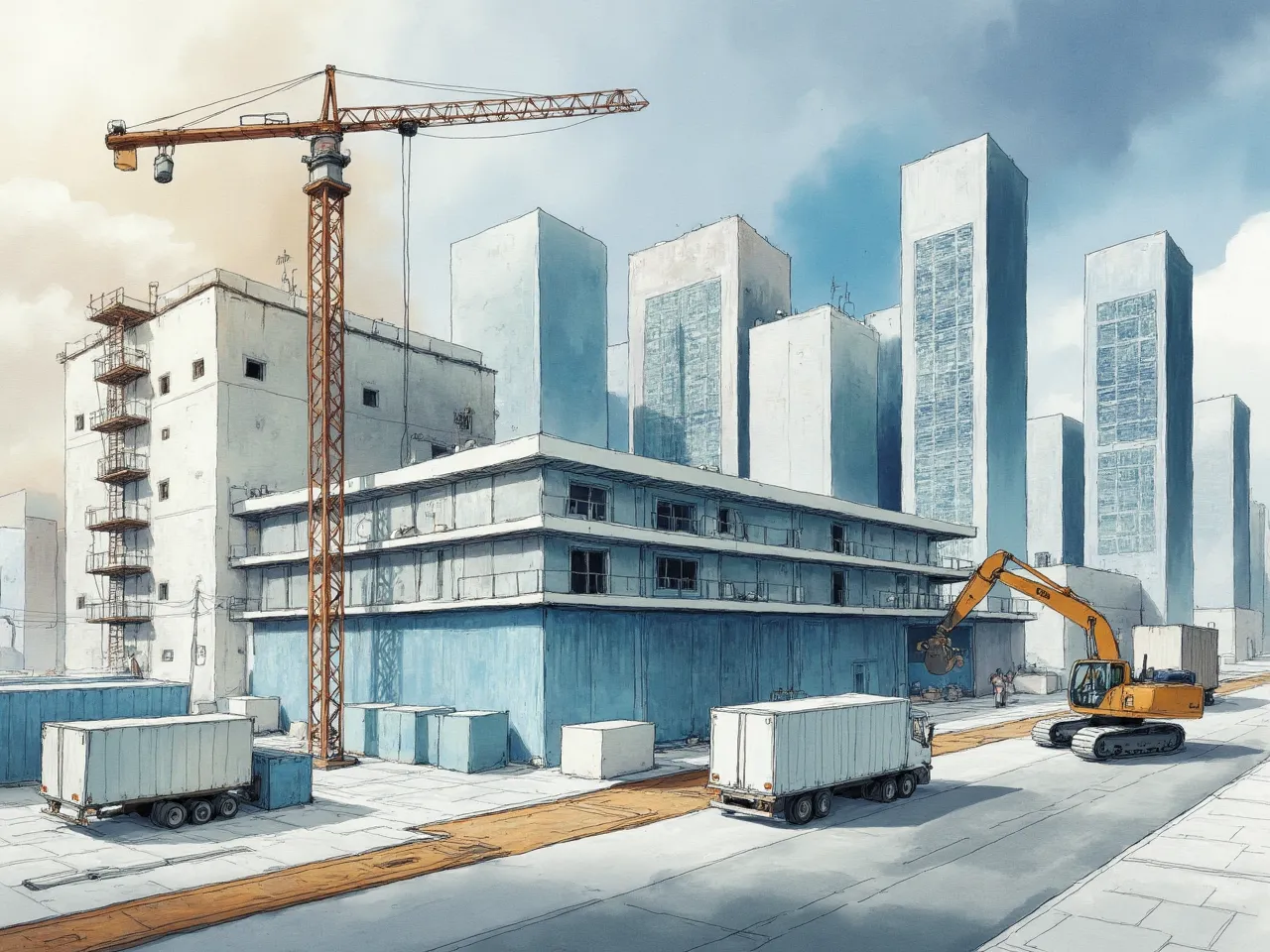
Data center construction reached an estimated $60 billion to $70 billion out of $1.25 trillion in total U.S. construction starts in 2025, accounting for roughly five to six percent of all new projects, according to Eric Gaus, Chief Economist at Dodge Construction Network. While data centers have expanded rapidly, surpassing traditional office construction in total value, they do not dominate overall industry activity or offset widespread stagnation elsewhere.
Most U.S. Construction Sectors Saw Flat or Declining Growth in 2025
Outside of data centers and other mega-projects, most construction sectors saw little to no growth in 2025. Gaus reports that multifamily construction, after a surge in 2023 and a modest uptick in early 2025, is now slowing. Single-family construction remained weak throughout the year. Both sectors were affected by immigration enforcement that limited labor supply and slowed household formation, further dampening demand.
Warehouse construction, which expanded rapidly during the pandemic as e-commerce soared, has pulled back sharply. Retailers and logistics companies have slowed their expansion, reassessing their space needs. Manufacturing construction, which benefited from reshoring initiatives and federal industrial incentives, has also slowed. Companies have delayed new facilities amid growing uncertainty about economic and regulatory policy.
Retail and hotel construction have shown modest improvement, driven primarily by renovation rather than new construction. Renovation projects move more quickly through the approval process, since the core structure already exists and permitting is less complex.
Billion-Dollar Mega-Projects Are Straining Local Labor and Material Supply Chains
Although mega-projects such as data centers, energy facilities, and large hospitals make up a small percentage of total construction starts, they create outsized effects in local markets. These billion-dollar-plus projects concentrate demand for labor and materials in specific regions, straining local supply chains and driving up costs.
Gaus points to a $4.6 billion hospital project in Texas as an example. Large projects such as this draw workers and materials from surrounding areas, which can delay smaller projects or force other developers to pay more for resources. As a result, some areas experience high demand and backlogs, while others face weak orders and excess capacity.
The effect is a patchwork market where supply chain conditions vary widely by location and project type. Some manufacturers and distributors report being unable to fulfill orders quickly due to backlogs, while others have too little business.
“You get these very idiosyncratic stories across the country and across different verticals,” Gaus says. “Some clients worry about a lack of orders, while others are backlogged and can’t ship products fast enough.”
This unevenness complicates industry analysis. National data may show stable or moderate growth, but the reality for individual firms depends heavily on their market segment and geographic exposure.
How Dodge Construction Network Tracks Typical Project Timelines Across the U.S.
To better understand market trends, Dodge Construction Network removes the largest and smallest projects from its analysis of project timelines. Gaus explains that mega-projects can take years to move from planning to construction, while small renovations can proceed almost immediately. By focusing on mid-sized projects, Dodge aims to provide a clearer picture of typical market conditions.
“We trim the largest projects because those can take years, and the smallest because those move very quickly. We focus on the middle,” Gaus says.
Even after excluding outliers, Dodge found that project planning timelines lengthened across all major sectors from March through September 2025. This points to a broad-based slowdown, not just delays in isolated sectors or project types.
Dodge’s data tracks projects from early planning through completion and is used by building product manufacturers, commercial real estate investors, and other industry stakeholders to monitor construction activity and anticipate changing market conditions.
Rising Oil Prices Are Compounding Cost Pressures Across the Construction Industry
Rising oil prices present a significant risk for construction costs in the near term. With crude oil above $100 per barrel due to Middle East conflicts, fuel expenses for heavy machinery have become a major cost driver for construction projects.
“Oil and gas has an outsized influence on the construction industry because a lot of heavy machinery requires diesel and gas,” Gaus says. “The fact that we’re over $100 a barrel — how long that lasts — can have a very significant influence on cost structure and what’s going to happen in the construction industry.”
Sustained high oil prices raise costs for site preparation, material transport, and equipment operation. These pressures are particularly acute for large-scale projects that require extensive earthwork and long-distance logistics.
Higher fuel costs compound existing challenges, including tariffs on building materials and a limited labor supply. Tariffs raise material prices, labor shortages drive up wages, and oil prices inflate transportation and equipment costs. If oil remains elevated for an extended period, some projects may be delayed or canceled as budgets are squeezed.
Gaus emphasizes that the duration of high oil prices is critical. Short spikes can be managed within existing budgets, but a prolonged period of expensive fuel may force developers to re-evaluate project feasibility.
Policy Uncertainty Makes Reliable Construction Forecasting Difficult for the Rest of 2026
The construction industry’s prospects for the second half of 2026 depend heavily on policy decisions expected in June, including USMCA recertification and the appointment of a new Federal Reserve chair. Gaus notes that the range of possible outcomes is unusually wide, making reliable forecasting difficult.
“There are so many things that could happen, and they’re radically different scenarios. That makes it really hard to do any forecasting at this point,” Gaus says.
This environment leaves construction firms with strong financial fundamentals but little clarity on where to invest next. Many firms have the capacity to ramp up activity but are holding back until there is greater certainty on trade, monetary policy, and regulatory conditions.
In response to this uncertainty, Dodge Construction Network is developing scenario-based forecasting tools to help clients assess how different policy outcomes could affect construction activity at the county level. Rather than relying on single-point projections, these tools offer probabilistic analysis to capture a range of possible futures for the industry.
What the U.S. Construction Industry Can Expect in the Second Half of 2026
The next several months are likely to determine whether construction activity remains stagnant or begins to recover. If policy outcomes in June bring clarity and stability, construction firms could move forward with delayed projects, particularly in sectors such as manufacturing and multifamily housing. However, if uncertainty persists or oil prices remain high, further slowdowns and project cancellations are possible.
The construction industry is currently defined by selective growth in data centers, energy, and healthcare mega-projects in some regions, against a backdrop of flat or declining activity in housing, warehouses, and manufacturing. Local supply chains will continue to experience strain where mega-projects are concentrated, while other areas may see weak demand and excess capacity.
The real test for the industry will come as firms, investors, and policymakers grapple with persistent cost pressures and an unpredictable policy environment. Firms able to adapt quickly to changing conditions and identify pockets of opportunity will be best positioned to weather the uncertainty and capitalize on the next wave of construction demand.
Similar Articles
Explore similar articles from Our Team of Experts.